IBM Faces Worst Month Since 1992 - Is Anthropic The New Dot-Com Moment?
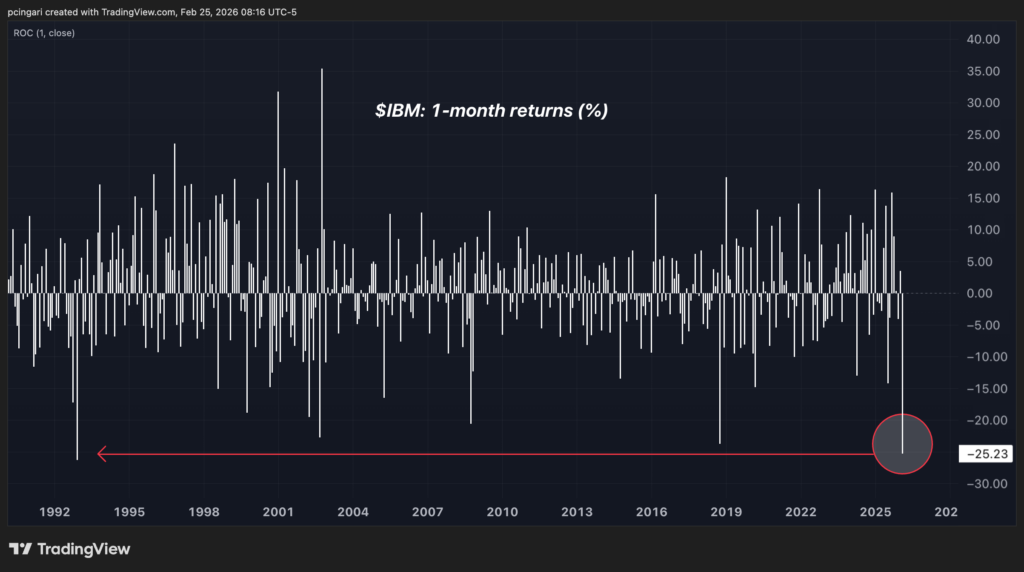
As of Tuesday's close, International Business Machines Inc. (NYSE:IBM) is down 25% month-to-date — putting the stock on pace for its worst month since December 1992.
That's worse than October 2018's 23% decline. Worse than September 2002's 22% drop.
And relative to the Nasdaq 100 index, IBM is underperforming by 23% this month — its weakest relative showing since February 2000.
The capitulation accelerated Monday, when IBM plunged 13% in a single session — its worst day since Oct. 19, 2000, at the peak of the dot-com bubble burst.
What Just Happened To IBM?
The selloff was triggered by a blog post.
Specifically, a post from AI startup Anthropic claiming that its Claude model can now analyze and interpret COBOL code — the decades-old programming language that still powers the backbone of global finance.
That claim struck at the heart of one of IBM's most durable businesses.
COBOL runs banks, insurance systems, airlines and government infrastructure. Roughly 95% of ATM transactions in the United States rely on it.
Hundreds of billions of lines of legacy code still operate mission-critical systems worldwide.
The programmers who built those systems largely retired decades ago. Finding engineers who can even read COBOL grows harder every year.
Rewriting these systems from scratch can cost millions — sometimes billions — and carries enormous operational risk.
IBM's moat was never that COBOL was cutting-edge. It was that almost nobody else could understand it.
Entire consulting divisions were built on maintaining, patching and modernizing systems too fragile to replace. Companies paid IBM billions because the alternative wasn't innovation — it was potential system failure.
Now Anthropic says Claude can map dependencies across thousands of lines of COBOL, document workflows, identify migration risks and translate legacy logic into modern languages.
If true, that could compress modernization timelines from years to quarters.
And that possibility was enough to rattle investors.
How Big Is The Real Risk?
At this stage, the market reaction appears to be pricing in significant uncertainty — not confirmed revenue disruption.
It remains unclear how much of IBM's recurring revenue could realistically be displaced, how quickly enterprises would adopt AI-driven migration tools, or whether such tools meaningfully reduce risk in mission-critical environments.
Wall Street analysts have yet to materially revise IBM's long-term business model assumptions.
But the stock has already repriced dramatically.
Is IBM Stock Now A Compelling Opportunity?
After the selloff, IBM closed at $229.32 on Tuesday.
The median Wall Street price target stands at $340 — implying roughly 48% potential upside. That's the widest implied upside spread since March 2020.
On valuation, IBM now trades at 18x forward earnings — its lowest multiple since July 2024.
That's still above its 10-year average forward P/E of 12.9x. But compared to the broader market, the discount is notable:
- The SPDR S&P 500 ETF Trust (NYSE:SPY) trades around 22x forward earnings
- The Invesco QQQ Trust (NYSE:QQQ) trades near 25x
That places IBM at roughly a 20% discount to major index benchmarks.
Panic Or Inflection Point?
The core question now isn't whether AI can read COBOL.
It's whether that capability truly dismantles IBM's long-standing economic moat — or simply becomes another tool IBM itself can leverage.
Markets often overshoot during structural uncertainty.
IBM just recorded its worst relative performance since the dot-com bubble burst.
Whether this moment marks the beginning of secular erosion — or one of the most compelling entry points in years — may depend less on a five-minute blog post and more on how quickly reality matches the narrative.
Photo: PJ McDonnell / Shutterstock
Mentioned In This Article
Latest News
| 6 min | |
| 3 hours | |
| 4 hours | |
| 4 hours | |
| 6 hours | |
| Oct-18 | |
| Oct-18 | |
| Oct-18 | |
| Oct-18 | |
| Oct-18 | |
| Oct-16 | |
| Oct-16 | |
| Oct-16 | |
| Oct-16 | |
| Oct-16 |
