VST Stock Underperforms Industry in the Past 6 Months: How to Play?
Shares of Vistra Corp. VST have lost 9.5% in the past six months against the Zacks Utility- Electric Power industry’s rally of 17.5% and the Zacks Utilities sector’s growth of 14.7%.
Vistra’s performance was weighed down by an accident at its 300-MW Moss Landing battery storage facility, which forced the site offline. This event partially offset gains from recent acquisitions and rising data-center demand. The company was also supported by securing a 20-year power purchase agreement for its Comanche Peak nuclear plant in Texas.
Price Performance (Six Months)
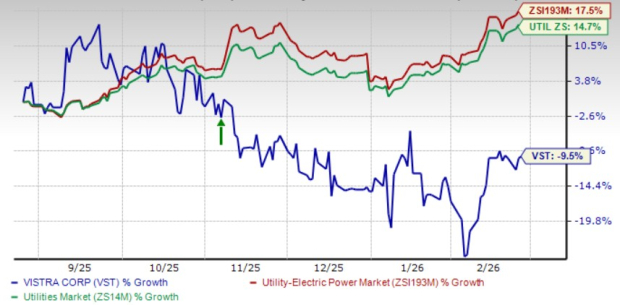
Image Source: Zacks Investment Research
Another utility, Duke Energy DUK, also produces a substantial volume of clean energy from its nuclear generation assets. Duke Energy’s shares have gained 0.6% in the past month.
Should you consider adding VST to your portfolio only based on softness in price movements? Let’s delve deeper and find out the factors that can help investors decide whether it is a good entry point to add VST stock to their portfolio.
Factors to Consider Amid VST Stock’s Weak Price Performance
Growing demand for clean electricity across Vistra’s markets is being fueled by the rapid expansion of AI-driven data centers and rising electrification in Permian Basin oilfield operations. With 41,000 MW of diversified capacity spanning gas, nuclear, coal, solar and storage, Vistra is well positioned to serve increasing commercial and industrial demand and support long-term growth in the clean energy transition.
Vistra has signed a definitive agreement to acquire Cogentrix Energy, adding 10 modern natural gas–fired plants with nearly 5,500 MW of capacity for a net price of about $4 billion. The deal marks Vistra’s second opportunistic expansion of the clean energy portfolio, strengthening its ability to meet rising customer demand in core markets.
Vistra operates a fully integrated model encompassing power generation, retail electricity sales and energy storage, supported by robust risk management. This structure enables the company to balance supply and demand, reduce exposure to commodity price volatility and generate stable cash flows with more predictable earnings.
Vistra has a clear and disciplined capital expenditure strategy centered on expanding zero-carbon nuclear generation, increasing solar and battery storage capacity and optimizing its natural gas fleet to meet peak demand. Declining interest rates further strengthen Vistra’s financial position by lowering borrowing costs and interest expenses.
In 2025, Vistra’s performance was hindered by an accident at the Moss Landing battery storage facility, which forced a 300-MW unit offline. The outage weighed on earnings, reduced the benefits from acquisitions and growing data-center demand, and increased regulatory and operational scrutiny, limiting the company’s ability to take full advantage of otherwise favorable market conditions.
Positive Movement in Estimates
The Zacks Consensus Estimate for VST’s revenues and earnings per share reflects year-over-year growth of 25.35% and 81.57%, respectively.
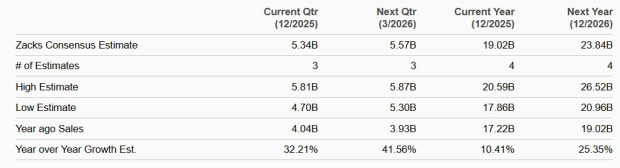
Image Source: Zacks Investment Research
Long-term (three to five years) earnings growth of VST is currently pegged at 18.89%
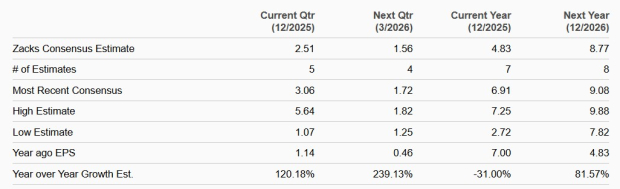
Image Source: Zacks Investment Research
VST Stock’s ROE Is Higher Than Its Industry
ROE, a profitability measure, reflects how effectively a company is utilizing the shareholders’ funds in its operations to generate income.
VST’s trailing 12-month return on equity (“ROE”) is 64.04%, way ahead of its industry average of 10.7%. The company’s better ROE than the industry indicates that it is utilizing funds more efficiently than peers to generate returns.
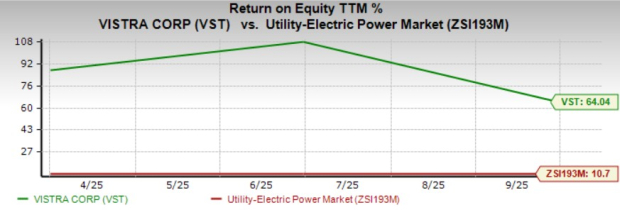
Image Source: Zacks Investment Research
Vistra’s Capital Return Program
Vistra continues to increase its shareholders' value through the share repurchase program and dividend payments.
VST’s quarterly dividend for the fourth quarter of 2025 is 22.7 cents. Management is targeting a dividend payment of $300 million annually. VST has raised dividends 18 times in the past five years.
Vistra’s board of directors has approved an additional $1 billion for share repurchases. As of Oct. 31, 2025, $2.2 billion remained under the current authorization, which the company expects to fully utilize by the end of 2027.
Another utility, NextEra Energy NEE, has the capability to produce a large volume of clean electricity and is working to increase the clean generation capacity further from current levels. NextEra Energy’s management also approves a regular quarterly dividend. The current dividend yield of the company is 2.37%, which is better than the Zacks S&P 500 composite’s yield of 1.37%
VST Stock Is Trading at a Premium
Vistra is currently trading at a premium valuation compared with the industry. Its forward 12-month price-to-earnings (P/E) ratio is 18.85X compared with the industry average of 17.23X.

Image Source: Zacks Investment Research
Rounding Up
Vistra is well positioned to benefit from the growing demand for clean electricity across its service areas. The company’s diversified, multi-fuel generation mix and emphasis on cleaner energy sources align with the evolving energy landscape, while ongoing additions of clean energy assets further strengthen its growth prospects. VST currently has a Zacks Rank #3 (Hold).
Given that VST’s shares have been trading at a premium valuation compared with the industry average in the past six months, new investors should keep monitoring the stock and wait for a favorable entry point before making investments.
You can see the complete list of today’s Zacks #1 Rank (Strong Buy) stocks here.
Want the latest recommendations from Zacks Investment Research? Today, you can download 7 Best Stocks for the Next 30 Days. Click to get this free report
NextEra Energy, Inc. (NEE): Free Stock Analysis Report
Duke Energy Corporation (DUK): Free Stock Analysis Report
Vistra Corp. (VST): Free Stock Analysis Report
This article originally published on Zacks Investment Research (zacks.com).
Mentioned In This Article
Latest News
| Oct-14 | |
| Oct-14 | |
| Oct-14 | |
| Oct-14 | |
| Oct-13 | |
| Oct-12 | |
| Oct-12 | |
| Oct-12 | |
| Oct-12 | |
| Oct-11 | |
| Oct-10 | |
| Oct-09 | |
| Oct-09 | |
| Oct-09 | |
| Oct-09 |
