|
|
|

|
|||||
|
|
|

Packaged foods company J.M Smucker (NYSE:SJM) beat Wall Street’s revenue expectations in Q4 CY2025, with sales up 7% year on year to $2.34 billion. Its non-GAAP profit of $2.38 per share was 5.2% above analysts’ consensus estimates.
Is now the time to buy J. M. Smucker? Find out by accessing our full research report, it’s free.
"Our business continues to deliver strong results in a dynamic external environment. In the third quarter, net sales and adjusted earnings per share exceeded our expectations, reflecting the strength of our portfolio of leading brands, along with our disciplined cost management," said Mark Smucker, Chief Executive Officer, President and Chair of the Board.
Best known for its fruit jams and spreads, J.M Smucker (NYSE:SJM) is a packaged foods company whose products span from peanut butter and coffee to pet food.
A company’s long-term sales performance can indicate its overall quality. Any business can put up a good quarter or two, but the best consistently grow over the long haul.
With $8.93 billion in revenue over the past 12 months, J. M. Smucker is one of the larger consumer staples companies and benefits from a well-known brand that influences purchasing decisions. However, its scale is a double-edged sword because there are only a finite number of major retail partners, placing a ceiling on its growth. To accelerate sales, J. M. Smucker likely needs to optimize its pricing or lean into new products and international expansion.
As you can see below, J. M. Smucker’s sales grew at a sluggish 2.3% compounded annual growth rate over the last three years as it failed to grow its volumes. We’ll explore what this means in the "Volume Growth" section.
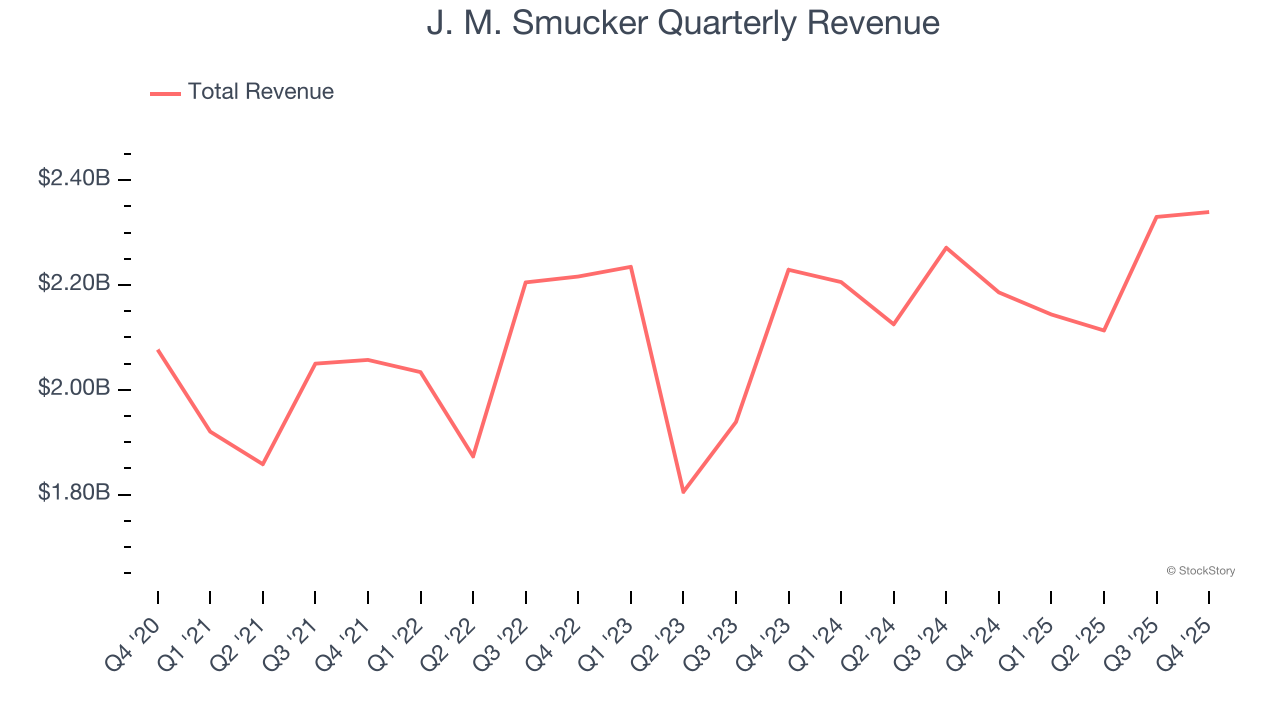
This quarter, J. M. Smucker reported year-on-year revenue growth of 7%, and its $2.34 billion of revenue exceeded Wall Street’s estimates by 0.5%.
Looking ahead, sell-side analysts expect revenue to grow 4% over the next 12 months. Although this projection indicates its newer products will fuel better top-line performance, it is still below average for the sector.
The 1999 book Gorilla Game predicted Microsoft and Apple would dominate tech before it happened. Its thesis? Identify the platform winners early. Today, enterprise software companies embedding generative AI are becoming the new gorillas. a profitable, fast-growing enterprise software stock that is already riding the automation wave and looking to catch the generative AI next.
Revenue growth can be broken down into changes in price and volume (the number of units sold). While both are important, volume is the lifeblood of a successful staples business as there’s a ceiling to what consumers will pay for everyday goods; they can always trade down to non-branded products if the branded versions are too expensive.
J. M. Smucker’s quarterly sales volumes have, on average, stayed about the same over the last two years. This stability is normal because the quantity demanded for consumer staples products typically doesn’t see much volatility.
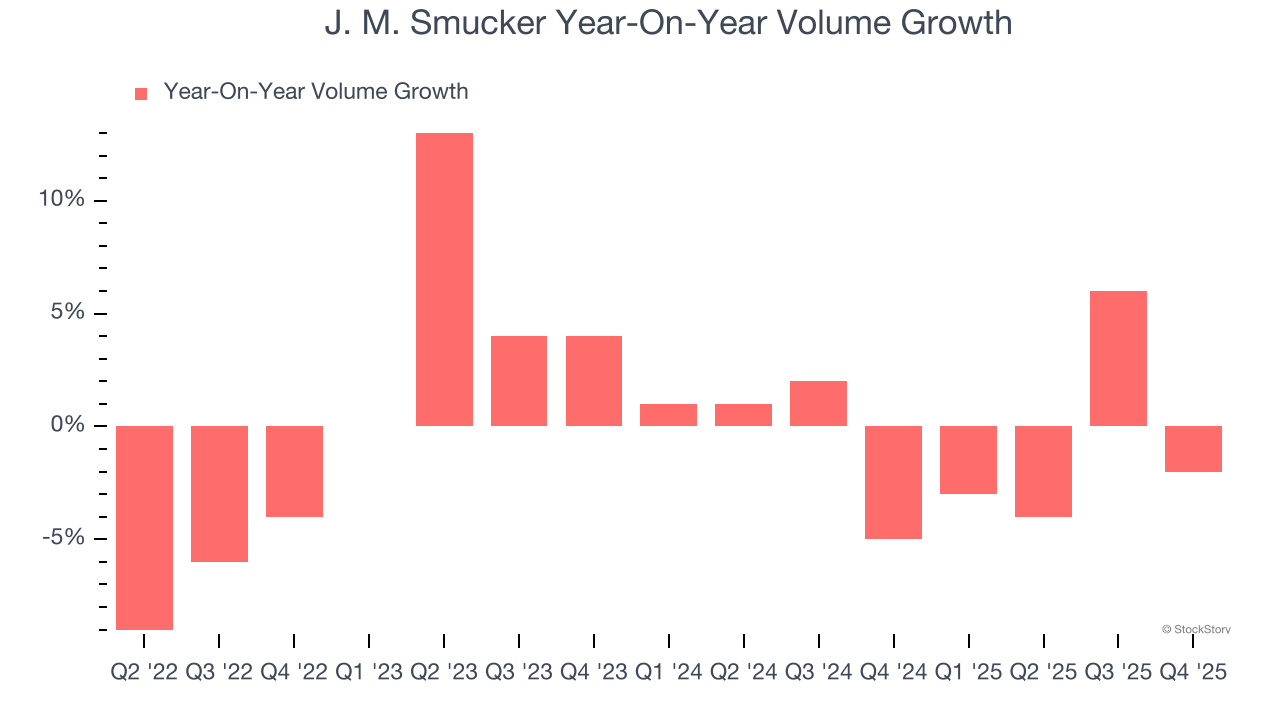
In J. M. Smucker’s Q4 2026, sales volumes dropped 2% year on year. This result represents a further deceleration from its historical levels, showing the business is struggling to move its products.
We were impressed that J. M. Smucker beat analysts’ EPS expectations this quarter. We were also happy its gross margin outperformed Wall Street’s estimates. Overall, this print had some key positives. The stock traded up 7.2% to $114.25 immediately following the results.
Sure, J. M. Smucker had a solid quarter, but if we look at the bigger picture, is this stock a buy? The latest quarter does matter, but not nearly as much as longer-term fundamentals and valuation, when deciding if the stock is a buy. We cover that in our actionable full research report which you can read here (it’s free).
| 4 hours | |
| Aug-10 | |
| Aug-10 | |
| Aug-05 | |
| Jul-21 | |
| Jul-20 | |
| Jul-17 | |
| Jul-17 | |
| Jul-15 | |
| Jul-09 | |
| Jul-07 | |
| Jun-28 | |
| Jun-25 | |
| Jun-09 |
The Corners of the Market Where Investors Are Riding Out Turbulence in Chip Stocks
SJM +10.44%
The Wall Street Journal
|
| Jun-09 |

Join thousands of traders who make more informed decisions with our premium features. Real-time quotes, advanced visualizations, alerts, and much more.
Learn more about Finviz Elite