Energy Fuels vs. Uranium Energy: Which Uranium Stock Has an Edge?
Energy Fuels UUUU and Uranium Energy UEC are U.S.-based uranium companies positioned to benefit from rising uranium demand driven by the global shift toward nuclear energy as a clean power source. Uranium’s inclusion in the U.S. Geological Survey’s Final 2025 Critical Minerals List underscores its strategic importance to U.S. energy security and national defense.
UUUU, with a market capitalization of $5.44 billion, is a leading U.S. producer of natural uranium concentrate and is increasingly positioning itself as a rare earth elements (REE) supplier. Uranium Energy, valued at $7.6 billion, recently restarted production at its Wyoming hub and spoke In-Situ Recovery (ISR) platform.
For investors keen on this sector, we analyze and compare the fundamentals, growth prospects and risks of UUUU and UEC to determine which stock offers the stronger investment case.
The Case for Energy Fuels
Energy Fuels has produced roughly two-thirds of all uranium in the United States since 2017 and continues to ramp up production further, backed by its debt-free balance sheet. The Pinyon Plain Mine in Arizona and La Sal Complex in Utah produced more than 1.6 million pounds of uranium through 2025, exceeding the upper end of its guidance by approximately 11%.
Current operations are running at an annualized rate of about 2 million pounds of recoverable uranium, a level management expects to sustain through 2026. Additional exploration drilling is planned in the Juniper Zone at Pinyon Plain in 2026 to further delineate and potentially expand the resource base.
Energy Fuels recently secured two uranium supply contracts with U.S. nuclear utilities covering deliveries from 2027 through 2032. With these agreements, the company expects to sell 780,000–880,000 pounds of uranium under long-term contracts in 2026, while retaining flexibility to sell into the spot market.
From 2027-2032, its current six long-term contracts represent delivery commitments totaling 2.41-4.41 million pounds of uranium, leaving significant additional uncommitted low-cost uranium for sale.
Energy Fuels is also advancing its strategy to establish itself as one of the lowest-cost uranium producers globally. The company has begun processing low-cost, high-grade ores from its Pinyon Plain mine, starting in the fourth quarter of 2025, which is expected to lower its costs.
The company, meanwhile, is developing significant REE capabilities. In December, the 99.9% purity dysprosium oxide produced at its White Mesa Mill passed the stringent quality check requirements of a major South Korean permanent magnet manufacturer. This follows the earlier qualification of its Neodymium and praseodymium (NdPr) oxide for use in NdFeB magnet applications. These achievements position it among the very few U.S. companies capable of supplying both “light” (NdPr) and “heavy” rare earth oxides that are qualified for permanent magnet applications.
Energy Fuels is planning a Phase 2 expansion of REE processing at White Mesa, increasing NdPr oxide capacity from roughly 1,000 tons per year to more than 6,000 tons annually. With an estimated capital cost of $410 million and projected all-in production costs of $29.39/kg NdPr equivalent, the company expects its REE operations to rank among the lowest-cost producers globally. The expansion could play a pivotal role in rebuilding a competitive U.S.-based rare earth supply chain.
Energy Fuels has also inked a deal to acquire Australian Strategic Materials, a leading producer of REE (rare earth element) metals and alloys. Expected to close in the first half of this year, the deal will help create the largest, fully integrated REE "mine-to-metal and alloy" producer outside of China.
The Case for Uranium Energy
UEC is advancing its next generation of low-cost, in-situ recovery (ISR) uranium mining projects. The ISR mining process has an edge over conventional mining methods as it requires lower capital and operating expenditures with a shorter lead time to extraction and a reduced impact on the environment.
Uranium Energy has a combined 12.1 million pounds of US-licensed uranium production capacity from three central processing plants. The company also boasts the largest resource portfolio in the United States and one of the largest in North America. Fiscal 2025 marked a turning point as Uranium Energy transitioned from developer to producer with the successful restart of the Christensen Ranch ISR mine in Wyoming’s Powder River Basin.
Since the resumption of operations at the Christensen Ranch ISR Mine, the company has reported a cumulative production of around 199,000 pounds of precipitated uranium and dried and drummed concentrate (as of Oct. 31, 2025). The ramp-up phase continues with new production being constructed.
Process upgrades at the Irigaray central processing plant and refurbishment at Christensen Ranch are expected to support higher output and improved operational efficiency. Meanwhile, major construction milestones at Burke Hollow have largely been completed, paving the way for initial operations.
UEC also launched United States Uranium Refining & Conversion Corp. (UR&C) to position itself as the only vertically integrated U.S. company with uranium mining, processing and planned refining and conversion capabilities.
Uranium Energy has a debt-free balance sheet, which provides the capacity to support both production expansion and the advancement of UR&C. However, it is seeing higher operational costs due to increased development spending on the Burke Hollow Project and the Christensen Ranch Mine.
How do Estimates Compare for UUUU & UEC?
The Zacks Consensus Estimate for Energy Fuels’ fiscal 2026 revenues is $96 million, indicating year-over-year growth of 46%. The estimate for earnings is at a loss of 14 cents per share.
The Zacks Consensus Estimate for Uranium Energy’s fiscal 2026 revenues is $60 million, implying a 10% decline from the prior fiscal. The company is, however, anticipated to report a loss of 11 cents per share in fiscal 2026.
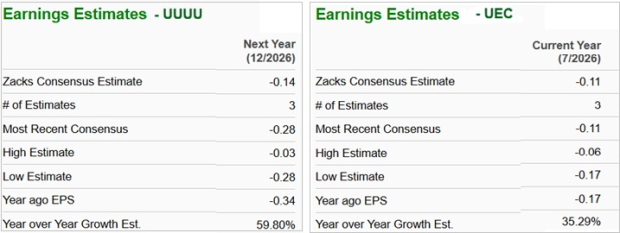
Image Source: Zacks Investment Research
The estimates for both Energy Fuels and Uranium Energy experienced a downward revision over the past 60 days.

Image Source: Zacks Investment Research
UUUU & UEC: Price Performance & Valuation
Energy Fuels' stock has surged 409% in the past year compared with Uranium Energy’s 182% rise.

Image Source: Zacks Investment Research
Energy Fuels is currently trading at a forward 12-month price-to-sales ratio of 48.53X. Meanwhile, Uranium Energy is trading way higher at a forward 12-month price-to-sales ratio of 73.24X.
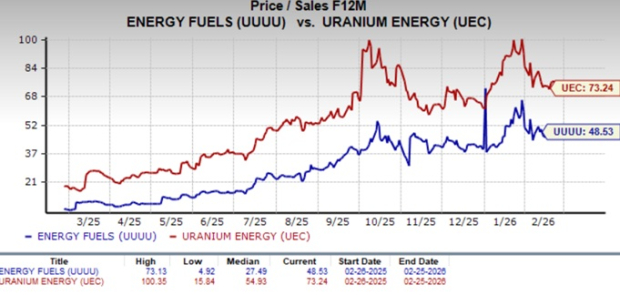
Image Source: Zacks Investment Research
Energy Fuels or Uranium Energy: Which Stock is the Better Buy?
Both companies are strategically positioned to benefit from the structural tailwinds supporting nuclear energy. Uranium Energy offers strong ISR leverage, a large resource base and an emerging vertically integrated model. However, its near-term earnings pressure, declining revenue outlook and premium valuation temper its appeal.
Energy Fuels has an edge with stronger projected revenue growth, an established production track record and a comparatively lower valuation multiple. Its dual-market strategy provides investors with broader exposure to two critical minerals essential for energy transition and defense technologies.
Considering these factors, it will be wise to steer clear of UEC stock as of now, and UUUU stands out as a better investment choice. UUUU currently carries a Zacks Rank #3 (Hold), while UEC has a Zacks Rank #5 (Strong Sell).
You can see the complete list of today’s Zacks #1 Rank (Strong Buy) stocks here.
Want the latest recommendations from Zacks Investment Research? Today, you can download 7 Best Stocks for the Next 30 Days. Click to get this free report
Energy Fuels Inc (UUUU): Free Stock Analysis Report
Uranium Energy Corp. (UEC): Free Stock Analysis Report
This article originally published on Zacks Investment Research (zacks.com).
Mentioned In This Article
Latest News
| Sep-30 | |
| Sep-30 | |
| Sep-29 | |
| Sep-29 | |
| Sep-29 | |
| Sep-29 | |
| Sep-29 | |
| Sep-22 | |
| Sep-22 | |
| Sep-14 | |
| Sep-13 | |
| Sep-09 | |
| Sep-04 | |
| Sep-03 | |
| Sep-03 |
