Bruker (BRKR): Buy, Sell, or Hold Post Q4 Earnings?

Over the past six months, Bruker has been a great trade, beating the S&P 500 by 16%. Its stock price has climbed to $41.37, representing a healthy 23.2% increase. This was partly thanks to its solid quarterly results, and the performance may have investors wondering how to approach the situation.
Is now the time to buy Bruker, or should you be careful about including it in your portfolio? Check out our in-depth research report to see what our analysts have to say, it’s free.
Why Is Bruker Not Exciting?
Despite the momentum, we're swiping left on Bruker for now. Here are three reasons there are better opportunities than BRKR and a stock we'd rather own.
1. Core Business Falling Behind as Demand Plateaus
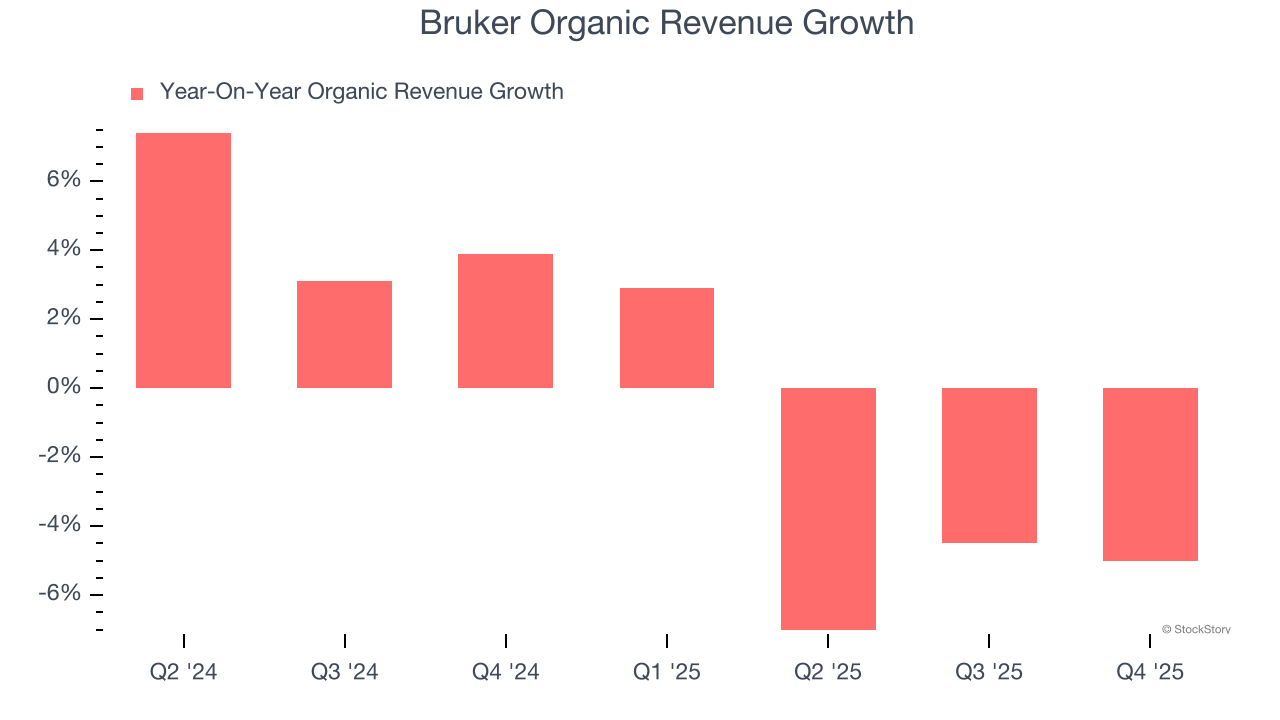
We can better understand Research Tools & Consumables companies by analyzing their organic revenue. This metric gives visibility into Bruker’s core business because it excludes one-time events such as mergers, acquisitions, and divestitures along with foreign currency fluctuations - non-fundamental factors that can manipulate the income statement.
Over the last two years, Bruker failed to grow its organic revenue. This performance was underwhelming and implies it may need to improve its products, pricing, or go-to-market strategy. It also suggests Bruker might have to lean into acquisitions to accelerate growth, which isn’t ideal because M&A can be expensive and risky (integrations often disrupt focus).
2. Shrinking Adjusted Operating Margin
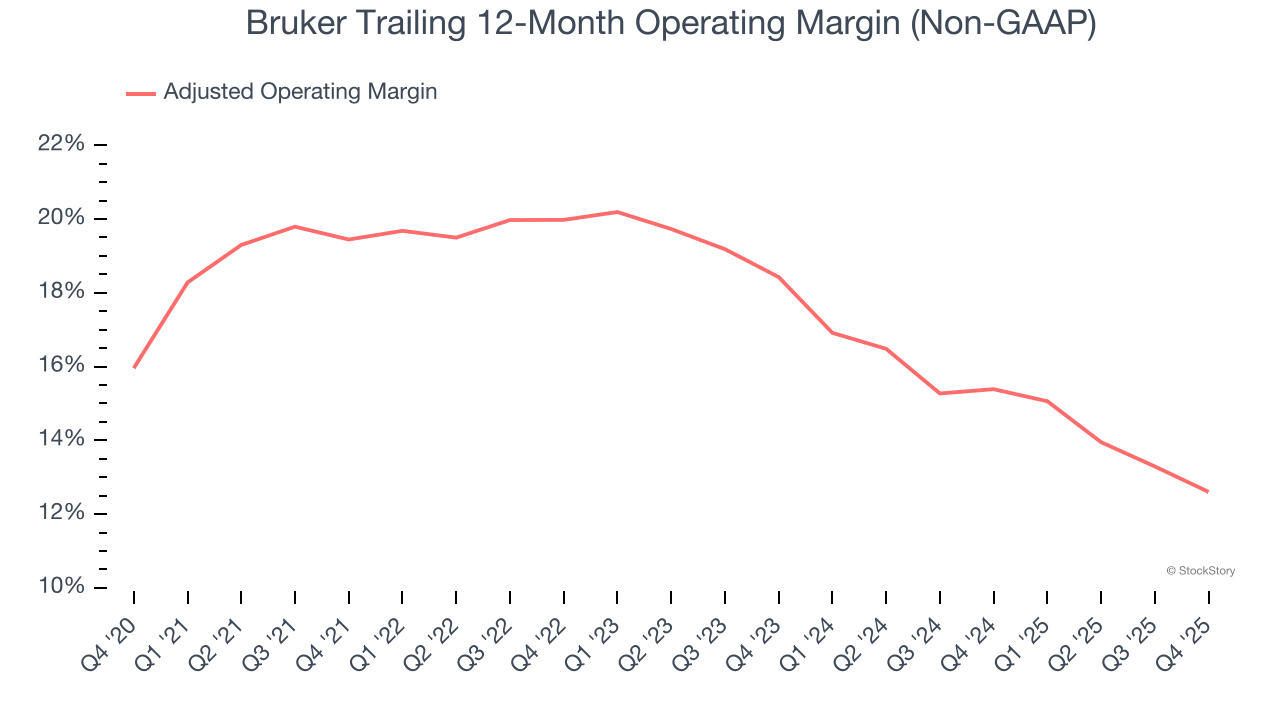
Adjusted operating margin is a key measure of profitability. Think of it as net income (the bottom line) excluding the impact of non-recurring expenses, taxes, and interest on debt - metrics less connected to business fundamentals.
Analyzing the trend in its profitability, Bruker’s adjusted operating margin decreased by 6.8 percentage points over the last five years. This raises questions about the company’s expense base because its revenue growth should have given it leverage on its fixed costs, resulting in better economies of scale and profitability. Its adjusted operating margin for the trailing 12 months was 12.6%.
3. New Investments Fail to Bear Fruit as ROIC Declines
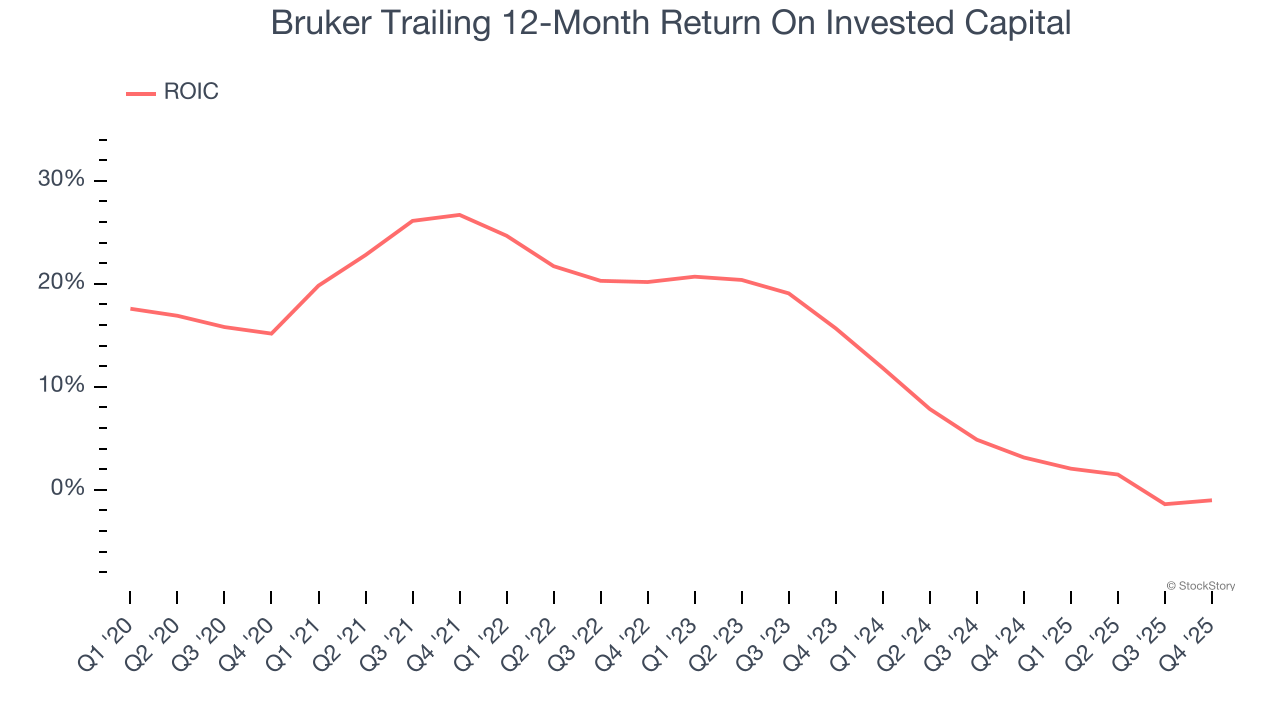
ROIC, or return on invested capital, is a metric showing how much operating profit a company generates relative to the money it has raised (debt and equity).
We like to invest in businesses with high returns, but the trend in a company’s ROIC is what often surprises the market and moves the stock price. Unfortunately, Bruker’s ROIC has decreased significantly over the last few years. We like what management has done in the past, but its declining returns are perhaps a symptom of fewer profitable growth opportunities.
Final Judgment
Bruker isn’t a terrible business, but it doesn’t pass our bar. With its shares outperforming the market lately, the stock trades at 18.8× forward P/E (or $41.37 per share). While this valuation is fair, the upside isn’t great compared to the potential downside. We're fairly confident there are better investments elsewhere. We’d recommend looking at our favorite semiconductor picks and shovels play.
High-Quality Stocks for All Market Conditions
If your portfolio success hinges on just 4 stocks, your wealth is built on fragile ground. You have a small window to secure high-quality assets before the market widens and these prices disappear.
Don’t wait for the next volatility shock. Check out our Top 9 Market-Beating Stocks. This is a curated list of our High Quality stocks that have generated a market-beating return of 244% over the last five years (as of June 30, 2025).
Stocks that have made our list include now familiar names such as Nvidia (+1,326% between June 2020 and June 2025) as well as under-the-radar businesses like the once-micro-cap company Kadant (+351% five-year return). Find your next big winner with StockStory today.
Mentioned In This Article
Latest News
| Oct-06 | |
| Sep-28 | |
| Sep-21 | |
| Sep-08 | |
| Sep-04 | |
| Aug-11 | |
| Aug-10 | |
| Aug-04 | |
| Aug-04 | |
| Aug-04 | |
| Aug-04 | |
| Aug-04 | |
| Jul-24 | |
| Jul-15 | |
| Jun-04 |
