European Gas Prices Just Doubled In 48 Hours - The Last Time That Happened, Everything Broke
The global energy market is flashing warning signals not seen in four years.
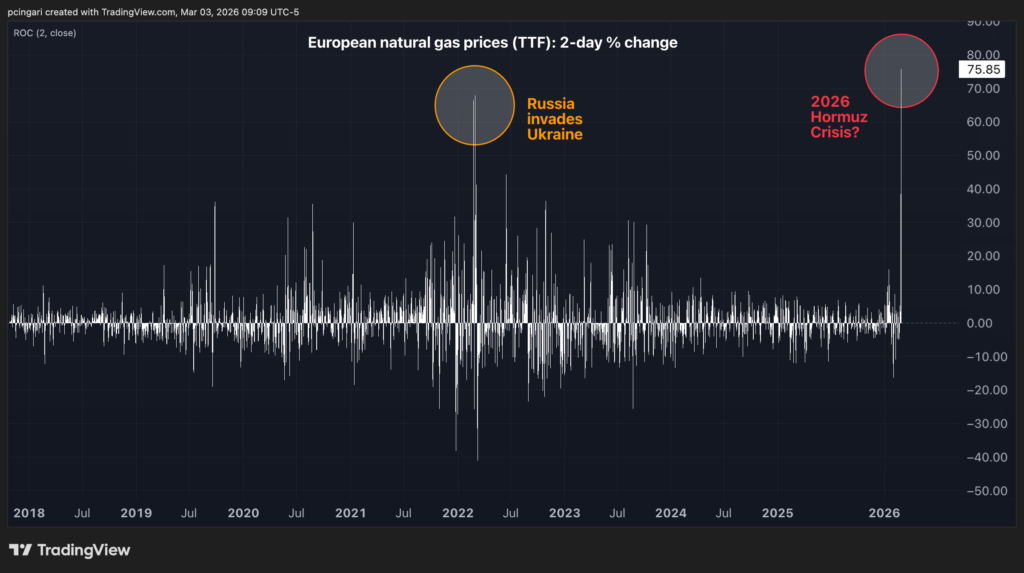
The last time European gas prices doubled in a matter of days was in February–March 2022. Russia's invasion of Ukraine sent oil above $100 per barrel, natural gas prices into the stratosphere, and Europe scrambling to replace Russian supply.
The aftermath was brutal: the sharpest inflation surge since the 1970s, one of the fastest and most synchronized global rate-hiking cycles in history, and equity markets tumbling as liquidity evaporated.
Now, on Day 4 of the war in Iran, energy markets are again under acute stress.
Oil And Natural Gas Prices Spike As Hormuz Fears Mount
On Monday, a commander of Iran's Revolutionary Guard Corps declared the Strait of Hormuz "closed" — a statement that immediately rattled global energy markets.
The Strait is one of the world's most critical energy chokepoints. Roughly 20% of global crude oil supply transits through the narrow waterway each day. It is also a vital artery for liquefied natural gas (LNG) exports to both Europe and Asia.
Oil prices reacted swiftly. Crude – as tracked by the United States Oil Fund (NYSE:USO) – rallied 8% on Monday and extended gains by nearly 9% in early Tuesday trading — a two-day jump of roughly 14%, the sharpest since March 2022.
Brent briefly climbed above $82 per barrel and WTI above $77.
According to Bridget Payne, head of energy forecasting at Oxford Economics, the oil market remains relatively well supplied. Spare production capacity in Saudi Arabia and the UAE could offset lost Iranian output.
However, rerouting oil flows away from Hormuz is far more difficult. Alternative trade routes can handle only about one-third of normal Strait volumes.
European Gas Prices Nearly Double
If oil is flashing amber, gas is flashing red.
European natural gas prices jumped 40% on Monday and another 30% Tuesday. In 48 hours, benchmark prices have nearly doubled — a move unseen since the early days of the Ukraine war.
“Gas markets are more exposed because buffers are weaker,” Payne said.
Qatar, the world's second-largest LNG exporter, has no alternative export route that bypasses the Strait of Hormuz.
Iranian drone strikes have reportedly shut down production at Qatari liquefaction plants, representing roughly one-fifth of global LNG supply.
Kristian Kerr, head of macro strategy at LPL Financial, says oil and gas markets are acting as real-time barometers of the conflict's trajectory. Their sustained rise suggests tensions are not yet stabilizing.
Jack Reid, economist at Oxford Economics, warned that while Qatari LNG accounts for only about 11% of Europe's direct LNG imports, global disruptions will force European buyers to compete aggressively with Asia for cargoes.
Europe is already on track for storage levels to fall below 20% by the end of the refueling season.
Even under the EU's more lenient 80% storage target by Dec. 1, sustained disruption could make that goal difficult to achieve.
US Markets Turn Riskoff
U.S. equity futures are reflecting a clear shift into risk-off mode. In premarket trading on Tuesday, S&P 500 futures were down 1.77% at 6,760,
Dow futures fell 1.9% to 48,000 and Nasdaq 100 futures dropped 2.1% to 24,460. On Monday
The sharp pullback in large-cap benchmarks underscores investor concern that a renewed energy shock could complicate the inflation outlook and delay any potential easing in the Fed’s interest rates.
Image created using artificial intelligence via Gemini.
Mentioned In This Article
Latest News
| 5 hours | |
| Oct-23 | |
| Oct-20 | |
| Oct-20 | |
| Oct-16 | |
| Oct-05 |
'Big Short' Investor Steve Eisman Warns Oil, Rates Push the Market Closer to 'Breaking'
USO
Benzinga Prediction Markets
|
| Sep-28 | |
| Sep-25 | |
| Sep-23 | |
| Sep-21 | |
| Sep-21 | |
| Sep-16 | |
| Sep-15 | |
| Sep-15 | |
| Sep-15 |
