Energy Stocks Are Flashing A Signal Markets Haven't Seen Since The 2022 Oil Crisis
Energy stocks are diverging sharply from the rest of the U.S. equity market as oil prices surge following the outbreak of conflict in Iran — a pattern investors haven't seen since the 2022 Russian invasion of Ukraine.
Five days into the conflict, the broader market has absorbed the geopolitical shock surprisingly well. The SPDR S&P 500 ETF Trust (NYSE:SPY) is down only about 1% for the week.
But beneath the surface, something relevant is happening.
Wall Street is splitting into two camps: industries that produce energy and those that consume it.
The performance divergence is widening quickly.
Oil Prices Surge On Strait Of Hormuz Disruption
Oil prices have jumped roughly 18% this week, climbing toward $80 per barrel as shipping disruptions around the Strait of Hormuz threaten global crude flows.
The Strait is one of the world's most critical energy chokepoints, handling nearly 20% of global oil shipments.
Any threat to that corridor forces traders to rapidly price in tighter supply.
That shift is now cascading through equity markets.
Oil prices are rising primarily because potential disruptions to tanker traffic through the Strait of Hormuz are tightening expectations for global crude supply.
Energy: The Only Sector In The Green
According to CountryETFTracker data, the Energy Select Sector SPDR Fund (NYSE:XLE) is currently the only S&P 500 sector trading higher this week, rising 0.7%.
All ten other sectors are in the red.
Energy-sensitive sectors are suffering the most.
The Consumer Staples Select Sector SPDR Fund (NYSE:XLP) has fallen 5.1%. The Materials Select Sector SPDR Fund (NYSE:XLB) is also down 5.1%, while the Health Care Select Sector SPDR Fund (NYSE:XLV) has declined 4.4%.

The Gap Widens At The Industry Level
Looking deeper into industry ETFs reveals an even more dramatic split.
Oil producers are surging.
Energy consumers are sliding.
The SPDR S&P Oil & Gas Exploration & Production ETF (NYSE:XOP) has gained 7% this week, reflecting rising profit expectations for U.S. oil producers as crude prices climb.
Airlines — one of the most fuel-sensitive industries — are moving in the opposite direction.
The U.S. Global Jets ETF (NYSE:JETS) has fallen 8.8% this week.
Mining companies are under even greater pressure.
The VanEck Gold Miners ETF (NYSE:GDX) has plunged 13.45%, highlighting how diesel-heavy extraction operations become vulnerable when energy costs spike.
The relative performance gaps are striking.
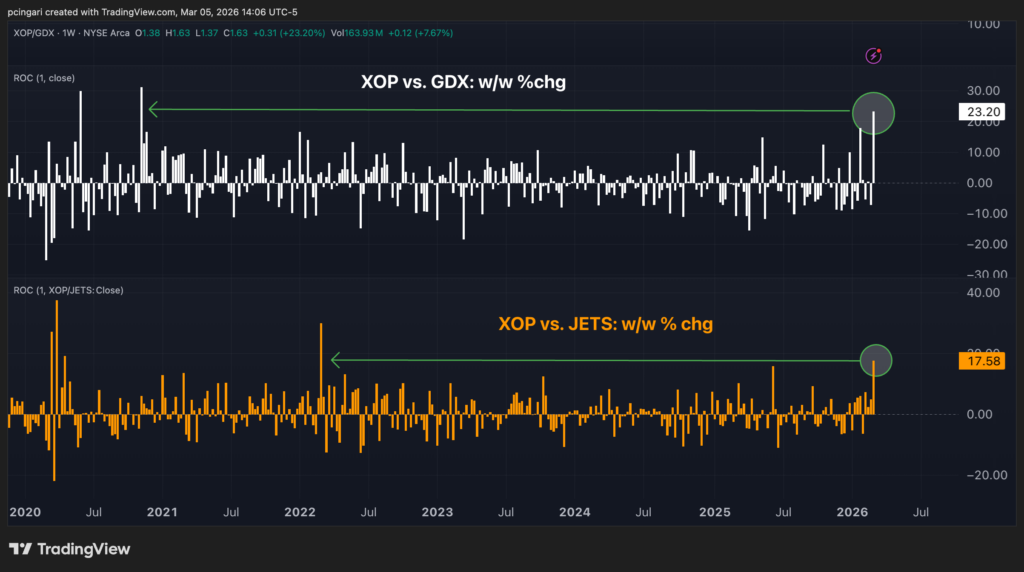
The 16-percentage-point divergence between XOP and JETS is the widest since February 2022, when Russia's invasion of Ukraine triggered a global energy shock.
The 20-percentage-point gap between XOP and GDX is the largest since November 2020, when news of COVID-19 vaccines sparked a powerful rebound in battered oil producers.
Energy Is Already Leading In 2026
The latest surge in oil prices is reinforcing a leadership trend that has been building all year.
Energy is already the best-performing theme of 2026.
The VanEck Oil Services ETF (NYSE:OIH) has climbed 31.4% year-to-date, while the SPDR S&P Oil & Gas Exploration & Production ETF (NYSE:XOP) is up 29.4%.
At the bottom of the leaderboard are sectors tied to the low-energy-cost environment that dominated markets in recent years.
The iShares Expanded Tech-Software Sector ETF (NYSE:IGV) has fallen 17.6% this year.
The First Trust Dow Jones Internet ETF (NYSE:FDN) is down 7.9%, while airlines tracked by the U.S. Global Jets ETF (NYSE:JETS) have declined 7.8%.
The divergence has a clear structural logic. Higher oil prices compress margins for energy consumers while expanding them for producers.
For investors, the message is simple: this is not a market to hide in cash or defensive sectors. It is a market where your exposure to energy — as producer or consumer — may be the single most important variable in your portfolio.
The longer the conflict runs, the wider that gap becomes.
Image: Shutterstock
Mentioned In This Article
Latest News
| Oct-17 | |
| Oct-16 | |
| Oct-16 | |
| Oct-16 | |
| Oct-16 | |
| Oct-16 |
October Rate-Hike Odds Collapse as Warsh Keeps His Cards Close but AI Transition Looms
SPY
Benzinga Prediction Markets
|
| Oct-16 | |
| Oct-16 | |
| Oct-15 | |
| Oct-15 | |
| Oct-15 | |
| Oct-15 | |
| Oct-15 | |
| Oct-15 | |
| Oct-15 |
