How Stocks Tend to Behave After Large Weekly Oil Gains
Oil prices spiked last week after the U.S. and Israel bombed Iran. Looking at weekly oil prices since 1985, last week’s 35% return was the second largest on record. The largest was back in early April 2020, when Saudi Arabia and Russia agreed to significantly lower oil production, ending a price war.
This week, I’m looking at historical data to see how oil and stocks have behaved after large weekly oil gains. I will also look at what option buyers were doing in regards to a popular oil exchange-traded fund (ETF) as prices surged.
Oil Spikes
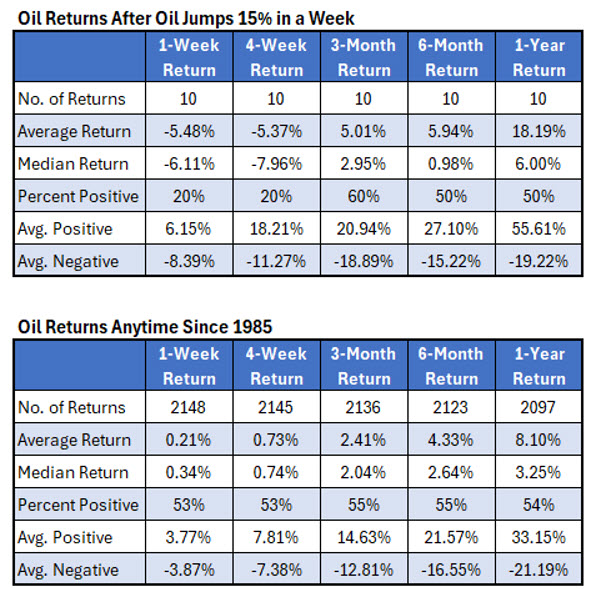
Going back to 1985, there were 10 times when oil jumped by 15% or more in a week. I’m only looking at data on the first instance in at least three months. The table below shows oil returns over the next week to one year. The second table shows typical oil returns for comparison.
Oil tended to fall by over 5% on average over the next week, and remain over 5% lower over the next month. It was positive over those time frames only 20% of the time. As you would expect, these huge weekly moves tended to be followed by increased volatility.
Oil tended to rebound, however, and showed better than usual returns in the next three months and out to one year. Looking specifically at six months, oil averaged a return of 5.95% return, with 50% of the returns positive.
Interestingly, over the longer term after these weekly oil spikes, there was more upside on average than downside. In the next six months, the average positive return was 27%, which was higher than the typical positive return, while the average negative return was -15%, and that was less in magnitude than the typical downside move (-16.5%).
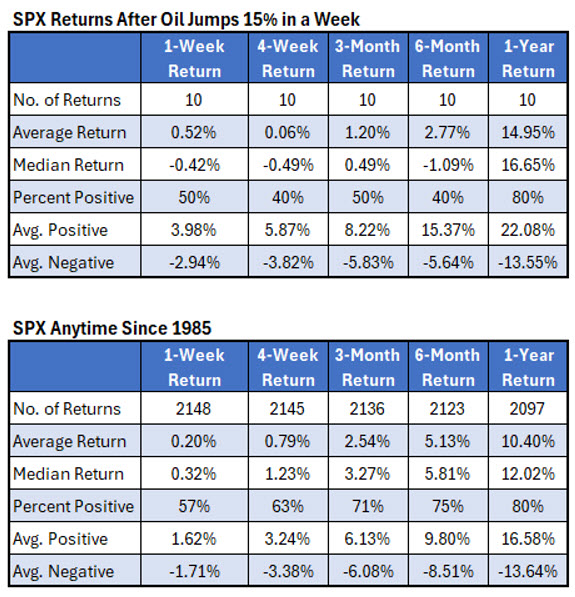
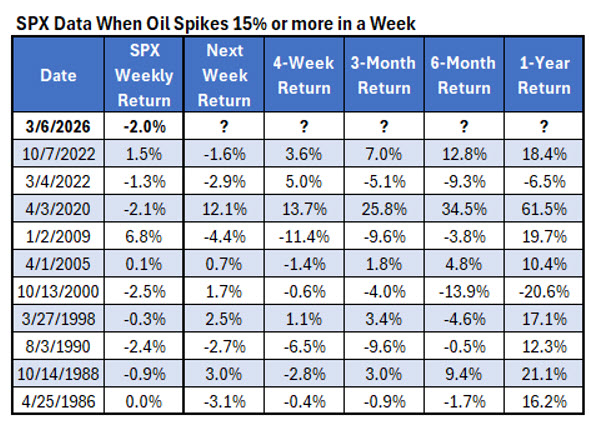
The table below summarizes the S&P 500 Index (SPX) returns after oil surges during a week. While stocks showed slight upside in the coming week when looking at average returns, just half of the returns were positive, and the outperformance was short-lived.
SPX returns underperformed compared to the usual return over the next four week to six months. Six months after the oil spikes, the SPX averaged a return of 2.77%, compared to the usual 5.13%. What's more, stocks were higher just 40% of the time after these spikes, compared to the benchmark of 75%.
USO Options
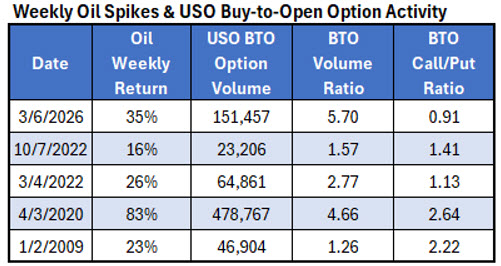
I found some interesting buy-to-open (BTO) options activity in the United States Oil Fund LP (USO), an ETF that track the price of oil. We have BTO data on USO going back to 2009. During that time, we have four other instances when oil surged 15% or more during a week. The table below shows those weeks.
The BTO Volume Ratio column compares the week’s BTO volume to the average BTO volume over the previous three months. Last week stood out with the BTO volume five times more than the recent average. Additionally, the call/put ratio of 0.91 (below one) means there were more puts bought than calls. That’s different from the four previous occasions, when calls outpaced puts.
If this heavy put buying reflects sentiment that oil prices will fall, the contrarian perspective would be the opposite, suggesting oil prices could continue higher.
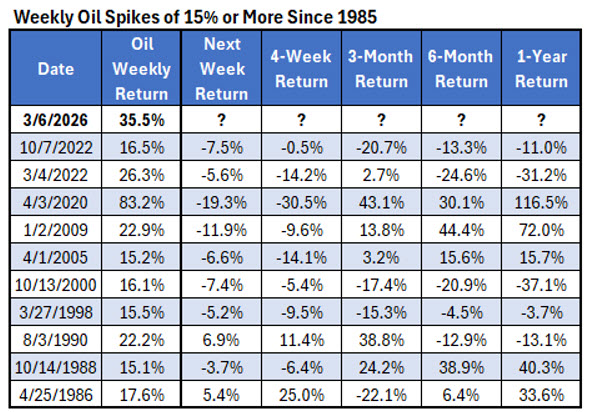
For those who like to see the raw numbers, the table below shows the individual weeks that oil spiked by over 15, along with the commodity’s subsequent returns.
Finally, this last table shows SPX data for the same weeks in the table above.
Mentioned In This Article
Latest News
| Oct-20 | |
| Oct-20 | |
| Oct-16 | |
| Oct-05 |
'Big Short' Investor Steve Eisman Warns Oil, Rates Push the Market Closer to 'Breaking'
USO
Benzinga Prediction Markets
|
| Sep-28 | |
| Sep-25 | |
| Sep-23 | |
| Sep-21 | |
| Sep-21 | |
| Sep-16 | |
| Sep-15 | |
| Sep-15 | |
| Sep-15 | |
| Sep-14 | |
| Sep-11 |
