How Can Investors Proceed When There Are No 'Cheap' Options?
The war in Iran is causing uncertainty in the markets, which has led to a general increase in the price of options. There are hardly any stocks whose options are cheap right now, relative to the past year. In the article below, I’m examining the data to see if this could lead to headwinds for options traders going forward.
What Are “Cheap” and “Expensive” Options?
There are a few ways to define cheap and expensive when it comes to option prices. For example, a week ago, McDonald’s (MCD) one-week at-the-money (ATM) call had a 21% implied volatility (IV), compared to about 45% for Tesla (TSLA). On an absolute basis, MCD options were much cheaper than TSLA. But relative to itself over the past year, MCD was actually more expensive. Its IV was higher than about 85% of the past year’s readings, while TSLA’s IVs ranked higher than 40% of its own readings over the past year. MCD has lower IV’s naturally because its earnings are more predictable than TSLA. Compared to itself over the past year, however, MCD options were more expensive.
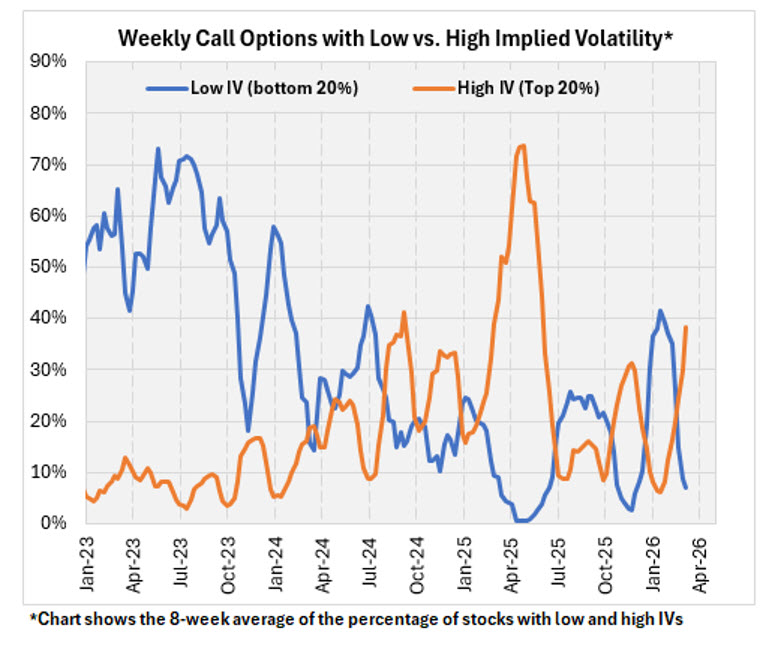
The chart below compares the proportion of “cheap” options and “expensive” options available. Every Friday, I found the at-the-money call implied volatility (IV) for stocks expiring the next Friday. I calculated the 52-week IV percentile rank for each stock. Stocks with an IV rank in the bottom 20%, I called “Cheap,” while those in the top 20%, I called “Expensive.”
You can see in the chart below, the availability of cheap options has been tumbling while expensive options have been surging.
Buy Cheap Options
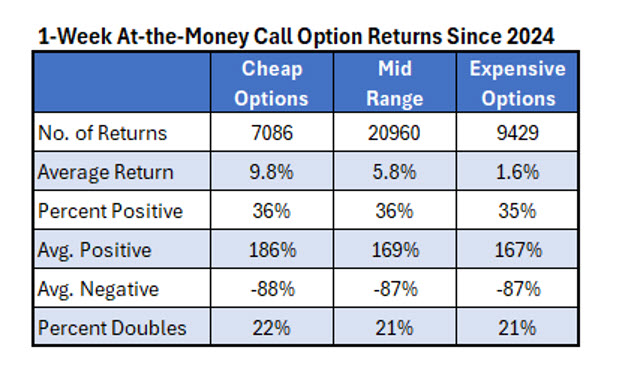
The table below shows why the lack of cheap options is concerning. I looked at one-week ATM call option returns since 2024. Specifically, I assumed the option was purchased on Friday with an expiration date the following Friday then closed at intrinsic value on the expiration date. I went back to 2024, which has been a bullish time for the market. Therefore, the call returns have been excellent.
The “cheap” options, however, were the most bullish, averaging a return of 9.8% per trade. The “expensive” options, over the same period, averaged a return of just 1.6%. The reason for the outperformance in the cheap options is the average return for the positive trades (186% for the cheap options compared to about 168% for the other two buckets).
The other metrics in the table are similar for every bucket. Note that these are very volatile options being one week and at-the-money, in case those average positive and negative returns are alarming.
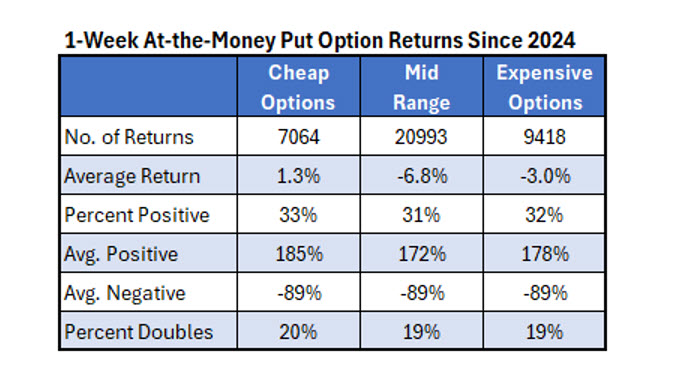
This next table looks at the same stocks and timeframe, but it summarizes the returns of the put options. Again, buying the “cheap” options was the best way to go. Even during the bull market of the last two years, the “cheap” put options showed a positive 1.3% return per trade. The mid-range and expensive options averaged a return of -6.8% and -3.0%, respectively.
Cheapest Options Available
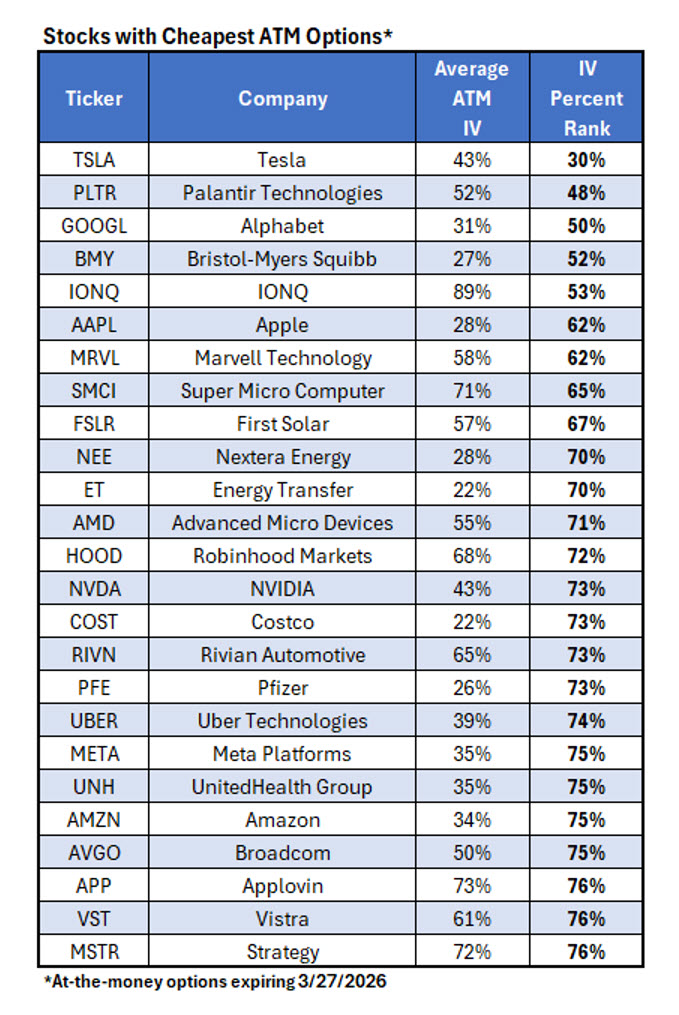
Using the method above that is comparing current IVs for stocks with their own IVs over the previous 52 weeks, there are no “cheap” options, as I defined them above. No stocks have IVs in the bottom 20% of readings over the past 52 weeks. This is using ATM options that expire next Friday, 3/27.
If you’re looking for one-week option plays based on the analysis above, there are no “cheap” options. But the stocks listed below are the cheapest they get right now.
Mentioned In This Article
Latest News
| 4 min | |
| 5 min | |
| 16 min | |
| 2 hours | |
| 2 hours | |
| 3 hours | |
| 3 hours | |
| 4 hours | |
| 6 hours | |
| Oct-22 | |
| Oct-22 | |
| Oct-22 | |
| Oct-22 | |
| Oct-22 | |
| Oct-22 |
