3 'Yard Markers' S&P 500 Bulls Should Be Watching
“…the next levels of importance begin at 6,280, which is a 10% correction below the late-January all-time closing high of 6,978… we know President Donald Trump is keenly aware of stock prices, oil prices, and interest rates. From an equity perspective, and assuming he uses the SPX as his benchmark, the pre-Inauguration close sits at 5,966… In the absence of a Tuesday close above 6,491, it will be the SPX’s first monthly close below its 12-month trendline since March 2025…looking back 15 years, a significant (month-end) close below the SPX’s 12-monh trendline increases risk of a move to a 36-month, 48-month, or 60-month moving average, which are currently situated at 5,576, 5,175, and 5,027, respectively.”
- Monday Morning Outlook, March 30, 2026
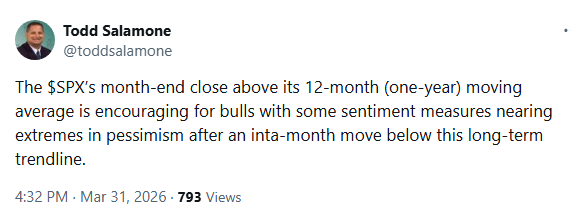
The excerpt from last week’s commentary, particularly when I emphasized the S&P 500 Index's (SPX -- 6,582.69) Tuesday, or March month-end close, hints at why I made a rare Tuesday afternoon post on X. When using monthly moving averages in my technical analysis, I emphasize the month-end close, which admittedly leaves one vulnerable after an intra-month breach that occurs early in the month.
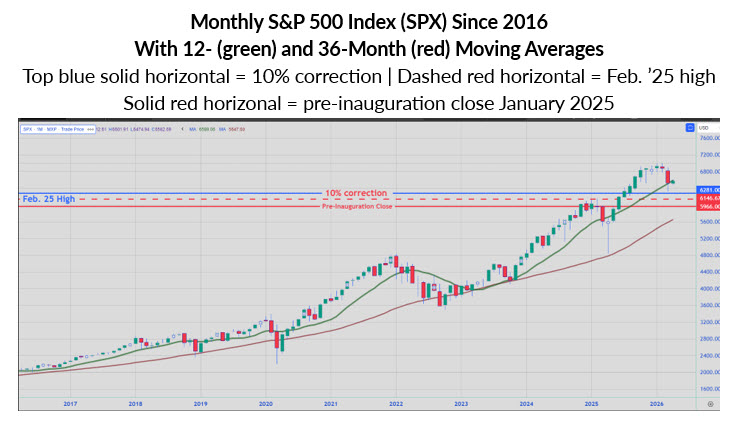
The monthly chart is still a solid way to assess the bigger picture, which is especially handy during increases in volatility like we are seeing now. The increase in volatility has been brought on by concerns in the private-equity industry and the Israel and U.S. conflict with Iran. Both macro events have left investors dealing with a lack of transparency and, in the case of the war with Iran, mixed messages from President Donald Trump (who has suggested the war will end soon) and what is left of Iranian leadership (who claims they aren’t negotiating and are not prepared to accept the U.S. terms of ending the war).
The ambiguity has understandably left investors in a predicament, as they cannot possibly predict what will happen next. While short-term and intermediate-term levels on the SPX have been violated, the SPX is above most longer-term support levels.
But bulls are not out of the woods, however, especially as the SPX lingers below the following indicators and “yard markers”:
1) its 200-day moving average at 6,645
2) the 20-day moving average at 6,608 (Thursday’s high) and 50-day moving average (at 6,785) – both of which are pointing lower.
3) Its year-to-date breakeven at 6,845
“Analysts Prepare for $200 Oil as Some Gas Prices Set to Cross $5 a Gallon
$200 oil isn't as crazy as it sounds
The increase in skepticism by investors as analysts and mainstream media come to grips with current realities overseas is encouraging. But if the SPX ventures too far below its 12-month moving average in the days and weeks ahead, such skepticism will continue to be validated and lose its significance from a contrarian perspective.
For example, stock prices declined and oil prices soared as investors were initially caught off guard by the late-February attack on Iran. Moreover, oil prices continued their advance and stocks dropped as sentiment transitioned from “the fighting ending in hours or days” to acceptance that “the war could last for months.”
The acceptance that the war could last longer than initially anticipated has caused analysts and mainstream media to caution against $200 per barrel of oil, or a near-doubling from current levels. The significance of this is that while the initial 50% increase in oil prices took market participants by surprise, warnings about $200 oil may not take as many participants by surprise.
The implications are that those that are heeding the warnings of $200 per barrel are likely hedged for such a scenario and/or have already run for the cover of cash.
I found the price action in the SPX and oil stocks last week interesting in the next of the $200/barrel oil warnings that began early last week and picked up steam as the week progressed. The State Street Energy Select Sector SPDR ETF (XLE -- 59.25) experienced a down week, not necessarily what one might expect with projections of $200/oil barrel. Then again, it had experienced 14 consecutive weeks of higher closes, so last week may have been just a pause in an uptrend. Stay tuned.
Moreover, the SPX experienced its first advance after five consecutive losing weeks amid the warnings of $200/barrel oil. Plus, the index ended last week back above the 6,535 level, which marked multiple lows since October before bears finally pushed it below late last month. This sets up the potential for a bear trap with the month-end close above the 12-month moving average.
How pessimistic are traders and investors?
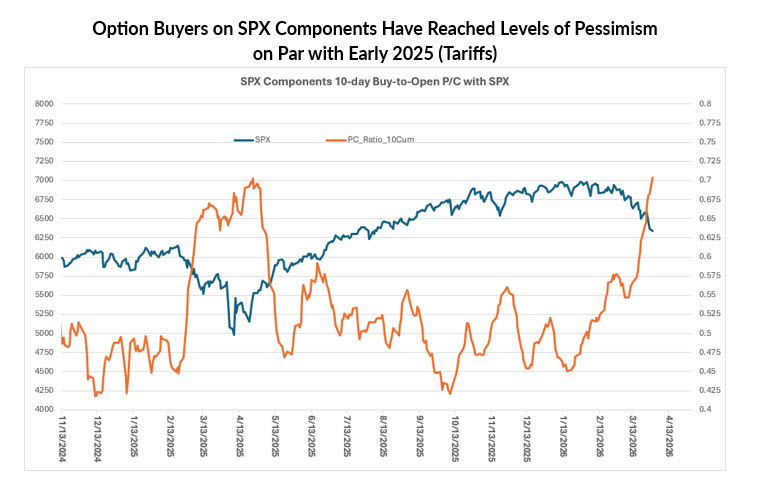
By one measure – put purchases on SPX component stocks relative to call purchases (see chart below) - the amount of negativity toward stocks is on par with the 20% decline in the SPX from February through early-April 2025 (the Liberation Day tariff days).
This sentiment extreme might be considered bullish because a decline of less than 10% in the SPX generated the same bearishness as a 20% slide. In other words, the headlines are seemingly stirring up more worries than the index is discounting moving forward. If this is true, you are looking at a buying opportunity. And if looking to increase stock holdings, consider only buying if the SPX is above 6,535. Or, if you want to key to a moving average, consider an entry point based on the SPX closing above its 200-day moving average at 6,645.
Todd Salamone is Schaeffer's Senior V.P. of Research
Continue reading:
Mentioned In This Article
Latest News
| Oct-16 | |
| Oct-12 | |
| Oct-11 | |
| Oct-07 | |
| Oct-07 | |
| Oct-01 | |
| Sep-28 | |
| Sep-21 | |
| Sep-16 | |
| Sep-15 | |
| Sep-11 | |
| Sep-09 | |
| Sep-04 | |
| Sep-02 | |
| Sep-02 |
