Rent or buy? How long it takes for buying a home to pay off in each metro
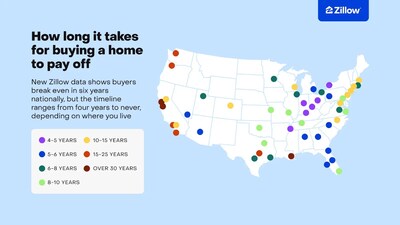
New Zillow data shows buyers break even in six years nationally, but the timeline ranges from four years to never, depending on where you live
- Conditions for buyers have improved, shortening the national breakeven point to six years from a peak of 8.4 years in 2023.
- Buyers break even in as little as four years in Columbus, Memphis and Buffalo. In San Francisco, San Jose and New Orleans, today's prices and rents leave renting ahead even over 30 years.
- The decision to rent or buy is as much a lifestyle choice as a financial decision.
SEATTLE, June 4, 2026 /PRNewswire/ -- The answer to "Should I rent or buy?" depends almost entirely on where you live and how long you plan to stay. According to a new Zillow® Rent vs. Buy analysis, the typical home buyer breaks even relative to renting in about six years nationally, down from a peak of 8.4 years in October 2023. In affordable Midwest cities like Columbus and Indianapolis, that window shrinks to just four years. In high-cost coastal markets like San Francisco and San Jose, buying never surpasses renting over a full 30-year horizon.
"For generations, Americans have been told that buying a home is the smartest financial move they'll ever make. This analysis finds the truth is more complicated," said Orphe Divounguy, senior economist at Zillow. "This research shows that both renting and buying can be smart decisions, just in different cities. The good news is that for buyers who are ready, conditions today are the most favorable they've been in years. But the ZIP code you choose may matter more than any other financial decision you make."
How the analysis works
Zillow's analysis looked at what happens over the duration of a 30-year fixed-rate mortgage when a typical household buys, versus rents, a home in each of the 50 largest U.S. metro areas. For buyers, the model accounts for all the direct costs of ownership including mortgage payments, property taxes, insurance, maintenance and closing costs. For renters, the model factors in monthly rent and renters insurance, plus the return on cash that wasn't spent on a down payment.
Where buying pays off sooner
In the Midwest and parts of the South, the case for buying is clear. Columbus leads the country with a four-year break-even horizon. Memphis, Buffalo, Indianapolis, Cincinnati and Louisville follow, with buyers coming out ahead in less than five years.
In these markets, the relationship between home prices and rents is relatively balanced. The monthly cost of owning isn't dramatically higher than renting, so buyers don't have a big financial hole to dig out of at the start. Add in steady home value appreciation and you have a market where ownership starts paying off quickly.
Where renting makes financial sense
In San Francisco, San Jose and New Orleans, renting holds the financial advantage throughout the entire 30-year time horizon. In Seattle, Austin, Los Angeles, San Diego and Portland, buying can eventually win, but only after 16–23 years.
The one thing these markets have in common is a wide gap between what it costs to own and what it costs to rent. That gap can be the result of high home prices, high insurance premiums or weak home value appreciation, and it may never close, even after decades.
Making the choice
Buying is not automatically a bad deal in expensive markets, but it often becomes a long-term decision that can't be treated as purely financial. Buyers still benefit from:
- Building equity and long-term wealth
- A stable, predictable monthly payment
- The ability to customize their space and put down roots in a community
- Tax benefits, including potential mortgage interest deduction, which are not included in this analysis
Renting, meanwhile, offers its own set of lifestyle benefits, including:
- No maintenance or repair costs
- Cash liquidity for other investments
- Greater financial flexibility
- Ability to move when life calls for it
"The rent-versus-buy decision in 2026 is as much of a lifestyle decision as a financial one," said Amanda Pendleton, Zillow's home trends expert. "Do you want a backyard garden and a menagerie of pets? Or do you want to skip yard work entirely and have the flexibility to move on a whim? These types of lifestyle questions are as important as whether or not the math works in your favor."
The rent-or-buy bottom line
Buy if: You plan to stay more than six years (nationally), your metro has a short break-even horizon, or you value stability and building equity.
Rent if: You might move in less than six years, you're in an expensive coastal market, or you want financial flexibility and liquidity.
To better understand what's right for you, Zillow's Rent vs. Buy Calculator is a great starting point that takes your personal finances into account.
Busting the down payment myth
Conventional wisdom says to put down as much as you can, but this research suggests otherwise. A larger down payment means a smaller loan, lower monthly payments and less interest paid over time. That sounds like a clear win, but it ignores what happens to the money you don't put into the home. Cash held back from a down payment can be invested and, over time, those investment returns can outpace the savings from borrowing less.
In Cincinnati, for example, a buyer who puts down just 5% breaks even about six months sooner than one who puts down 20%. The math works because the stock market returns on the extra cash outweigh the mortgage cost savings from a larger down payment, especially in a market where home values are rising steadily and rents are relatively high.
The reverse is also true. In markets where owning is significantly more expensive than renting month to month, a larger down payment reduces that gap and becomes more valuable. The "right" down payment isn't always 20%. It's a function of your local market, your mortgage rate and what you'd realistically do with the money you keep.
The impact of mortgage rates
Mortgage rates are one of the most powerful levers in the rent-vs.-buy equation. The current six-year national breakeven sits at an inflection point: a rate drop of 1% could unlock buying as a realistic option for millions of additional households, while a 1% rise could push conditions back toward the difficulty of 2023–24.
Renters who want to become buyers have valuable digital tools to help them reach homeownership. When mortgage rates fluctuate, Zillow's BuyAbilitySM accounts for a buyer's personal rate scenario to help them understand what they can afford in real time. CreditClimb helps renters become buyers by using rent payments to build credit. And Zillow shows buyers available down payment assistance programs on for-sale listings.
Breakeven points across major U.S. metros
Metro | Buying break-even point in years |
United States | 6.0 |
Columbus, OH | 4.1 |
Memphis, TN | 4.2 |
Buffalo, NY | 4.2 |
Indianapolis, IN | 4.3 |
Cincinnati, OH | 4.6 |
Louisville, KY | 4.8 |
Birmingham, AL | 5.1 |
Detroit, MI | 5.2 |
Las Vegas, NV | 5.2 |
Pittsburgh, PA | 5.3 |
Orlando, FL | 5.4 |
Jacksonville, FL | 5.4 |
Atlanta, GA | 5.5 |
Tampa, FL | 5.6 |
Phoenix, AZ | 5.8 |
Charlotte, NC | 5.9 |
Cleveland, OH | 6.1 |
Houston, TX | 6.3 |
Richmond, VA | 6.4 |
Chicago, IL | 6.5 |
Salt Lake City, UT | 6.8 |
San Antonio, TX | 7.7 |
Minneapolis, MN | 7.8 |
Providence, RI | 7.8 |
Kansas City, MO | 8.5 |
Nashville, TN | 8.8 |
Oklahoma City, OK | 8.9 |
Miami, FL | 9.0 |
Virginia Beach, VA | 9.5 |
Dallas, TX | 9.6 |
St. Louis, MO | 9.8 |
Baltimore, MD | 9.8 |
Milwaukee, WI | 10.1 |
Philadelphia, PA | 10.2 |
Denver, CO | 10.2 |
Raleigh, NC | 10.3 |
Riverside, CA | 10.5 |
Washington, DC | 12.0 |
New York, NY | 12.5 |
Hartford, CT | 13.7 |
Sacramento, CA | 13.8 |
Boston, MA | 13.9 |
Portland, OR | 16.7 |
Los Angeles, CA | 17.1 |
Austin, TX | 18.4 |
Seattle, WA | 19.7 |
San Diego, CA | 23.3 |
San Francisco, CA | Renting beats buying over 30 years |
San Jose, CA | Renting beats buying over 30 years |
New Orleans, LA | Renting beats buying over 30 years |
About Zillow Group
Zillow Group, Inc. (Nasdaq: Z and ZG) is reimagining real estate to make home a reality for more and more people.
As the most visited real estate app and website in the United States, Zillow connects hundreds of millions of consumers with innovative technology, trusted agents and loan officers, and seamless digital solutions. With industry-leading tools and resources, Zillow supercharges real estate professionals so they can grow their businesses and deliver exceptional client experiences. For renters and housing providers, Zillow offers not only a robust marketplace but a set of end-to-end products and services to streamline applications, leases, payments and more.
Zillow's ecosystem spans the entire home journey — from dreaming and shopping to renting, buying, selling and financing.
Zillow Group's affiliates, subsidiaries and brands include Zillow®, Zillow Premier Agent®, Zillow Home Loans®, Zillow Rentals®, Zillow® New Construction, Trulia®, StreetEasy®, Out East®, HotPads®, Follow Up Boss®, ShowingTime®, dotloop® and Zillow® Closing.
All marks herein are owned by MFTB Holdco, Inc., a Zillow affiliate. Zillow Home Loans, LLC is an Equal Housing Lender, NMLS #10287 (www.nmlsconsumeraccess.org). © 2026 MFTB Holdco, Inc., a Zillow affiliate.
(ZFIN)

SOURCE Zillow Group, Inc.

Mentioned In This Article
Latest News
| Sep-18 | |
| Sep-17 | |
| Sep-16 | |
| Sep-14 | |
| Sep-11 | |
| Sep-08 | |
| Sep-02 | |
| Aug-31 | |
| Aug-27 | |
| Aug-25 | |
| Aug-25 | |
| Aug-24 | |
| Aug-24 | |
| Aug-24 | |
| Aug-20 |
