Fate Therapeutics Showcases Data from FT819 and FT839 Programs at the European Congress of Rheumatology Annual Meeting
FT819 off-the-shelf CAR T-cell therapy product candidate continues to broaden patient access with 21 SLE patients now treated, including as outpatient administration in community hospitals
Continued demonstration of rapid and sustained clinical improvement with favorable tolerability profile observed following treatment of systemic lupus erythematosus (SLE) patients with FT819 and less-intensive conditioning chemotherapy; a majority of evaluable patients on background glucocorticoids achieved either complete glucocorticoid discontinuation or guideline-based tapering targets
FT819 demonstrated deep B-cell depletion with reconstitution of preferred less-differentiated state associated with a healthier repertoire of B cells; elimination of dominant B-cell clones in dose-dependent manner was seen while vaccination titers were maintained
In preclinical studies, FT839 exhibited comprehensive elimination of activated immune cells in rheumatoid arthritis patient samples; activity accomplished while in allogeneic setting without the need for conditioning chemotherapy
SAN DIEGO, June 04, 2026 (GLOBE NEWSWIRE) -- Fate Therapeutics, Inc. (NASDAQ: FATE), a clinical-stage biopharmaceutical company dedicated to bringing a transformative pipeline of induced pluripotent stem cell (iPSC)-derived cellular immunotherapies broadly to patients with cancer and autoimmune disease, presented data today featuring its off-the-shelf CAR T-cell programs FT819 and FT839 at the European Congress of Rheumatology (EULAR) annual meeting being held in London, UK, June 3-6, 2026.
“The data presented for FT819 with less-intensive conditioning and off-the-shelf CAR T-cell therapy product candidate in SLE is truly exciting, and we are very pleased that our highly-differentiated therapeutic approach has the potential to transform autoimmune disease outcomes by supporting persistent reductions in cSLEDAI, PGA, FACIT-fatigue, and UPCr scores and promoting effective B-cell depletion with preferred subtype reconstitution while maintaining a distinctly favorable tolerability profile,” said Bob Valamehr, Ph.D., MBA, President and Chief Executive Officer of Fate Therapeutics. “What is particularly noteworthy is that FT819 is consistently produced from a clonal iPSC master cell bank, meaning it can be manufactured at mass scale and administered on demand in an outpatient setting with same-day discharge, bringing CAR T-cell therapy out of specialized academic centers and into community hospitals for broad patient accessibility, including in underserved regions. In fact, the broad accessibility and on-demand availability of FT819 have specifically contributed to the accelerated enrollment seen in the Phase 1 trial. We continue to fiercely pursue the commencement of our Phase 2 potentially registrational trial in lupus nephritis, RECLAIM-LN, and look forward to providing an update soon. With FT839 now advancing as a next-generation dual-CAR targeting product candidate with the potential to eliminate a full spectrum of aberrant immune cell–driven autoimmune disease, we believe we are building a truly transformative and accessible portfolio for patients with serious autoimmune conditions.”
Presentation Summary Includes:
Title: Safety and Efficacy of an Off-the-Shelf Anti-CD19 CAR T-Cell Therapy with Reduced Conditioning in SLE: A Phase 1 Study Supporting Same-Day Discharge
As of a May 14, 2026 data cutoff date, 21 systemic lupus erythematosus (SLE) patients have been treated, including 16 patients in Regimen A receiving a single dose of FT819 with less-intensive conditioning chemotherapy consisting of either cyclophosphamide or bendamustine alone, avoiding the less-preferred intensive-conditioning combination of 3 days of fludarabine and cyclophosphamide commonly administered in most CAR T-cell trials. Patients were generally young (mean age 33.8 years), predominantly female (87.5%), had refractory SLE with a median disease duration of 7.56 years, and had failed a median of 7 prior therapies.
Favorable Tolerability Profile and Clinically Meaningful and Persistent Improvements Across Disease Measures in the Phase 1 Trial
FT819 maintained a favorable safety profile and across key disease activity endpoints, drove deep and sustained efficacy responses with depth of response greater with bendamustine compared to cyclophosphamide, supporting bendamustine as the preferred conditioning regimen for the planned RECLAIM-LN study (NCT07570862), a Phase 2 potentially registrational trial:
- Preferable tolerability profile: All Regimen A patients with SLE tolerated FT819 without dose limiting toxicity (DLT) with no Grade >2 cytokine release syndrome (CRS) and no immune effector cell-associated neurotoxicity syndrome (ICANS), graft versus host disease (GvHD), or deaths reported on study (see Table 2 from presentation below, summarizing the incidence of adverse events of special interest in Regimen A).
Table 2 [from presentation]. Preliminary Safety Data of FT819 in Regimen A SLE: Select AESIs
| Safety Parameter | Incidence, n (%) (N=16)1,2 |
| CRS (Grades 1-2) | 4 (25.0) |
| CRS (Grade ≥3) | 0 |
| ICANS | 0 |
| GvHD | 0 |
| Hypogammaglobulinemia | 0 |
| Dose Limiting Toxicity | 0 |
| Grade ≥3 Adverse Events (any) | 6 (37.5) |
| Infection (Grade ≥3)* | 3 (18.8) |
| Cytopenia (Grade ≥3)† | 3 (18.8) |
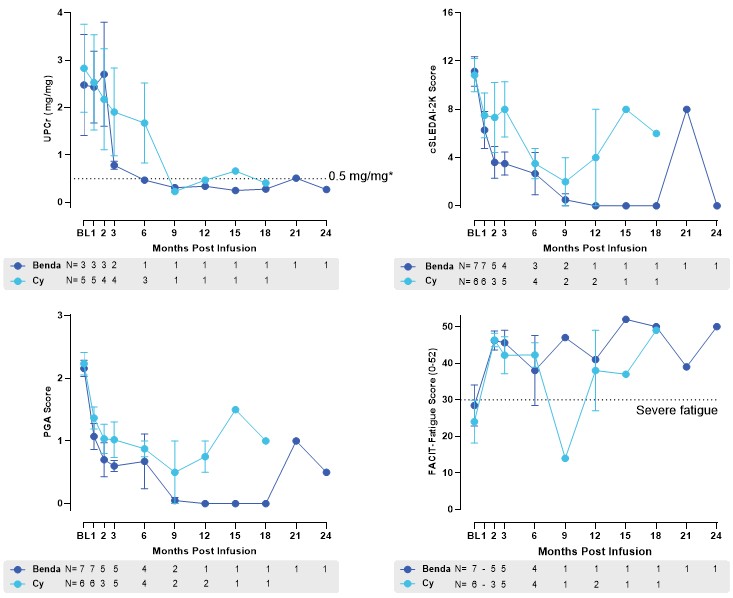
- Clinical Systemic Lupus Erythematosus Disease Activity Index-2K (cSLEDAI-2K): As shown in the cSLEDAI-2K panel of Figure 4 from the presentation, disease activity scores declined rapidly within the first few months following infusion and remained consistently low through post-treatment follow-up. Preliminary data shows that FT819 demonstrated clinical efficacy with both conditioning arms, while the bendamustine conditioning arm demonstrated the greatest and most sustained reductions in disease activity, reflecting durable control of overall lupus disease activity.
- Urine Protein-to-Creatinine Ratio (UPCr, Lupus Nephritis): The UPCr panel of Figure 4 shows a rapid decrease in proteinuria within the first few months, with bendamustine-treated patients exhibiting the most pronounced and sustained decrease.
- Physician Global Assessment (PGA): The PGA panel of Figure 4 shows a reduction in physician-rated global disease activity that was maintained over time, corroborating the improvements seen in the other disease measures and reflecting sustained physician-assessed improvement in overall disease status.
- FACIT-Fatigue: As plotted in the FACIT-Fatigue panel of Figure 4, scores rose from a baseline in the severe-fatigue range (below the threshold of 30) into the non-severe range and were sustained over follow-up visits, indicating a meaningful and lasting reduction in fatigue burden, an observation that is not often seen with other treatments.
- Glucocorticoid reduction: Of 10 patients entering the trial on background glucocorticoids with ≥1 month of follow-up, 7 achieved a dose of ≤5 mg/day, 5 of whom discontinued steroids altogether.
Figure 4 [from presentation]– Disease Activity Measures Among SLE patients in Regimen A With at Least 1-Month Follow-up
- Effective B-Cell Depletion and Reset Towards a Healthier Repertoire: The data also showed deep and durable B-cell depletion following treatment with FT819 across all analyzed patients in Regimen A, with reconstitution suggesting a reset of the pathogenic B-cell repertoire. The remodeling depicts depletion of circulating B cells following treatment with the reconstituting compartment shifting toward a less-differentiated naïve phenotype and reduced switched-memory population. B-cell reset after FT819 treatment was further confirmed by B-cell receptor sequencing demonstrating a 74–96% reduction in the top 50 most expanded clones at baseline in all patients analyzed (n=5). Critically, these dominant clones did not reappear at any timepoint analyzed out to 12 months, suggesting durable elimination of the pathogenic B-cell landscape. The data also showed FT819’s capacity to eliminate B-cells outside of peripheral blood and in tissue. FT819 with bendamustine conditioning drove deeper, more consistent B-cell depletion and greater FT819 expansion compared to cyclophosphamide. Furthermore, no loss of vaccine titers was observed in tested patients in which tetanus toxoid, measles, and mumps IgG titers were unchanged following treatment, indicating that protective humoral immunity was preserved.
Fate Therapeutics also presented preclinical data for FT839, its next-generation off-the-shelf dual-CAR T-cell product candidate.
Title: Off-the-Shelf Dual-CAR T-Cell Therapy: Targeting B and T Cells in Autoimmune Disease Without Preconditioning
Preclinical Results: FT839 Exhibits Potent, Selective, and Durable Activity in Rheumatoid Arthritis without the Need for Conditioning Chemotherapy
- Targeting B-cell lineage (CD19) and activated immune cells (CD38) is a comprehensive approach to treating multicellular autoimmune diseases.
- Generated from a multiplexed engineered clonal master cell bank, FT839 is a dual-CAR T cell targeting CD19 and CD38 and capable of being manufactured at large-scale in a consistent and uniform manner.
- In cytotoxicity assays against healthy donor and rheumatoid arthritis patient peripheral blood mononuclear cells (PBMCs), FT839 selectively eliminated CD19+CD38+/− B cells, CD19lowCD38+ plasmablasts, CD19−CD38+ plasma cells, and CD38+ activated CD4+ and CD8+ T cells, while demonstrating no cytotoxicity against non-activated, CD38-negative T cells — preserving the host’s non-pathogenic immune compartment.
- Sword and Shield™ engineering enabled FT839 to specifically suppress the emergence of alloreactive CD25+4-1BB+ T cells while sustaining CD19 and CD38 cytotoxicity in allogeneic settings.
- Depth of activity was further enhanced when combined with a CD20-specific mAb (activating hnCD16 Fc receptor) or a CD20-specific T-cell engager (activating CD3 fusion receptor), demonstrating the potential combinability of FT839 with standard-of-care biologics.
- Scoped initial disease indications include rheumatoid arthritis, systemic sclerosis, ANCA-associated vasculitis, idiopathic inflammatory myositis, Type 1 diabetes, and multiple sclerosis—reflecting the broad CD19/CD38 co-expression landscape identified across autoimmune pathology via single-cell RNA sequencing data from 108 healthy donors.
About FT819
FT819 is an off-the-shelf CD19-targeting chimeric antigen receptor (CAR) T-cell product candidate engineered to improve safety and efficacy. Analogous to master cell banks used to mass produce biopharmaceutical drug products such as monoclonal antibodies, a precisely engineered clonal master induced pluripotent stem cell (iPSC) bank serves as the starting cell source to manufacture FT819, overcoming numerous limitations associated with patient- and donor-sourced CAR T-cell therapies. FT819 is well-defined and uniform in composition, produced at a low cost of goods, and can be stored in inventory for off-the-shelf, on-demand availability to enable access for a broad patient population. This research was additionally made possible by funding from the California Institute for Regenerative Medicine (CIRM), a state agency in California that supports research in regenerative medicine, stem cell therapy, gene therapy, and clinical trials. (Grant number: CLIN2-16303)
About FT839
FT839 is the Company’s first multi-antigen dual-CAR T-cell product candidate that is designed to express two unique CARs: a first CAR targeting the B-cell lineage marker CD19 and the second CAR targeting the immune activation marker CD38, which is often found on aberrant T, NK and B cells. FT839 is the second program to contain the Company’s Sword and ShieldTM technology. At the 2025 ASH Annual Meeting, the Company presented preclinical data demonstrating the ability of FT839, with its dual-CAR mechanism and unique ability to synergize with monoclonal antibodies and T-cell engagers through its incorporated hnCD16 Fc receptor and CD3 fusion receptor, respectively, to specifically eliminate a variety of pathogenic immune cell types without requiring conditioning chemotherapy, suggesting its potential to broadly treat complex autoimmune diseases and hematologic malignancies. The Company has created the FT839 master cell bank and is completing IND-enabling activities to support initial clinical investigation of FT839 for the treatment of autoimmune diseases and hematologic malignancies in 2026.
About Fate Therapeutics, Inc.
Fate Therapeutics is a clinical-stage biopharmaceutical company dedicated to bringing a pipeline of induced pluripotent stem cell (iPSC)-derived cellular immunotherapies to patients. Using its proprietary iPSC product platform, the Company has established a leadership position in creating multiplexed-engineered iPSC lines and in the manufacture and clinical development of off-the-shelf, iPSC-derived cell products. The Company’s pipeline includes iPSC-derived T-cell and natural killer (NK) cell product candidates, which are selectively designed, incorporate novel synthetic controls of cell function, and are intended to deliver multiple therapeutic mechanisms to patients. Fate Therapeutics is headquartered in San Diego, CA. For more information, please visit www.fatetherapeutics.com
Forward-Looking Statements
This release contains "forward-looking statements" within the meaning of the Private Securities Litigation Reform Act of 1995 including statements regarding the Company's product candidates, clinical studies and preclinical research and development programs, the Company’s progress, plans and timelines for the clinical investigation of its product candidates, including the Company’s plans to complete IND-enabling activities and submit IND applications for its product candidates, the initiation and continuation of enrollment in the Company’s clinical trials, the initiation of additional clinical trials, including in new indications, and additional dose cohorts in ongoing clinical trials of the Company’s product candidates, the availability of data from the Company’s clinical trials and the Company’s plans to provide updates on its clinical trials, the clinical, therapeutic and market potential of the Company’s research and development programs and product candidates, the Company’s clinical and product development strategy, and the Company’s progress and plans relating to, and the anticipated timing and outcome of, interactions with the FDA and other regulatory authorities, including its expectations relating to alignment with regulatory authorities on potential registrational pathways for FT819. These and any other forward-looking statements in this release are based on management's current expectations of future events and are subject to a number of risks and uncertainties that could cause actual results to differ materially and adversely from those set forth in or implied by such forward-looking statements. These risks and uncertainties include, but are not limited to, the risk that the Company’s research and development programs and product candidates, including those product candidates in clinical investigation, may not demonstrate the requisite safety, efficacy, or other attributes to warrant further development or to achieve regulatory approval, the risk that results observed in prior studies of the Company’s product candidates, including preclinical studies and clinical trials, will not be observed in ongoing or future studies involving these product candidates, the risk of a delay or difficulties in the manufacturing of the Company’s product candidates or in the initiation and conduct of, or enrollment of patients in, any clinical trials, the risk that the Company may cease or delay preclinical or clinical development of any of its product candidates for a variety of reasons (including requirements that may be imposed by regulatory authorities on the initiation or conduct of clinical trials, changes in the therapeutic, regulatory, or competitive landscape for which the Company’s product candidates are being developed, the amount and type of data to be generated or otherwise to support regulatory approval, difficulties or delays in patient enrollment and continuation in the Company’s ongoing and planned clinical trials, difficulties in manufacturing or supplying the Company’s product candidates for clinical testing, failure to demonstrate that a product candidate has the requisite safety, efficacy, or other attributes to warrant further development, and any adverse events or other negative results that may be observed during preclinical or clinical development), the risk that its product candidates may not produce therapeutic benefits or may cause other unanticipated adverse effects, and risks relating to regulatory interactions and the outcome of such interactions. For a discussion of other risks and uncertainties, and other important factors, any of which could cause the Company’s actual results to differ from those contained in the forward-looking statements, see the risks and uncertainties detailed in the Company’s periodic filings with the Securities and Exchange Commission, including but not limited to the Company’s most recently filed periodic report, and from time to time in the Company’s press releases and other investor communications. Fate Therapeutics is providing the information in this release as of this date and does not undertake any obligation to update any forward-looking statements contained in this release as a result of new information, future events or otherwise.
Ryan Douglas
Fate Therapeutics, Inc.
IR@fatetherapeutics.com
A photo accompanying this announcement is available at https://www.globenewswire.com/NewsRoom/AttachmentNg/3c9cb4a9-d06a-42d0-a2f7-ed4d0a63735c

Mentioned In This Article
Latest News
| Oct-07 | |
| Oct-02 | |
| Oct-01 | |
| Sep-25 | |
| Sep-16 | |
| Sep-09 | |
| Sep-03 | |
| Sep-02 | |
| Aug-14 | |
| Aug-13 | |
| Aug-13 | |
| Aug-03 | |
| Jul-09 | |
| Jul-09 | |
| Jul-06 |
