Where SpaceX Stock Could Fly Next
Subscribers to Chart of the Week received this commentary on Sunday, June 14.
Back in late 2024, I predicted we would be seeing an initial public offering (IPO) from Elon Musk’s SpaceX within the next four years. Less than two years later this prediction has come to fruition, with Friday marking the aerospace name’s official first day of public trading. Debuting under the ticker SPCX, the stock kicked off with a record-breaking $150 per share on the Nasdaq Composite (IXIC), with options slated to begin trading Tuesday, June 16.
This marked the largest ever IPO, allowing the company to add $75 billion in value at its launch, bringing its market cap to roughly $1.77 trillion. This offering not only broke records on Wall Street, but it brought Musk’s net worth to $1.1 trillion, making him the first trillionaire, wealthier than the majority of all but 20 countries on Earth.
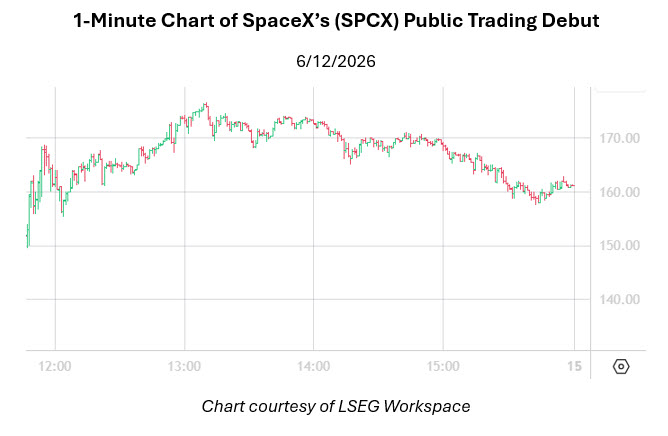
It Was Good Until It Wasn’t
Whispers of the impending IPO kicked off a surge in the broader aerospace and defense sector, with names such as AST SpaceMobile (ASTS), Intuitive Machines (LUNR), Rocket Lab (RKLB), and Virgin Galactic (SPCE) area charging to either annual or record peaks by late May. The rally didn’t last into this past Friday’s IPO, however, as SPCX’s peers all took a blow as investors turned their focus to the shiny bellwether. Regardless, the equities continue to sport impressive 2026 leads of 18.4%, 68.2%, 51.9%, and 31.7%, respectively.

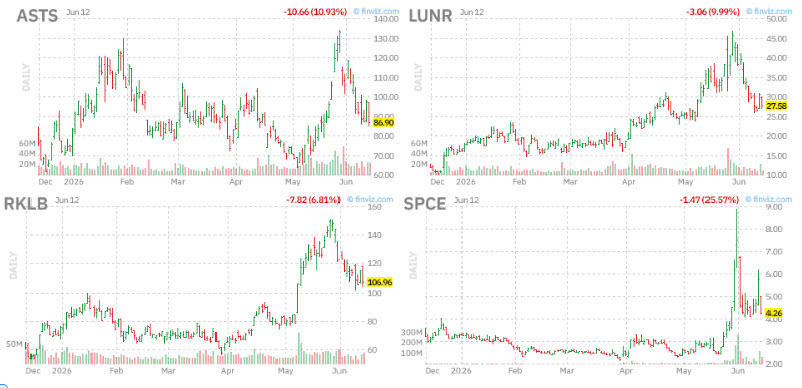
The Bad
It wasn’t all sunshine and rainbows on the path to IPO for SpaceX, with many voicing fears of the near- and long-term impacts a debut of this scale would have. Sen. Elizabeth Warren voiced a plea to delay the IPO to the Securities and Exchange Commission (SEC), citing governance and valuation concerns, saying the power imbalance was “uniquely unchecked.”
Plus, from a trader POV, the speedy launch is restricting the ability to sample size the stock’s activity and size. In other words, this leaves the possibility that Wall Street is entering the most challenging period for hedging in almost 30 years.
The Spacey Data
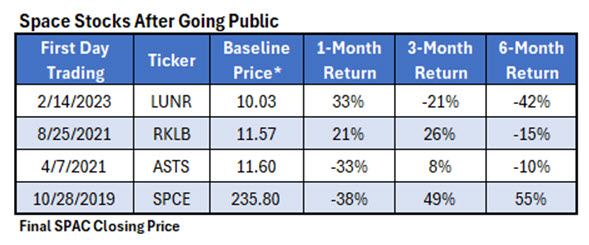
While it’s obvious this is an unprecedented IPO, looking at how the aforementioned space stocks fared after their respective debuts and SPAC launches can give us a longer-term outline of what we might expect trend-wise for SPCX. Schaeffer’s Senior Quantitative Analyst Rocky White pulled historic data covering the four space leaders in the first month, third month, and sixth month after debuting on the public market.
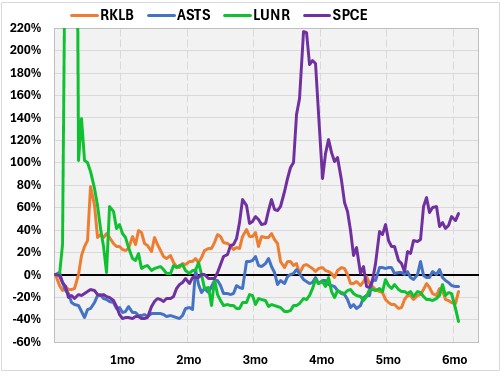
In order of public debut, Richard Branson’s SPCE set the precedent with a lofty surge of roughly 220% in the first six months of trading in 2019-2020, though it experienced a 38% drop in the first month before pivoting higher. While ASTS looked to be following a similar trend, hitting an 8% gain three months out, by the six-month mark it began pulling back.
It was much of the same after this, with both RKLB and LUNR starting on the up before turning in 15% and 42% deficits by the six-month mark. Regardless of this volatile price action while the aerospace stocks settled into the public market, the gaps began to settle into a more digestible pace, as shown in the second chart below.
We won’t pretend to have a crystal ball telling us what to expect in the long term from such an unprecedented, record-breaking public debut. But if historic data is any indication, investors are in for quite the ride with Musk’s latest endeavor. As of this writing, SPCX debuted at $150 per share, well above the anticipated $135, and was last seen up 30% at $175.88.
Mentioned In This Article
Latest News
| 9 min | |
| 10 min | |
| 20 min | |
| 22 min | |
| 24 min | |
| 26 min | |
| 26 min | |
| 26 min | |
| 28 min | |
| 39 min | |
| 41 min | |
| 51 min | |
| 53 min |
Elon Musk Can Build Terafab Faster Than Anyone, but Mass Production May Take Until 2030, Analyst Says
SPCX +10.47%
Benzinga Prediction Markets
|
| 1 hour | |
| 1 hour |
SpaceX Spikes As Analysts Hike Stock Targets. $1T Revenue Target 'Not Impossible,' Musk Says
SPCX +10.47%
Investor's Business Daily
|
