Retail's Big Q2 Beats Came From Washington, Not the Consumer
Four retailers reported Wednesday morning. All four beat expectations and raised guidance.
Yet a meaningful share of those profits arrived not from selling more to shoppers, but from a Supreme Court decision.
That is the single most important thing investors need to understand about this retail earnings season. The headline numbers look terrific. The underlying businesses are considerably more mixed. Both things are true at once, and telling them apart is now the whole job.
The $166 Billion Distortion
When the Supreme Court struck down the IEEPA tariffs on February 20th, it triggered one of the largest corporate cash windfalls in recent memory. Roughly $166 billion had been collected from some 330,000 importers, and approximately $100 billion had been refunded as of July 31st. Retailers are booking those refunds now, and the amounts are enormous and wildly uneven:
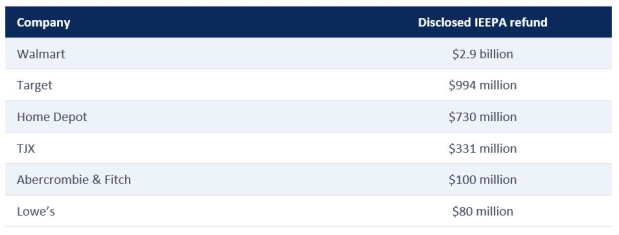
Image Source: Zacks Investment Research
Walmart’s is the largest disclosed by any U.S. company. Lowe’s, at $80 million, received roughly one-ninth of what Home Depot did. That unevenness is precisely why cross-retailer margin comparisons this quarter are close to meaningless unless you normalize for it.
Abercrombie Shows Exactly How Much It Matters
Abercrombie & Fitch ANF deserves credit for the cleanest disclosure of the season. The company reported record second-quarter net sales of $1.27 billion, up 5%, and earnings of $4.17 per diluted share against a Zacks Consensus Estimate near $1.95. On its face, that translates to a 114% beat.
Except management specified that the IEEPA refund contributed approximately $100 million pre-tax, or $1.75 per diluted share. Back that out and underlying EPS is roughly $2.42 — still a genuine beat of about 24%, but a fundamentally different number.
The margin math tells the same story. Operating margin of about 20% included roughly 790 basis points from the refund. Ex-refund, it lands near 12% against 17.1% a year ago. And comparable sales were flat. Record revenue came from new stores and new geographies, not from existing stores selling more. Still, the stock soared more than 30% in early trading on Wednesday morning.

Image Source: StockCharts
One Retailer Didn’t Need the Help
Williams-Sonoma WSM was the standout, and for the right reasons. Comparable brand revenue rose 6.2%, accelerating from 4.8% last quarter, with total revenue up 6.7% and every brand positive. Management raised its full-year outlook. Non-GAAP EPS of $2.10 topped the $2.05 consensus.
That result is genuinely surprising. Home furnishings should be suffering alongside the home-improvement retailers, where Home Depot managed a 1.7% comp and Lowe’s just 0.2%. Williams-Sonoma is instead compounding, which argues the affluent consumer remains healthy and that execution can overcome a frozen housing market.
Kohl’s KSS beat handily on earnings, with EPS of $1.28 against roughly $0.55 expected, improved free cash flow margin, and raised guidance. Operating margin was flat year over year at 7.4% and the top line is still shrinking — investors read the beat as cost control, not demand recovery.
Bath & Body Works BBWI beat and raised despite net sales declining 2.3% to $1.51 billion, with adjusted EPS of $0.62 and operating income up to $216 million from $157 million. Management was refreshingly blunt: “Underlying business trends remain pressured.”
What the Consumer Data Actually Says
The macro releases framing these results point in the same direction. Tuesday’s Conference Board index fell to 89.4, its lowest since January, but the internals split sharply: the Present Situation Index rose 6.8 points to 121.2 — its first improvement in four months — while Expectations fell 5.8 points to 68.2, further below the level historically associated with recession risk.
Consumers feel better about today and worse about tomorrow. That is a precise description of defensive spending: keep buying, trade down, defer anything large.
Wednesday’s core PCE rose 0.2% month over month, in line with forecasts. On an annual basis, core hold near 3.3% against the Fed’s 2% target. Prices are still rising faster than consumers believe their incomes will.
The retail data corroborates it. Growth has shifted from price-led to volume-led — driven by units rather than inflation. Traffic is rising at the largest, cheapest operators while ticket has stalled almost everywhere: up 1.1% at Walmart, roughly flat at Target, and down 2.5% at Sam’s Club.
Bottom Line
For investors, three conclusions follow. First, normalize everything. Any Q2 retail margin or EPS comparison that ignores tariff refunds is measuring the refund, not the business.
Second, watch what retailers do with the money. Walmart is putting its $2.9 billion into price rollbacks across food, general merchandise, consumables, and fashion; Target has committed to continued price investment. That is competitively rational and margin-dilutive — meaning the windfall converts into future price cuts rather than future earnings. It also intensifies pressure on mid-tier retailers with no comparable lever.
Third, the durable winners are the ones that didn’t need the help. Williams-Sonoma’s accelerating comps and Sam’s Club’s 7% transaction growth reflect real demand. Abercrombie’s flat comps and Kohl’s shrinking top line do not.
The consumer here is employed, still spending, and increasingly disciplined — defensive, not fragile. That environment rewards scale, price authority, and genuine traffic growth. One-time refunds flatter a quarter. They don’t change the trend.
Want the latest recommendations from Zacks Investment Research? Today, you can download 7 Best Stocks for the Next 30 Days. Click to get this free report
Kohl's Corporation (KSS): Free Stock Analysis Report
Abercrombie & Fitch Company (ANF): Free Stock Analysis Report
Williams-Sonoma, Inc. (WSM): Free Stock Analysis Report
Bath & Body Works, Inc. (BBWI): Free Stock Analysis Report
This article originally published on Zacks Investment Research (zacks.com).
Mentioned In This Article
Latest News
| 11 hours | |
| 12 hours | |
| 21 hours | |
| Oct-23 | |
| Oct-23 | |
| Oct-23 | |
| Oct-22 | |
| Oct-21 | |
| Oct-20 | |
| Oct-20 | |
| Oct-19 | |
| Oct-15 | |
| Oct-14 | |
| Oct-09 | |
| Oct-09 |
