Why We're Watching the Caterpillar Stock Pullback
Subscribers to The Contrarian Edge received this commentary on Saturday, August 30.
Without looking, could you name the best-performing Dow Jones Industrial Average (DJI) stock in the last 12 months? Maybe your first answer is Alphabet (GOOGL), or if recency bias is your thing, its Merck (MRK) after its massive breakthrough with Moderna (MRNA). Cisco Systems (CSCO) has also had quite the 2026.
All of those answers would be wrong.
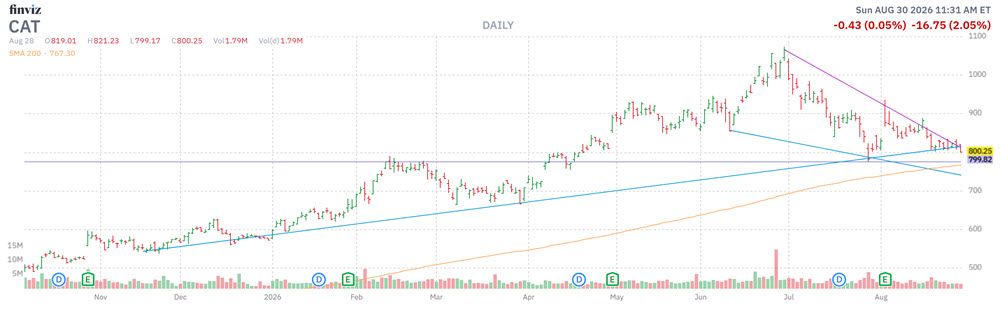
It’s machinery giant Caterpillar Inc (NYSE:CAT), with an 85% year-over-year gain. At the halfway point of the year, Caterpillar stock was also the best-performing blue chip across year to date, hitting a record high of $1,073.46 on June 30. The third quarter has not been kind to CAT though; the shares have taken a 25% haircut since that peak. With one month left in Q3, the stock is heading for its worst quarterly performance since September 2011.
That could be a very good thing for contrarian traders.
Although Caterpillar is ceding its ‘top Dow stock’ status to MRK for 2026, it means less eyes on the industrial staple. That’s ideal for a trader trying to dodge the noisy, often volatile trends, the trader that shrewdly steps in when cyclical outperformers pull back.
September is a historically bullish month for CAT. Per Schaeffer’s Senior Quantitative Analyst Rocky White, CAT is one of the 25-best stocks to own in September on the S&P 500 Index (SPX) in the last 10 years. The stock averages a 3.6% return next month, historically, with a 70% monthly win rate. No other blue chip appears on the list with a positive average return.
The Q3 drawdown only breached the psychologically-significant, round-number $800 level once on a closing basis. And since that retest on July 30, $800 has stepped up as a solid floor. Back in February, $800 was a ceiling for a month, if you’re into the ‘resistance-turned support’ angle.
If there were to be more September outperformance, it could embolden analysts. Of the 23 analysts covering CAT, 12 are on the sidelines with tepid “hold” ratings. There’s also skepticism among options traders, where Caterpillar’s 50-day put/call volume ratio of 1.82 at the International Securities Exchange (ISE), Cboe Options Exchange (CBOE), and NASDAQ OMX PHLX (PHLX) is just one percentage point from a 52-week high.
As of Friday, the most active contract was the September 970 call, though there are new positions being bought to open at the weekly 9/4 780-strike put. Looking ahead, the 875-strike call in the same standard September series is the top open interest position, though the weekly 9/4 790-strike put has seen the largest buildup in open interest among upcoming contracts.
The options activity is interesting because Caterpillar’s overall stock volume is low, in the 2nd percentile of its 52-week range. It’s average volume of 3.2 million shares is 25th amongst the Dow 30. For comparison purposes, Nvidia’s average volume sits at 141.8. However, options volume in relation to stock volume sits at 2.53, and in the 99th percentile.
Maybe premium buyers are aware CAT has tended to outperform volatility expectations in the past year, as suggested by its Schaeffer's Volatility Scorecard (SVS) of 82 out of 100.
In the event of a September slump, there’s a trendline to watch. Just below $800 is CAT’s 200-day moving average. Historically, the last eight pullbacks to this trendline have yielded an average 4,3% return one month later, with a 75%-win rate.
The major catalyst behind CAT’s year-over-year gains has been the ‘picks-and-shovels’ play associated with the AI infrastructure buildout. Caterpillar and its peers are tangentially connected to the likes of Nvidia, Micron, without the inherent and obvious risks.
Let’s not forget, stock gapped up by 5.6% on Aug. 4 after Caterpillar’s stellar second-quarter earnings report. The beat-and-raise was driven by the rabid demand for AI data center construction and the equipment needed to power them. While the shares have since filled that gap to the downside, the impact of their fundamentals remains.
All of the lucrative AI trade potential, without the outright exposure.
But it’s also left names like Caterpillar vulnerable to the kind of profit-taking pullbacks we’re seeing right now. Even though industrials and AI have six degrees of separation, the former is still dependent on the latter. The industrial exchange-traded fund (ETF) State Street Industrial Select Sector SPDR (XLI) is heading for back-to-back monthly losses for the first time since February 2025.
As long as you believe the AI buildout has long-term sustainability, then someone has to break the ground. With bullish seasonality, technical support, and solid fundamentals all in place, contrarians should be welcoming the CAT pullback with open arms and be glad they no longer get the attention-drawing distinction of top Dow stock.
Mentioned In This Article
Latest News
| Oct-12 | |
| Oct-12 | |
| Oct-12 | |
| Oct-12 | |
| Oct-12 | |
| Oct-12 | |
| Oct-12 | |
| Oct-12 | |
| Oct-12 | |
| Oct-12 | |
| Oct-12 | |
| Oct-12 | |
| Oct-12 | |
| Oct-12 | |
| Oct-12 |
