Rejoice! The Summer Stock Slump is Over
“The Longer the Base, The Higher in Space”
The longer the base, the higher in space” is a classic Wall Street stock market adage meaning that an extended period of price consolidation leads to a larger and stronger price move when a breakout finally occurs. A long base structure serves several purposes. It shakes out and frustrates weak shareholders, builds energy, and, when it breaks out, removes overhead selling supply. Gold is a fantastic example of this phenomenon. In late 2024, gold broke out of a massive, 14-year base. The Gold ETF (GLD) would double in less than two years.
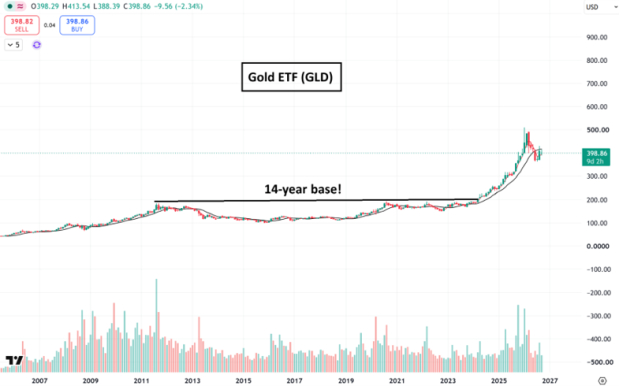
Image Source: TradingView
After consolidating in a long, frustrating base through the summer, the Nasdaq 100 Index ETF (QQQ) is threatening to break out of a more than three-month-long base structure. If QQQ can break and hold above the June 3rd, 2026 highs ($748.65), the Fibonacci extension suggests traders can look for an $800 target on QQQ.
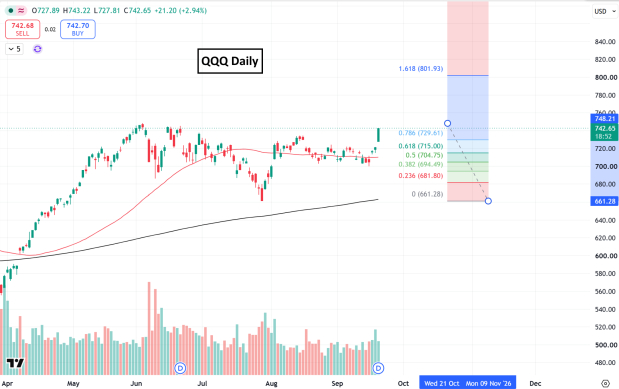
Image Source: TradingView
Mid-Term Election Cycle Seasonality Flips Bullish
Thus far in 2026, the market has been closely following historical mid-term election cycle seasonality trends. Historically, stocks rally in the first quarter, then consolidate in the summer as money managers take vacations, and investors reduce risk ahead of election uncertainty. However, investors who have preserved capital through the summer may be in for a treat. According to Ryan Detrick (@RyanDetrick) of Carson Investment Research, “October has been the best month in midterm years historically and November the second best.” Since 1950, the S&P 500 Index has delivered returns in each month ~70% of the time, with October’s average gain 3% and November’s average gain 2.7%.
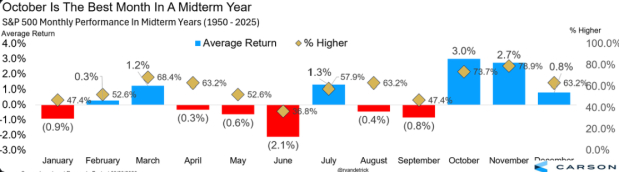
Image Source: Carson Investment Research
Oil: False Breakout
Soaring energy prices have acted as the proverbial “pebble in the shoe” for equity markets. Earlier this month, the United States Oil Fund ETF (USO) broke out of a three-month base. However, the breakout quickly failed, with USO falling in five consecutive sessions.
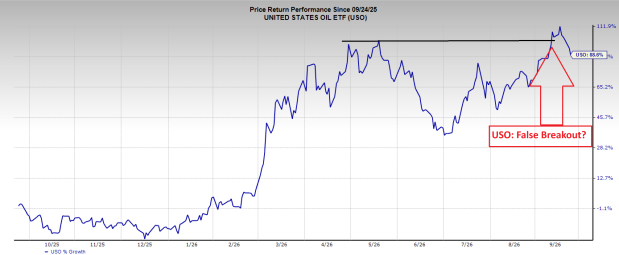
Image Source: Zacks Investment Research
An old Wall Street adage suggests that “From false moves come fast moves.” Meanwhile, on Tuesday, a deep-pocketed trader began selling call options in USO. Call selling can be a stronger tell for investors than put buying because it indicates that smart money is willing to take on more risk. This week, the President of Iran is in New York for the first time since the start of the war. Is a deal imminent?
Micron Earnings Loom
Micron (MU) has been one of the leading artificial intelligence names of the current cycle. The AI hardware provider will report earnings next week that could act as a catalyst for the tech sector. Although MU stock is off its recent highs, its earnings track record has been spotless lately, with the company beating Zacks Consensus Analyst Estimates in 13 consecutive quarters.
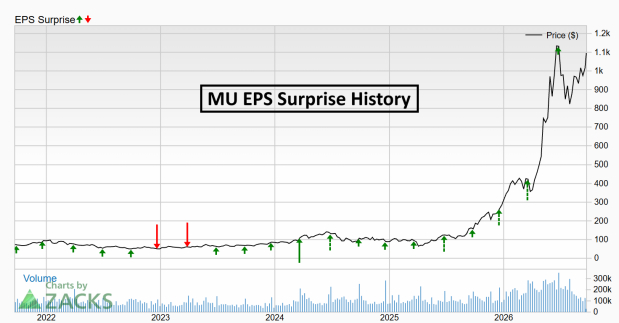
Image Source: Zacks Investment Research
Meanwhile, after plummeting due to AI fears, software names like Twilio (TWLO) have recovered and are printing fresh highs.
Bottom Line
As the summer chop fades and historical tailwinds align, patient investors who weathered the consolidation phase are well-positioned to capitalize on fourth-quarter strength.
Want the latest recommendations from Zacks Investment Research? Today, you can download 7 Best Stocks for the Next 30 Days. Click to get this free report
Micron Technology, Inc. (MU): Free Stock Analysis Report
Invesco QQQ (QQQ): ETF Research Reports
SPDR Gold Shares (GLD): ETF Research Reports
United States Oil ETF (USO): ETF Research Reports
Twilio Inc. (TWLO): Free Stock Analysis Report
This article originally published on Zacks Investment Research (zacks.com).
Mentioned In This Article
Latest News
| 1 hour | |
| 1 hour | |
| 1 hour | |
| 1 hour | |
| 1 hour | |
| 2 hours |
China's CXMT Sparked a Global Chip Stock Rout. Why Samsung, Micron and SK Hynix Are Tumbling.
MU
International Business Times
|
| 2 hours | |
| 2 hours | |
| 3 hours | |
| 4 hours | |
| 4 hours | |
| 4 hours | |
| 5 hours | |
| 5 hours | |
| 5 hours |
