Meta Muse: Sparking the AI Revolution
The Four Waves of the AI Revolution
According to NVIDIA’s (NVDA) iconic CEO Jensen Huang, there are four waves of the artificial intelligence revolution:
1. Perception AI (2012): Started over a decade ago. Focused on core recognition tasks like speech recognition and image classification.
2. Generative AI: Dominated recent years and characterized by large language models like OpenAI’s ChatGPT and Alphabet’s (GOOGL) Gemini that generate text, code, and images based on predictive patterns.
3. Agentic AI (Entering this Phase Now): Enables models to reason, plan, and perform complex multi-step tasks independently.
4. Physical AI (likely to be in 2027/2028): The next major industrial revolution. Integrates AI into real-world applications, advanced automation, and human-like robots that understand the laws of physics.
What is Agentic AI?
Agentic AI refers to artificial intelligence systems that can act independently to achieve multi-step goals without human supervision. Investors can think of agentic AI applications as the technology equivalent of a personal assistant. Unlike traditional chatbots that only answer single prompts, agentic AI has agency. It breaks user’s request into small steps, creates plans, uses tools (like external websites or APIs), and adapts to new information to complete an entire workflow on its own.
Real-World Agentic AI Examples
Imagine that you want to book the cheapest one-way flight from New York to London. Rather than manually searching through numerous websites, you can prompt an agentic AI application to do the work for you. Once the flight is found, the user merely has to confirm payment. Agentic AI can also be used in corporate settings. For instance, an e-commerce company can leverage agentic AI to conduct refunds. With clear rules, the AI system can decide whether a refund is allowed, process it automatically, update the in-house database, and create a shipping label. Agentic AI can even help financial companies to scan for fraud, automate loan approvals, and handle compliance checks.
Meta Launches “Muse” Personal AI Assistant
On September 8th,tech giant Meta Platforms (META) launched “Muse”, its first personal AI agent. Muse uses built-in intelligence to browse the internet and connect users to their favorite applications, like travel website Expedia (EXPE) or Google’s Gmail.
Muse Dethrones ChatGPT
Over the past few months, the number of AI product launches has been dizzying as tech companies look to cash in on the hype surrounding Wall Street’s hottest industry, artificial intelligence. In September alone, OpenAI expanded the “GPT-6” universe, Anthropic released “Claude Opus 5.5,” xAI launched “Grok 4.7,” and Google updated its family of applications. However, Meta’s “Muse” launch is arguably the most significant application release thus far in the AI revolution. In fact, within just a handful of days, Muse jumped to #1 on the Apple (AAPL) App Store and Google Play. Meanwhile, according to Apptopia app analytics, Meta reached 1.1 million installs roughly 10 days after launch, surpassing ChatGPT’s 2022 launch. For context, before the Muse launch, ChatGPT was the fastest-growing consumer application in history.
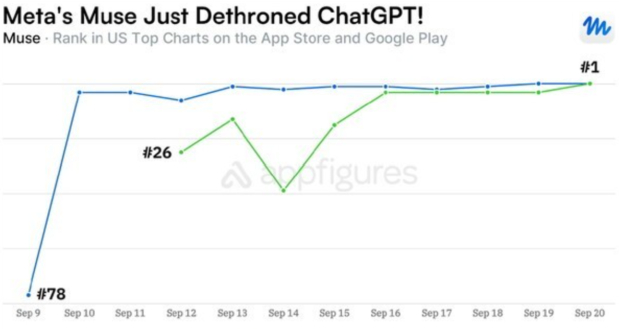
Image Source: Zacks Investment Research
Mark Zuckerberg is Vindicated
The business community widely recognizes Meta founder and CEO Mark Zuckerberg for his high-stakes, forward-looking business strategy. Zuck’s business acumen perfectly embodies hockey legend Wayne Gretzky’s famous philosophy:
“Skate to where the puck is going to be, not where it has been.”
For instance, Zuckerberg understood the threat of mobile-first, photo-centric social media platforms. In 2012, he shelled out $1 billion for Instagram. At the time, critics scoffed at a $1 billion purchase for an app with fewer than 20 employees. Today, Instagram is worth between $250 and $350 billion. Two years later, Zuckerberg saw that the future of global communication belonged to lightweight, cross-platform messaging networks. Zuckerberg paid a mind-boggling $19 billion for “WhatsApp,” outbidding Google. Today, WhatsApp boasts 3.3 billion global monthly active users and is valued at well over $100 billion.
Despite the impressive track record, Zuckerberg and the Meta team still have their fair share of doubters. In fact, Meta shares have traded in a sloppy, frustrating price consolidation for two years.
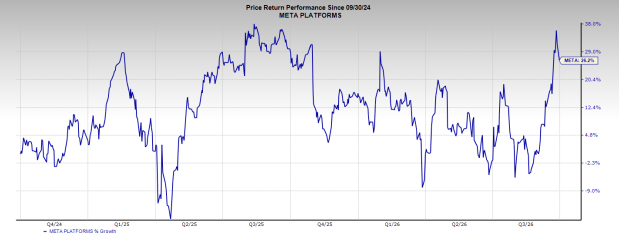
Image Source: Zacks Investment Research
However, investors are finally catching on to the potential of Meta’s AI ambitions. In September, Meta shares jumped more than 25%, marking its largest monthly gain in over a decade.
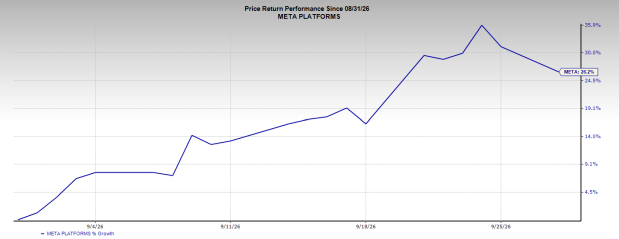
Image Source: Zacks Investment Research
In 2026, Meta spent more than $100 billion on its AI investments. In fact, Meta even poached top AI talent from industry peers for a cool $100 million. The enormous spending has created fear, uncertainty, and doubt across Wall Street. That said, Muse should dispel that fear. That fear has led to a reasonable 25x P/E ratio for Meta shares.
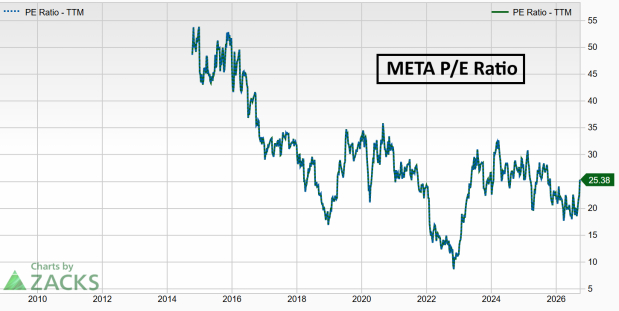
Image Source: Zacks Investment Research
Wall Street Analysts Will Need to Play Catch-Up
Despite the fact that Meta just had the most successful AI launch in history, most Wall Street analysts have not raised their earnings revisions to reflect that success. Actually, more analysts tracked by Zacks Investment Research have lowered their targets for next quarter over the past 60 days.
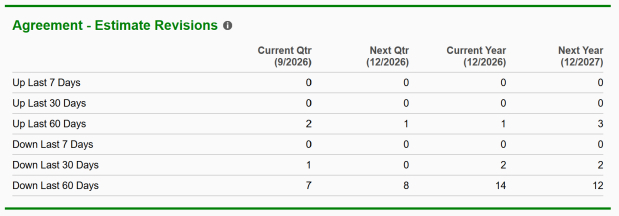
Image Source: Zacks Investment Research
Meta Aims at Enterprise Market
Last week, MongoDB (MDB) CEO CJ Desai jumped ship to run Meta’s enterprise platform business, underscoring that Meta has a “rare advantage” across models, infrastructure and agents. Zuckerberg commented that:
“We believe superintelligence will create significant new opportunities for all people and businesses. Meta already serves billions of people at scale and helps hundreds of millions of businesses reach customers. Today we are starting the next major pillar of our business, Meta Enterprise Platform, to help businesses use AI to grow and transform in new ways as well. Meta Enterprise Platform will use our strengths that few other companies have: advanced models, leading agents, large-scale infrastructure, and years of working closely with many businesses. Initially, we will focus on bringing our full technology stack, including the Muse agent, Meta Business Agent, Muse API, Muse Code, and more to businesses and developers to help them grow.”
Meta’s move into the enterprise market is a brilliant one. Enterprise customers not only have deeper pockets, but they also tend to be stickier clients. According to The Business Research Company, the enterprise AI market will grow from ~$40 billion in 2026 to ~$164 billion by 2030, which assumes a juicy compound annual growth rate (CAGR) of 42%.
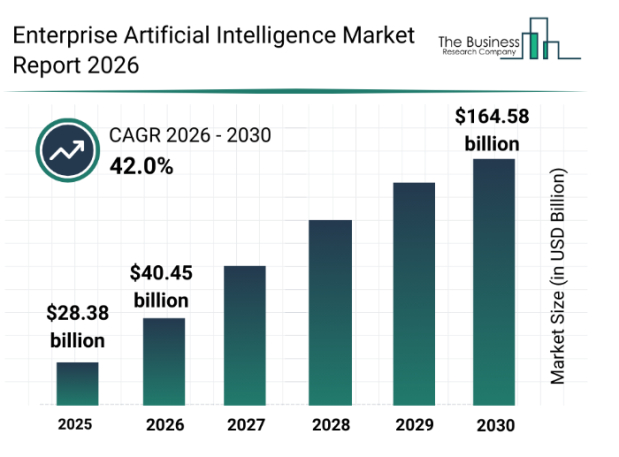
Image Source: The Business Research Commpany
Meta Price Target
If Meta shares can break out of the current multi-year base, the Fibonacci extensions suggest a target of $1,000 per share by the end of next year is reasonable.
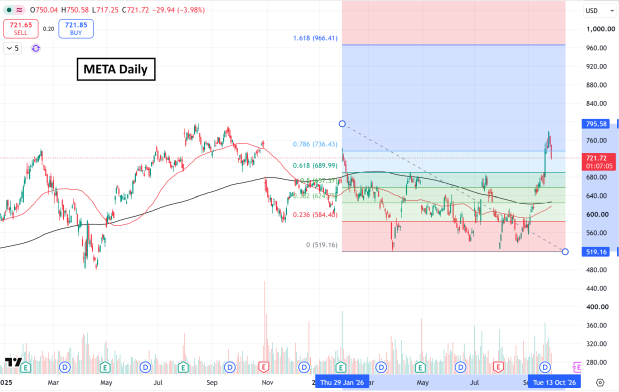
Image Source: TradingView
Bottom Line
As Meta bridges the gap between consumer-facing autonomy and high-value enterprise utility, the broader market is only beginning to wake up to what is happening. Backed by a robust technology stack, record-breaking adoption metrics, and massive long-term vision, Meta has positioned itself at the epicenter of the agentic revolution. For investors willing to look past near-term spending anxieties, the launch of Muse may well be remembered as the catalyst that sent Meta shares to $1,000.
Want the latest recommendations from Zacks Investment Research? Today, you can download 7 Best Stocks for the Next 30 Days. Click to get this free report
Apple Inc. (AAPL): Free Stock Analysis Report
NVIDIA Corporation (NVDA): Free Stock Analysis Report
Expedia Group, Inc. (EXPE): Free Stock Analysis Report
Alphabet Inc. (GOOGL): Free Stock Analysis Report
MongoDB, Inc. (MDB): Free Stock Analysis Report
Meta Platforms, Inc. (META): Free Stock Analysis Report
This article originally published on Zacks Investment Research (zacks.com).
Mentioned In This Article
Latest News
| 57 min | |
| 1 hour | |
| 1 hour | |
| 2 hours | |
| 2 hours | |
| 2 hours | |
| 3 hours | |
| 4 hours | |
| 5 hours | |
| 5 hours | |
| 5 hours | |
| 5 hours | |
| 5 hours | |
| 6 hours | |
| 6 hours |
