Hancock Whitney Edges Past Consensus But Misses Whisper As Raised NII Guidance Comes At A Capital Cost
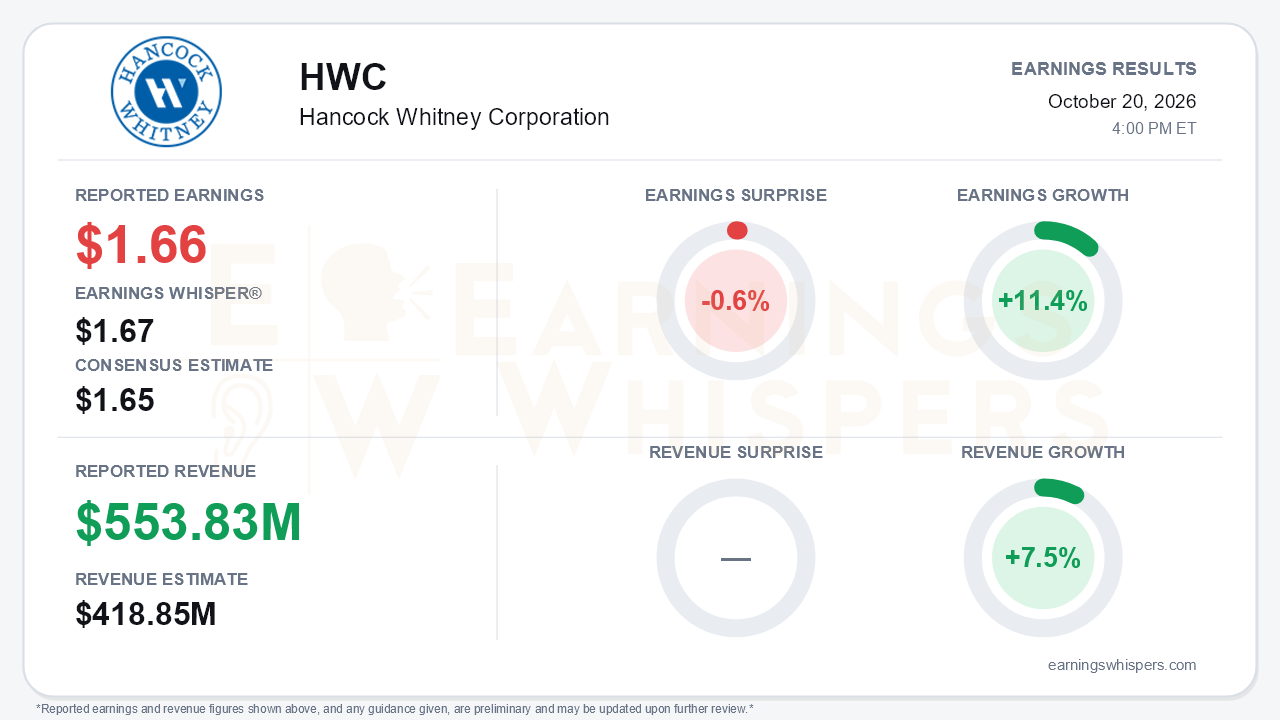
Hancock Whitney's third quarter delivered a better core earnings engine than its headline suggests, but the bank paid for it in capital flexibility. Adjusted EPS of $1.66 beat the $1.65 consensus by a penny. It fell short of the $1.67 Earnings Whisper number, a 0.6% miss against that bar. Earnings grew 11.4% year over year, revenue rose 7.5% to $553.83 million, and revenue came in 32.2% above the $418.85 million consensus. Sequentially, the trend is clearly improving: adjusted EPS climbed from $1.52 in the first quarter to $1.55 in the second and $1.66 now. The central tension is that this acceleration arrived alongside a sharp drop in tangible capital, a paused buyback, rising deposit costs and slowing organic loan growth.
The gap between GAAP and adjusted results is large enough to matter. GAAP EPS was $1.36, down from $1.55 in the prior quarter, after $30.4 million of pretax charges, or $0.30 per share, tied to the August 1 close of One Florida Bank. Stripping those out, the operating picture was solid:
- Net interest income rose 7% sequentially to $314.9 million, versus 3% growth in the second quarter.
- Adjusted PPNR increased 6% to $189.3 million.
- The efficiency ratio improved 85 basis points to 54.46%.
The quality of the margin story deserves scrutiny, however. NIM rose 5 basis points to 3.61%, but purchase accounting accretion from OFB contributed 4 of those points. Better earning-asset yields and mix added 8 basis points, and higher deposit costs took away 8. Fee income slipped $1.4 million as mortgage, trust and investment revenue softened.
The call made the deceleration beneath the deal math explicit. Organic loan growth slowed to 4% annualized from 10% in the second quarter, even as reported loans jumped $2.0 billion, $1.7 billion of which came from OFB. Organic deposit growth was healthier at 9% annualized. That growth was bought partly through promotional pricing: deposit costs rose 12 basis points to 1.55% after falling 4 basis points last quarter, and management guided to a similar or slightly larger increase in the fourth quarter. That exceeds the roughly 10-basis-point second-half rise it had signaled in July. The noninterest-bearing mix is also drifting lower, and OFB brings a mix of only about 22%. Credit was mixed. Criticized commercial loans fell for a seventh straight quarter to $485.3 million, and net charge-offs held at 16 basis points. Nonaccruals, however, rose $19.6 million to $133.3 million.
The forward story is better than the capital story. Management raised full-year NII growth, including OFB, to 9-9.5% from 8-9% and PPNR growth to 8-8.5% from 7-8%. It also guided to another 3-5 basis points of NIM expansion in the fourth quarter. The rate backdrop has flipped from two assumed cuts to a December hike, which favors what management calls a modestly asset-sensitive balance sheet. Roughly $300 million of bond cash flows yielding below 4% is being reinvested above 5.5%. On the organic side:
- Data center, industrial and SpaceX-related investment in Louisiana and Mississippi is supporting growth.
- The new-banker program drove 77% of third-quarter loan growth.
- OFB's HOA banking vertical is being rolled out across the footprint.
Against that, fee growth guidance was trimmed to 5.5-6% from 6-7%, and the net new banker count of 38 trails the 42 cited last quarter.
Bears have legitimate ammunition on capital. The TCE ratio fell 173 basis points to 8.05%, just above management's 8% internal floor. The drop came from the OFB cash price, AOCI losses as the 10-year Treasury rose 82 basis points, and buybacks. Tangible book value per share fell from $42.95 to $37.83. The remaining one million shares of authorization are now paused, reversing the plan to exhaust the program. Management also flagged client unease over energy costs and inflation, warning that a larger 50-100 basis-point hike could dampen loan production.
Investors were already leaning cautious. Earnings Whispers sentiment weakened from -0.08 to -0.19, a meaningful but not dramatic move deeper into negative territory. Shares at $72.50 are down 5.3% since the open after the July report and sit 9.5% below the $80.13 52-week high set in mid-August. The stock rebounded 10.7% off its October 14 low of $65.47 and entered the print 2.7% above its 200-day moving average. Trend readings are mixed, with momentum positive but AVWAP still negative.
The bottom line is that Hancock Whitney raised the outlook that matters most for a bank, net interest income, while the quarter exposed costs that the whisper-level miss only hints at. Higher funding costs, slowing organic loans, a buyback pause and a TCE ratio near its floor mean further upside likely depends on executing the OFB integration and rebuilding capital rather than on margin expansion alone.
Read our earnings preview for Hancock Whitney Corporation: https://www.earningswhispers.com/article/HWC/20404
This earnings review was originally published on Earnings Whispers.
This article is for informational purposes only and is not investment advice. Earnings Whispers and its staff may hold positions in the securities mentioned. It was generated automatically, with the help of AI, from Earnings Whispers and company data, and checked by Earnings Whispers before publication.
Mentioned In This Article
Latest News
| Oct-20 | |
| Oct-20 | |
| Oct-20 | |
| Oct-20 | |
| Sep-22 | |
| Aug-03 | |
| Jul-30 | |
| Jul-22 | |
| Jul-22 | |
| Jul-21 | |
| Jul-21 | |
| Jul-20 | |
| Jun-23 | |
| May-18 | |
| May-15 |
