Microsoft's Promised Jump To 45% Azure Growth Faces Its First Real Test
Microsoft heads into its fiscal first-quarter report with something it rarely offers: a specific, aggressive number to hit. Last quarter management guided Azure to roughly 45% constant-currency growth, a sharp step up from the 39% it just delivered. That target caps a steady climb in guidance over the past year, and it is the reason the stock has rallied. If Azure lands at or above that mark, the AI story moves from promise to proof. If it falls short, the market will start asking whether the acceleration was real or just optimistic forecasting.
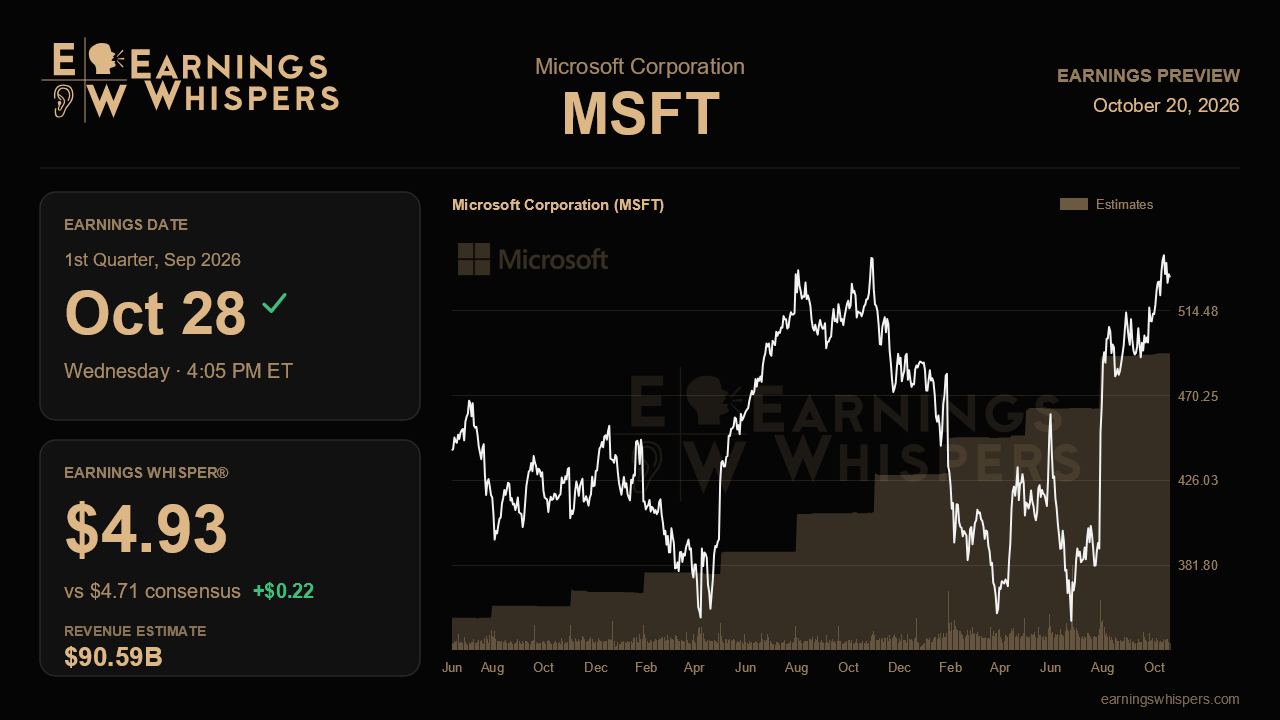
The headline numbers look set up for a clean print. Analysts expect earnings of $4.71 a share on revenue of $90.59 billion, which would be growth of 14% and 16.6% from a year earlier. That is strong growth for a company of this size. The EPS consensus sits almost exactly at the midpoint of management's $4.63 to $4.78 range. The revenue estimate leans toward the upper half of the $89.85 billion to $90.95 billion outlook. The more telling figure is the Earnings Whisper of $4.93. That sits well above consensus and above the top of company guidance, so the market's real bar is a beat that clears management's own range. One caveat on quality: Microsoft is extending the useful life of its data centers and office buildings from 15 to 25 years starting this fiscal year. That should ease depreciation, so part of any earnings upside may come from accounting rather than operations.
Beyond Azure, the call laid out several newer catalysts that this quarter should start to confirm. M365 Copilot paid seats jumped from 20 million to more than 30 million in a single quarter. Another strong increase would suggest the new E7 suite, anchored by EY's 400,000-seat deployment, is spreading beyond a handful of marquee buyers. Management is also pushing a model that charges per seat and then adds usage fees, already visible in GitHub Copilot's billing change. Signs that consumption revenue is stacking on top of seat growth would support the idea that AI can expand average revenue per customer rather than simply replace existing spending. Commercial remaining performance obligations reached $678 billion. Investors should look past the total to growth excluding OpenAI, which was 25% last quarter, because concentration in a single frontier customer remains the backlog's main weakness.
The soft spots are known, and the question is whether they stay contained. Windows OEM and devices revenue is guided down in the low 20s on weak PC demand and rising component costs. More Personal Computing revenue is expected at just $12.2 billion to $12.7 billion, and Xbox is still being reset. Dynamics 365 growth slowed from 22% to 13%, and further slowing would hint that longer sales cycles are spreading. Margins are the bigger swing factor. Company gross margin slipped to 67% and Microsoft Cloud gross margin to 65% as AI infrastructure scaled. With capital spending heading toward roughly $175 billion for calendar 2026, free cash flow and the return on that spending will get as much attention as revenue.
The market has already paid for much of the good news. Shares are up 21.8% since the last report, beating the S&P 500 by nearly 18 percentage points. They trade well above their 200-day moving average and sit about 3% below the post-earnings high of $551.15. Sentiment has improved from more bearish levels a quarter ago but remains mildly negative, a sign that some skepticism about AI costs lingers even as the stock climbs.
In the end, this report comes down to whether Azure delivers the 45% growth management promised while gross margins hold steady rather than slide again. Hitting both would show that Microsoft's huge AI spending is turning into profitable growth. Strong Azure growth paired with weaker margins would keep the debate about capital spending returns alive, even if earnings beat the estimate.
This earnings preview was originally published on Earnings Whispers.
This article is for informational purposes only and is not investment advice. Earnings Whispers and its staff may hold positions in the securities mentioned. It was generated automatically, with the help of AI, from Earnings Whispers and company data, and checked by Earnings Whispers before publication.
Mentioned In This Article
Latest News
| 32 min | |
| 2 hours | |
| 8 hours | |
| Oct-20 | |
| Oct-20 | |
| Oct-20 | |
| Oct-20 | |
| Oct-20 | |
| Oct-20 | |
| Oct-20 |
Microsoft Stock Strength Sets Up Strategy For A Fast Double-Digit Return
MSFT
Investor's Business Daily
|
| Oct-20 | |
| Oct-20 | |
| Oct-20 | |
| Oct-20 | |
| Oct-20 |
