Bridgewater Bancshares Beats On Record PPNR, But Rising Rates Force A Lower Loan-Growth Outlook And Higher Credit Costs
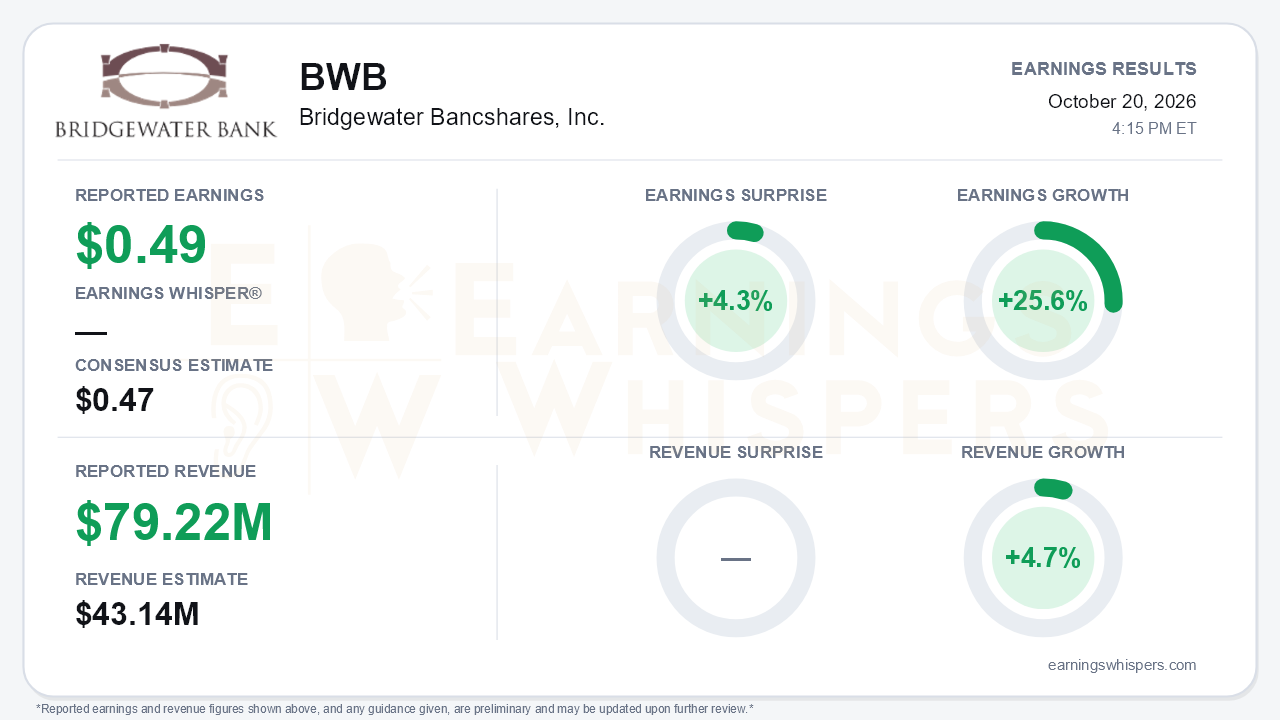
Bridgewater Bancshares delivered its cleanest operating quarter in years, then told investors the next few quarters will be harder. The Minneapolis-area lender earned $0.49 per diluted share in the third quarter, beating the $0.47 consensus by 4.3%. Earnings grew 25.6% from a year ago and rose from $0.45 in the second quarter. Pre-provision net revenue reached a record $21.9 million, up from $19.0 million sequentially, and the efficiency ratio fell to 48.8%, its first sub-50% reading since early 2023. That is the central tension: execution is improving even as management cut its loan-growth outlook and guided credit costs higher in response to a shift toward rising interest rates.
The quality of the beat holds up better than many bank beats do, though it was not flawless. First-quarter GAAP EPS of $0.58 included a $7.3 million securities gain. On an adjusted basis, EPS has climbed steadily from $0.41 to $0.45 to $0.49, so core earnings power is genuinely accelerating. Net interest income rose $2.1 million sequentially to $40.7 million, and expenses fell about $0.6 million. Two items cut in opposite directions. Provision expense jumped to $2.75 million from $550,000, absorbing much of the operating gain. A lower 21.5% tax rate, tied to tax-exempt municipal bond purchases, gave earnings a lift. The reported revenue figure also needs context. The $79.22 million total reflects gross interest income plus fee income, while the $43.14 million consensus appears to be built on a net-revenue basis. Net operating revenue of $43.2 million was essentially in line, so the 83.6% revenue surprise is largely a definitional artifact rather than a true blowout.
The call explained what improved beneath the surface. Core deposits grew $165 million, roughly 20% annualized, after shrinking in the second quarter. Noninterest-bearing deposits rose $63 million, and brokered funding fell $96 million. That funding rebound allowed loan growth to accelerate to 7.2% annualized from 5.4%. Net interest margin edged up to 3.09%, extending a climb from 2.75% at the end of 2025 and clearing management's original goal of 3% by year-end. New loans are being written in the mid-6% range, against $697 million of fixed-rate loans maturing at 5.70%, so back-book repricing still has room to run. Management's tone was its most upbeat of the year, calling the period an "incredibly strong quarter."
The forward guidance tells a less comfortable story. The loan-growth outlook has stepped down all year, from high single digits to mid-to-high single digits and now to mid-single digits, because higher rates mean fewer deals pencil out. The margin outlook moved from further expansion to "relatively stable." Management's case for stability rests on variable-rate loans, which now make up 26% of the book versus 15% two years ago, to offset about $1.6 billion of rate-sensitive deposits. Credit is the clearer pressure point. A $2.4 million charge-off on a $10 million mixed-use multifamily loan lifted net charge-offs to 0.21% annualized from 0.04%. The specific reserve on a downtown office loan rose to $5.3 million, with some of it expected to become charge-offs, and fourth-quarter provision is guided above the third quarter's level. Watch-list loans did fall by roughly half from year-end, which argues against broad deterioration. Still, bears have legitimate ammunition in a CRE-heavy book facing higher rates and in credit-union competition for short-term CDs.
Capital moved the wrong way despite the earnings growth. Tangible book value per share slipped to $16.33 from $16.61, and tangible common equity fell to 8.16% from 8.62% as unrealized securities losses widened. The company made no share repurchases in the quarter. Regulatory capital edged up, with CET1 at 9.63%.
The market setup is more complicated than the surprise implies. Investor sentiment remained negative but improved meaningfully, rising from -0.51 to -0.35. The stock, however, has gone essentially nowhere. Shares at $20.61 are down 0.8% from the open after the July report, even as adjusted EPS rose and the margin expanded. The stock sits about 5% above its $19.60 200-day moving average, so the longer-term trend is intact. Shorter-term price readings are neutral to negative, consistent with investors waiting for clarity on rates and credit.
The bottom line is that Bridgewater proved its franchise can generate operating leverage, with record PPNR, a sub-50% efficiency ratio and a sharply better deposit mix. The forward picture, however, has shifted from expansion to defense: slower loan growth, a flat margin, rising provisions and AOCI pressure on tangible book. Better sentiment suggests skeptics are softening, but the stock's flat performance since July shows the market wants proof that credit costs stay contained before it pays for the improved earnings run rate.
Read our earnings preview for Bridgewater Bancshares, Inc.: https://www.earningswhispers.com/article/BWB/20400
This earnings review was originally published on Earnings Whispers.
This article is for informational purposes only and is not investment advice. Earnings Whispers and its staff may hold positions in the securities mentioned. It was generated automatically, with the help of AI, from Earnings Whispers and company data, and checked by Earnings Whispers before publication.
Mentioned In This Article
Latest News
| Oct-21 | |
| Oct-20 | |
| Oct-20 | |
| Oct-06 | |
| Jul-22 | |
| Jul-21 | |
| Jul-21 | |
| Jul-07 | |
| Jul-07 | |
| Apr-23 | |
| Apr-21 | |
| Apr-21 | |
| Apr-21 | |
| Apr-07 | |
| Feb-17 |
