Agree Realty Beats And Edges Up AFFO Guidance, But Slowing Per-Share Growth And A Smaller Investment Pipeline Signal A Defensive Turn
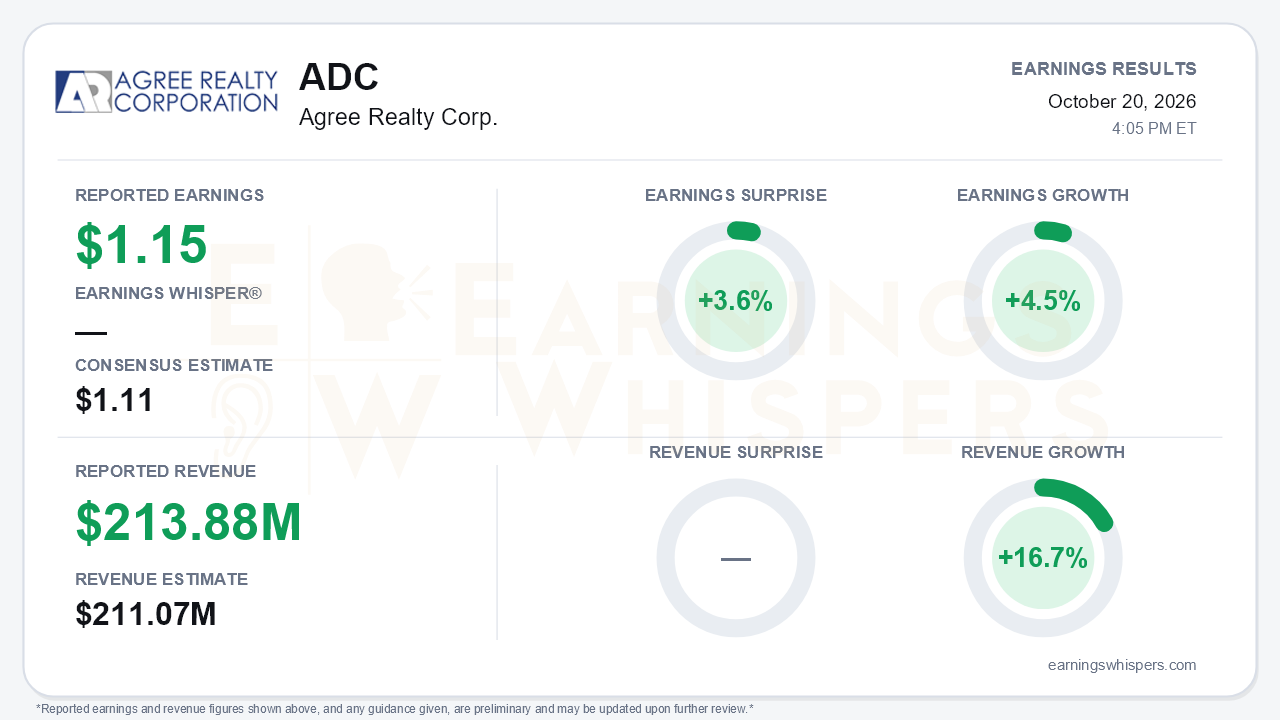
Agree Realty (NYSE: ADC) delivered a clean beat in the third quarter, but the more important story is what management chose not to do. AFFO of $1.15 per share topped the $1.11 consensus by 3.6%, and revenue of $213.88 million beat the $211.07 million estimate by 1.3%. The company also raised the low end of its 2026 AFFO guidance to $4.58 to $4.59 from $4.57 to $4.59. At the same time, it cut its investment volume outlook to about $1.6 billion from $1.6 to $1.8 billion. Rising rates and a falling share price have squeezed the spread on new acquisitions. The headline numbers were reassuring. The engine behind them is downshifting, and that is the central tension.
The quality of the beat is solid, though the growth math deserves scrutiny. Revenue grew 16.7% year over year, but per-share earnings grew just 4.5% by Earnings Whispers' measure. The company's own calculation puts AFFO per share growth at 4.9%, and on that basis the trend is clearly decelerating from 7.4% in the second quarter and 7.9% in the first. The gap between top-line and per-share growth reflects the cost of funding expansion. Diluted share count rose roughly 12% year over year, and net interest expense climbed to $41.0 million from $35.2 million. Dead-deal costs shaved about a penny off quarterly AFFO. GAAP net income per share rose 18.5% to $0.53, helped partly by $6.3 million in asset-sale and involuntary-conversion gains and no impairment charge. The underlying portfolio remains very strong: 99.8% leased, 65.1% of base rent from investment-grade tenants, 2026 expirations at just 0.2% of rent, and a recapture rate of about 106%. Management also cut its credit-loss assumption to 15 basis points from 25, with only 9 basis points incurred year to date.
The call marked a tonal shift. Last quarter management described all three growth platforms as firing with no material changes. This time it addressed the "elephant in the room": a sharp rise in the 10-year Treasury has pushed its spot cost of capital to roughly 6.8%. That leaves only about 50 basis points of spread against a 7.3% acquisition cap rate. Third-quarter investment fell to about $358 million from a record $500 million-plus in the second quarter. The investment-grade share of acquired rent dropped to 52% from 73%. Management framed the pullback as discipline, "value over volume," and cited lessons from 2023. Bears, however, have legitimate ammunition: slower deployment, lower-credit acquisitions, and management's own observation of pressure on lower-tier grocers with shrinking basket sizes.
There are real offsets. Acquisition cap rates widened 30 basis points sequentially, and management expects roughly 25 basis points more in the fourth quarter at comparable risk, which should help rebuild spreads. Disposition guidance rose to $100 to $150 million. Management is also targeting about $200 million of additional sub-6% cap-rate sales to bonus-depreciation buyers into early 2027, a form of capital recycling that reduces reliance on expensive equity. Development and Developer Funding Platform completions hit a record $82 million, and management sees possible upside as developer financing tightens. The balance sheet is a genuine advantage. Agree has about $2.0 billion of liquidity, 3.9 times pro forma net debt to recurring EBITDA, and $657 million of unsettled forward equity. Its new $400 million 10-year bond came at an all-in 5.36% after swap gains. Unhedged 2028 maturities are the main financing exposure.
The market had already priced in much of this caution. Shares have fallen 13.4% since the open following the July report, to $67.08, and sit about 10.2% below the $74.69 200-day moving average. Price and AVWAP trend readings both remain negative. Investor sentiment remained negative but improved modestly, from -0.38 to -0.35, a change too small to signal a meaningful shift in expectations. The stock decline is itself part of the fundamental problem, because a lower share price raises the cost of equity that funds acquisitions.
Management's early 2027 framework captures the setup. It still targets mid-single-digit AFFO per share growth but now emphasizes a roughly 3% "do-nothing" baseline that requires no external investment. That floor, together with a 69% AFFO payout ratio and an October dividend increase to $0.271 per month, gives income investors a reasonable degree of visibility. The upside above that baseline now depends on spreads recovering.
The bottom line is that Agree beat, nudged guidance higher, and fortified an already strong balance sheet, but the quarter confirmed that its growth algorithm is constrained by its cost of capital. Per-share growth is decelerating, investment volume is shrinking, and management has moved from offense to a defensive-opportunistic posture. The portfolio quality and liquidity are not in question. What remains open is whether widening cap rates and disposition recycling can restore the spread needed to move growth back toward the high end of mid-single digits.
Read our earnings preview for Agree Realty Corp.: https://www.earningswhispers.com/article/ADC/20398
This earnings review was originally published on Earnings Whispers.
This article is for informational purposes only and is not investment advice. Earnings Whispers and its staff may hold positions in the securities mentioned. It was generated automatically, with the help of AI, from Earnings Whispers and company data, and checked by Earnings Whispers before publication.
Mentioned In This Article
Latest News
| Oct-21 | |
| Oct-21 | |
| Oct-20 | |
| Oct-20 | |
| Oct-13 | |
| Sep-30 | |
| Sep-17 | |
| Sep-10 | |
| Sep-10 | |
| Aug-31 | |
| Aug-11 | |
| Jul-31 | |
| Jul-31 | |
| Jul-30 | |
| Jul-30 |
