Las Vegas Sands Misses Badly As Marina Bay Sands Slide Deepens, While Buybacks And A Dividend Hike Carry The Story
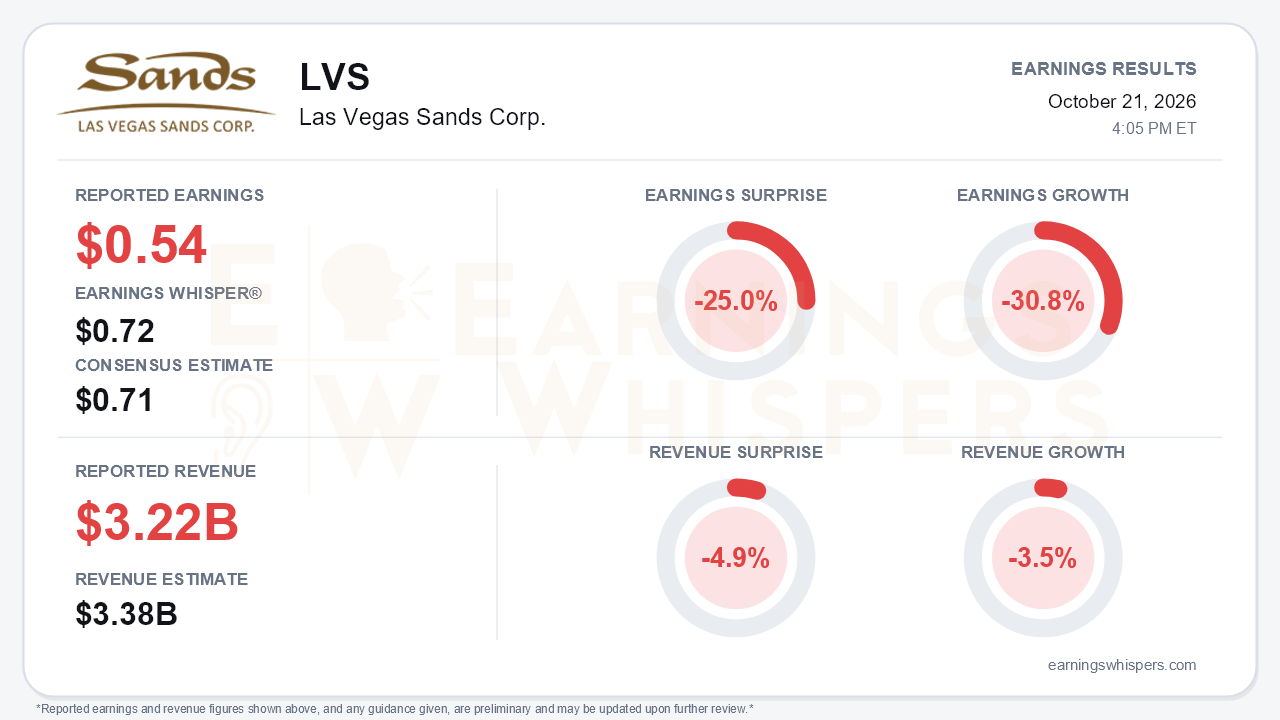
Las Vegas Sands delivered a decisive miss for the September quarter. Adjusted earnings of $0.54 per share fell 25.0% short of the $0.71 consensus and the $0.72 Earnings Whisper number. Revenue of $3.216 billion missed the $3.38 billion estimate by 4.9%. Adjusted earnings fell 30.8% year over year and revenue declined 3.5%, extending a second straight quarter of deceleration. GAAP results were similar: diluted EPS slipped to $0.48 from $0.61 and net income fell to $352 million from $491 million. That is the central tension. The operating engine is losing altitude, especially in Singapore, even as management sharply accelerates capital returns. The board raised the dividend 20% to $0.36 per quarter starting in 2027, and the company repurchased a record $950 million of stock.
The quality of the quarter is weaker than even the EPS miss suggests. Consolidated adjusted property EBITDA fell to $1.12 billion from $1.34 billion, and the margin compressed to 34.8% from 40.3%. Resort operating expenses rose about 5% while revenue declined. A jump in the effective tax rate to 22.5% from 15.6% added further pressure. The share count shrank to 640 million diluted shares from 685 million, which cushioned the per-share decline. Without that shrinkage, the earnings erosion would have looked materially worse. Buybacks are doing real work in the per-share math, but they are masking, not reversing, the profit decline.
Marina Bay Sands is the heart of the problem. Property EBITDA fell to $590 million from $743 million a year ago, and its margin dropped 6.1 points to 45.6%. The sequential trend is more concerning than any single comparison:
- $806 million in Q4 2025
- $788 million in Q1
- $689 million in Q2
- $590 million in Q3
On a hold-adjusted basis, EBITDA still slipped to about $594 million from $652 million. Low hold is part of the story. Non-rolling win fell to 18.7% from 24.5%, and the company's hold adjustment covers only rolling play. But management also acknowledged that its highest-value patrons simply visited less often, particularly in July and September. Rolling volume fell 7%. The hotel business held up well, with ADR rising to $1,038 and RevPAR up about 6%, so the weakness is concentrated in premium gaming rather than in visitation to the resort overall.
Macao offers a mixed picture. Reported EBITDA of $529 million rebounded sharply from $430 million in Q2, but much of that rebound reflects favorable hold. Hold-adjusted EBITDA was essentially flat at about $518 million, well below Q1's roughly $618 million and the $700 million target. On the positive side:
- Mass GGR share reached 26.1%, the best level since Q4 2023.
- Volumes grew in every segment.
- Fixed operating costs are now flat sequentially, with no material further hiring planned.
On the negative side:
- Rolling volume growth slowed to 31% from 73% in Q2.
- The broader market has contracted for several months.
- Margins are deteriorating, most visibly at the Londoner, where the property margin fell to 26.0% from 31.9%.
The tone shift on the call matters. Management, which had sounded unreservedly enthusiastic in Q1, described the quarter as "aberrational" and conceded that "when the customers don't show up, it's a little problematic." Management declined to rule out a demand effect from possible Chinese offshore-tax or outbound-investment tightening. If that risk materializes, it would be structural rather than a temporary hold or timing issue. Other risks include:
- construction-cost inflation on the $8 billion MBS expansion, with much of the purchasing not yet locked in;
- rising Venetian rooms out of service, from about 400 to about 500.
The constructive catalysts are mostly longer-dated. They include the MBS expansion and its planned arena, the Venetian renovation (where returned rooms are exceeding expectations), and roughly $5.06 billion of remaining buyback authorization.
The market had largely anticipated trouble. Shares fell 14.0% from the $44.40 open after the July report to $38.17 entering this release. That leaves the stock about 23.7% below its 200-day moving average and 23.8% below its late-July high of $50.08. The stock set a 52-week low of $35.28 on October 8 and sits only 8.2% above it. Price and AVWAP trend readings remain negative. Investor sentiment is still negative but improved meaningfully, rising to -0.23 from -0.37, suggesting some investors view the selloff as having priced in the Singapore weakness. Notably, the company bought back stock this quarter at an average of $45.31, well above current levels. That is a reminder that aggressive repurchases have so far not protected the share price.
The bottom line is that Las Vegas Sands produced a quarter in which shareholder returns are accelerating while the earnings base beneath them is shrinking. Marina Bay Sands has now declined for four consecutive quarters, and Macao's hold-adjusted earnings have stalled well short of target. Bears have legitimate ammunition in the premium-customer pullback and margin compression. Bulls can point to market-share gains, cost discipline, a depressed share price and a growing dividend. The next leg depends on whether management's "aberrational" framing of high-end demand proves correct.
Read our earnings preview for Las Vegas Sands Corp.: https://www.earningswhispers.com/article/LVS/20598
This earnings review was originally published on Earnings Whispers.
This article is for informational purposes only and is not investment advice. Earnings Whispers and its staff may hold positions in the securities mentioned. It was generated automatically, with the help of AI, from Earnings Whispers and company data, and checked by Earnings Whispers before publication.
Mentioned In This Article
Latest News
| Oct-21 | |
| Oct-21 | |
| Oct-21 | |
| Oct-21 | |
| Oct-20 | |
| Oct-16 | |
| Oct-15 | |
| Oct-15 | |
| Oct-14 | |
| Oct-14 | |
| Oct-13 | |
| Oct-11 | |
| Oct-10 | |
| Oct-09 | |
| Oct-08 |
