Knight-Swift's Truckload Upcycle Gains Traction As Q3 Beat Meets A Stock That Sold Off Into The Report
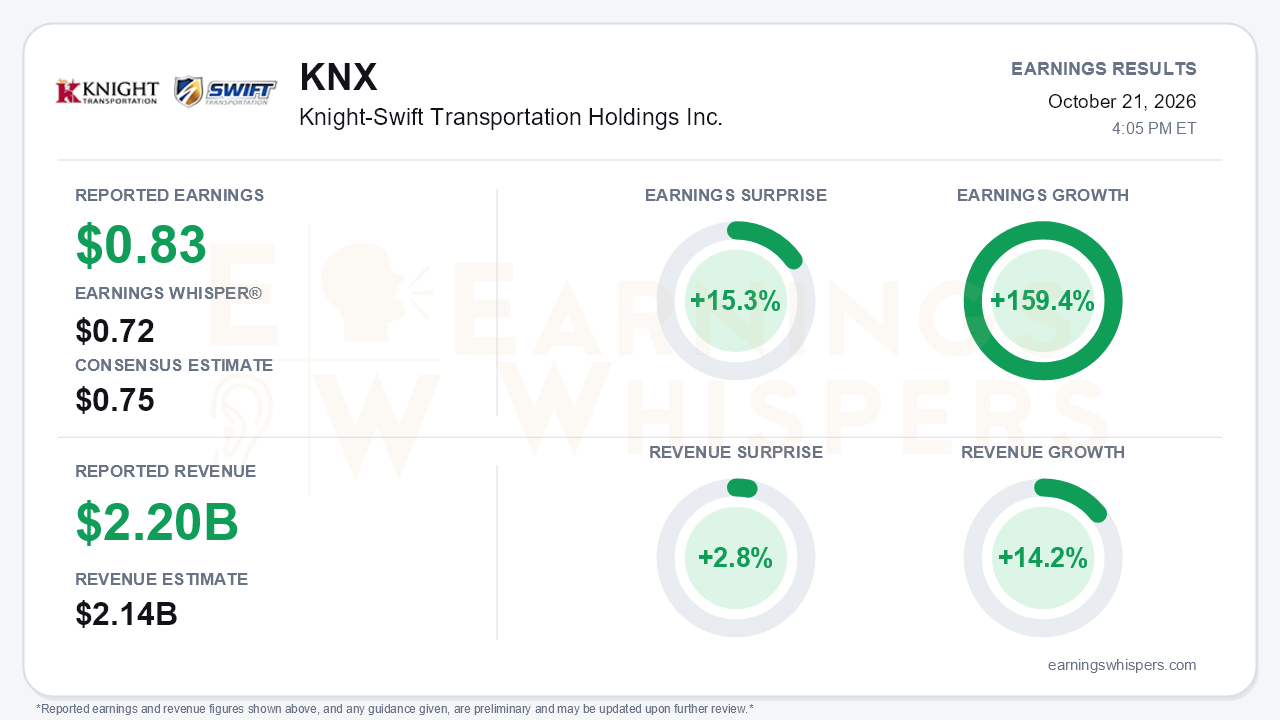
Knight-Swift Transportation (NYSE: KNX) delivered the clearest evidence yet that the truckload cycle has turned in its favor. Adjusted earnings of $0.83 per share beat the $0.75 consensus by 15.3% and cleared the $0.72 Earnings Whisper number. Earnings grew 159.4% from $0.32 a year ago. Revenue of $2.201 billion rose 14.2% and topped the $2.14 billion consensus by 2.8%. The central tension is that the fundamentals are inflecting just as the stock has moved the other way. Shares fell nearly 20% between the last report and this one, and investor enthusiasm drained away. Knight-Swift has stopped being a recovery story and is now posting upcycle earnings. The open question is whether investors trust the cycle to last.
The quarter-over-quarter progression matters more than the year-over-year comparison. Adjusted EPS climbed from $0.31 in Q4 2025 to $0.09 in Q1 and then to $0.83 in Q3. The consolidated adjusted operating ratio improved to 89.3%, which is 450 basis points better than a year ago and far stronger than the 97.0% posted in Q1. Revenue excluding fuel rose 7.7%, compared with roughly flat in Q1. That gap matters: part of the 14.2% headline growth reflects fuel surcharges tied to record diesel prices rather than underlying pricing or volume. Even so, the ex-fuel acceleration is real. The guidance trail also shows how quickly the setup changed. Management guided Q1 to $0.28 to $0.32 and Q2 to $0.45 to $0.49. It now expects $0.78 to $0.84 for Q4.
The call showed that pricing is now doing the heavy lifting. Truckload revenue per mile excluding fuel accelerated to 12.2% year over year from 2.5% in Q1. Cost per mile was held to roughly 3.3% to 3.8% growth. About 68% of rate gains flowed to margin, up from 50% in Q2. One-way truckload margins exceeded dedicated margins for the first time in years, which signals a spot-driven market tightening in carriers' favor. Productivity helped as well: miles per seated tractor rose 2.7% and empty miles fell 170 basis points.
The gains extended beyond truckload:
- **Intermodal** returned to profitability on its highest load count in more than five years, with revenue per load up 15.2%, or 5.5% excluding fuel.
- **Logistics** adjusted operating income rose about 20%, with the first year-over-year gross margin improvement in four quarters, even though segment revenue slipped 1%.
- **Dedicated** fleet count is up about 3.5% since mid-Q2.
Management's rate ambitions have escalated on every call. The target moved from low-to-mid single digits at the Q4 2025 call, to high single or low double digits in Q1, to a stance of low-to-mid double-digit contract increases in early 2027 bids. Peak-season project activity is the strongest since the pandemic. Management also cited the Montgomery ruling as pushing shippers toward asset-based carriers.
Bears still have legitimate ammunition. Management described broad demand as only stable, which means this upcycle is driven by tighter supply rather than freight volume, and supply-driven cycles can be fragile. Diesel sits at record highs, and driver pay, insurance, claims exposure and EPA-driven equipment costs are all rising. The LTL shift from a regional to a national network is taking longer than expected, with line-haul inefficiencies. Management did not reaffirm the sub-90 operating ratio target it discussed on the Q1 call, even as it plans a Northeast LTL expansion in 2027. The All Other segments are guided to a Q4 operating loss because of warehousing seasonality on a higher fixed-cost base. Overall, Q4 EPS guidance of $0.78 to $0.84 is essentially flat sequentially and roughly in line with expectations, so it extends the inflection rather than accelerating it further. On the positive side, the 1% convertible bond reduced floating-rate exposure and is moving leverage toward the company's target range. That reopens room for acquisitions and buybacks.
The market setup is more complicated than the surprise implies. Investor sentiment fell from 0.32 at the prior report to 0.03, a meaningful cooling to roughly neutral. Shares were at $63.25 before the release, down 19.9% from the $79.01 opening after the July report. That leaves the stock 3.8% below its 200-day moving average of $65.72 and only 2.1% above its inter-earnings low of $61.95, set on October 14, after peaking at $80.01 the day after the last report. Earnings Whispers price and AVWAP trends remain negative, while momentum has turned positive. That mix fits a stock whose earnings are improving faster than its chart.
The bottom line is that Knight-Swift delivered a high-quality beat backed by accelerating pricing, better incremental margins and a more aggressive 2027 rate outlook. However, flat sequential guidance, cost inflation, LTL execution delays and only-stable demand give skeptics reasons to doubt how durable the upcycle is. With sentiment reset and shares near their quarterly lows, expectations entering the report were far lower than the operating trajectory now justifies. The next test is whether early 2027 contract bids actually deliver the double-digit increases management is targeting.
Read our earnings preview for Knight-Swift Transportation Holdings Inc.: https://www.earningswhispers.com/article/KNX/20466
This earnings review was originally published on Earnings Whispers.
This article is for informational purposes only and is not investment advice. Earnings Whispers and its staff may hold positions in the securities mentioned. It was generated automatically, with the help of AI, from Earnings Whispers and company data, and checked by Earnings Whispers before publication.
Mentioned In This Article
Latest News
| 46 min | |
| 2 hours | |
| Oct-21 | |
| Oct-21 | |
| Oct-21 | |
| Oct-21 | |
| Oct-21 | |
| Oct-01 | |
| Sep-10 | |
| Sep-03 | |
| Sep-01 | |
| Aug-31 | |
| Aug-28 | |
| Aug-24 | |
| Aug-14 |
