Cathay General Misses By A Penny, But Charge-Offs And One-Time Items Hide A Stronger Core Bank
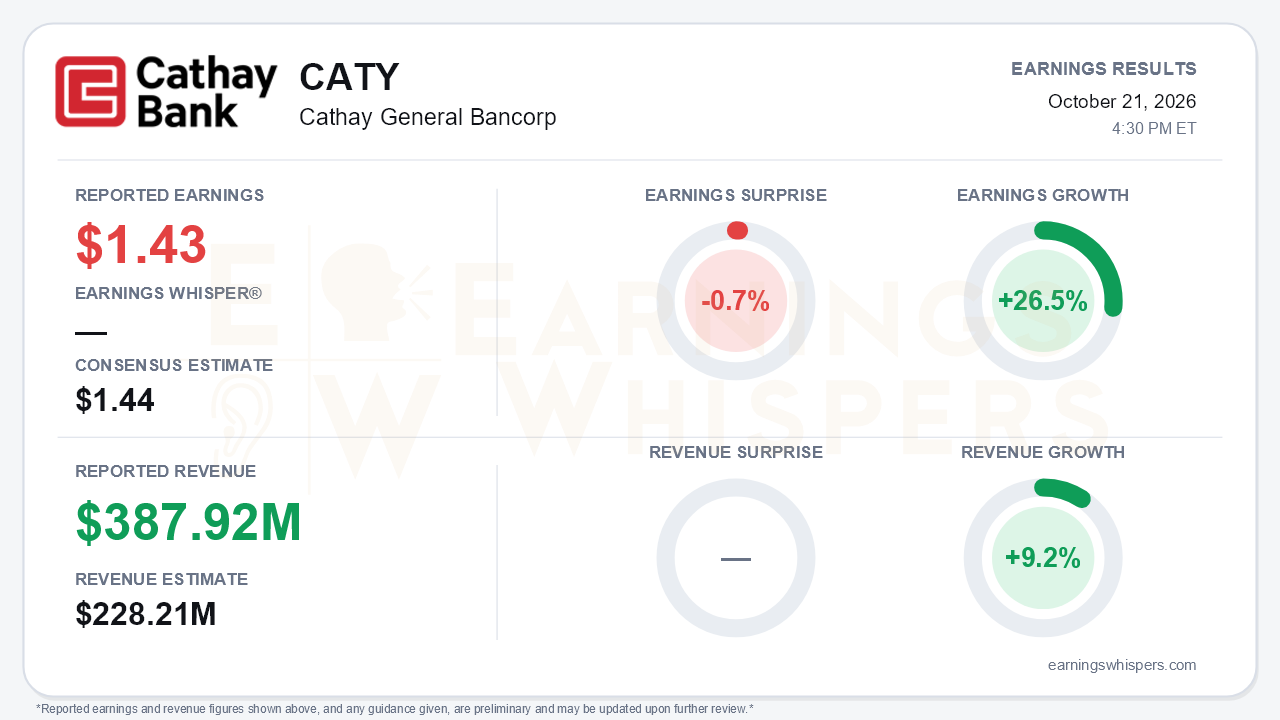
Cathay General Bancorp (NASDAQ: CATY) earned $1.43 per share in the third quarter, a penny short of the $1.44 consensus, a 0.7% miss. The shortfall understates the quarter. Earnings grew 26.5% year over year and rose from $1.37 in the second quarter. Net interest income hit a record $211.9 million, net interest margin expanded for a ninth straight quarter, and loans and deposits both grew at their fastest pace in recent quarters. The central tension is that a cleaner, faster-growing core franchise was offset by a credit cleanup that pushed the provision for credit losses to $28.6 million from $11.2 million, plus a set of unusual items on both sides of the ledger.
The quality of the quarter deserves scrutiny in both directions. Reported non-interest income nearly doubled to $42.8 million, but that included $36.1 million of equity-securities gains and a $3.1 million benefit from redeeming trust preferred securities (TruPS). Those gains were partly offset by a $15.1 million loss on securities repositioning. Expenses rose 12.0% to $103.4 million, driven by an $8.0 million charitable contribution and a $5.4 million contract termination fee. Strip out the noise and the core picture is clean. Adjusted total revenue rose to $230.5 million from $221.2 million, adjusted expenses barely moved at $82.9 million, and the adjusted efficiency ratio improved to 35.9% from 37.0%. On revenue, the $387.92 million figure and its 70.0% surprise reflect a gross measure: interest income plus fee income, set against a consensus framed closer to net revenue. On a comparable basis, adjusted revenue came in only modestly above the $228.21 million estimate.
Credit is where bears have legitimate ammunition, though the signals are mixed. Net charge-offs jumped to $25.3 million, or 0.48% annualized, from just $1.8 million. The losses came from three borrower-specific credits: a construction loan and two movie-theater commercial real estate loans inherited from the Far East National Bank acquisition. Management also updated its loss assumptions to reflect that charge-off experience. Yet the overall problem-loan picture improved:
- Nonperforming assets fell 18.0% to 0.47% of assets.
- Non-accrual loans dropped 21.8%.
- Reserve coverage of nonperforming loans rose to 243% from 196%.
This reads more like the resolution of known problems than the start of new ones. Investors should still watch the $5.0 million of loans 90 days past due but still accruing interest, which rose from zero.
The operating story continued the rebound management described on its July call, with some notable shifts. Then, management said activity had "accelerated meaningfully," with loan growth led by commercial real estate. This quarter, gross loans grew 2.79%, roughly 11.4% annualized. The mix tilted sharply toward commercial (C&I) loans, which grew $420 million, or 11.9%, even though management had flagged narrowing spreads in that category. Deposits rose 3.67%, including a $383 million increase in non-interest-bearing balances. Combined with the first half, that pace appears to put year-to-date deposit growth at or above the 3% to 4% full-year guide management had lowered from 4% to 5% in July. Margin also outperformed the cautious framing. The CFO had said future margin gains would come over "more months than quarters" as $3.3 billion to $3.4 billion of CDs repriced. Instead, the margin rose four basis points to 3.52%. Asset yields rose to 5.74% while interest-bearing deposit costs crept up only to 2.91%, and time-deposit rates edged up just as warned. Amortization of low-income housing investments, guided to rise to about $8 million, actually fell to $6.5 million.
Capital actions remain a catalyst. The company completed the $54.1 million TruPS redemption, retiring its most expensive funding at a 6.20% cost. Share count fell to 66.1 million from 66.8 million. Tangible book value per share climbed to $40.54. Common equity tier 1 capital slipped to 13.51% from 13.70% as the balance sheet grew, but that still leaves ample room to use the expanded $200 million buyback authorization. Management had signaled it would be more active with buybacks in early 2027.
The market setup is more complicated than the fundamentals imply. Investor sentiment collapsed into the report, swinging from 0.33 to -0.70, a genuinely large move into clearly negative territory. Shares, at $60.67 before the release, were 2.3% below the open following the July report. They had faded 7% from an August 52-week high of $65.26 and bounced only modestly off an October 14 low of $58.21. The stock still sits about 6.7% above its 200-day moving average, and the Earnings Whispers trend readings are largely neutral, with AVWAP negative. That suggests a market that has cooled on the name rather than abandoned it.
The bottom line is that Cathay's penny miss is a product of a one-time credit cleanup and offsetting one-off items, not a weakening franchise. Core revenue, margin, efficiency, loan growth, and deposit growth all moved in the right direction, several of them ahead of management's own July caution. The open questions are whether the legacy charge-offs are truly contained and whether margin expansion survives CD repricing in a firmer rate environment. With sentiment deeply negative heading into the print, the bar for the stock is lower than the headline suggests.
Read our earnings preview for Cathay General Bancorp: https://www.earningswhispers.com/article/CATY/20445
This earnings review was originally published on Earnings Whispers.
This article is for informational purposes only and is not investment advice. Earnings Whispers and its staff may hold positions in the securities mentioned. It was generated automatically, with the help of AI, from Earnings Whispers and company data, and checked by Earnings Whispers before publication.
Mentioned In This Article
Latest News
| Oct-21 | |
| Oct-21 | |
| Oct-21 | |
| Oct-08 | |
| Aug-27 | |
| Aug-14 | |
| Jul-23 | |
| Jul-22 | |
| Jul-22 | |
| Jul-09 | |
| May-15 | |
| Apr-24 | |
| Apr-23 | |
| Apr-23 | |
| Apr-22 |
