Spok's Spectrum Windfall Will Flatter Third-Quarter Profit, But Software Revenue Holds The Verdict
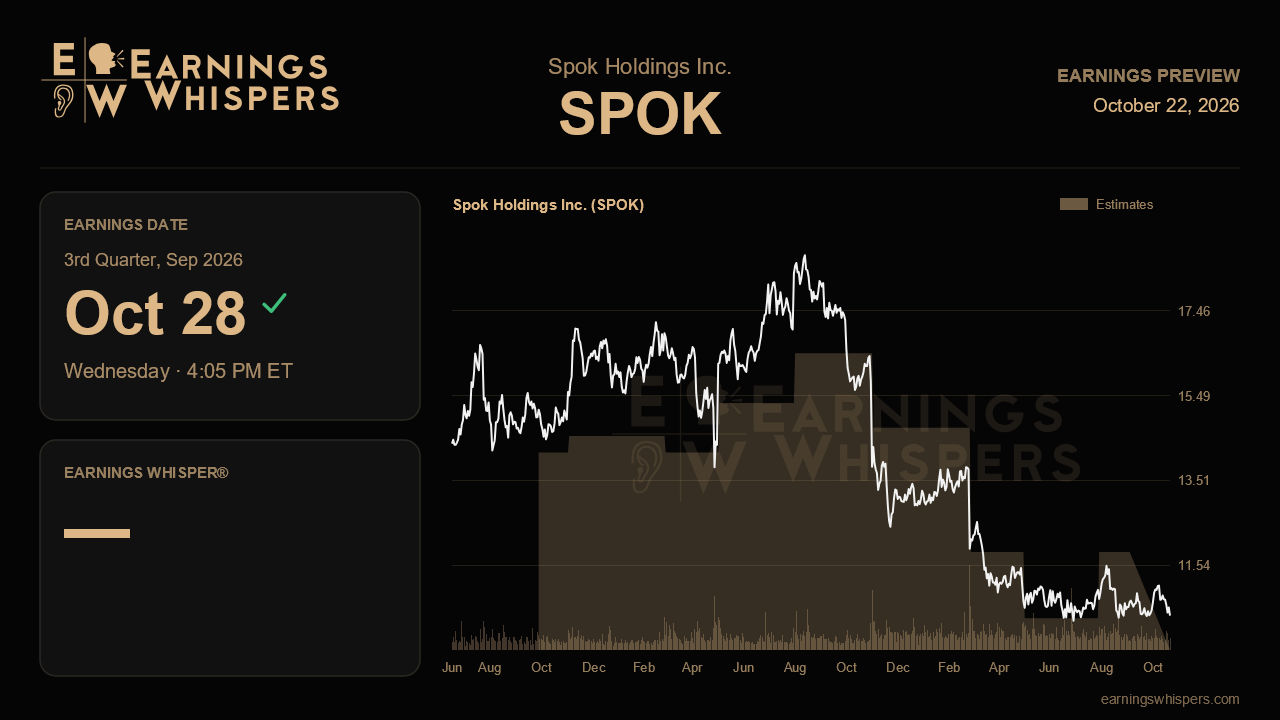
Spok heads into its third-quarter report with an unusual problem: the headline profit number will almost certainly look better than the business underneath it. The $8 million sale of narrowband spectrum licenses to CensusUSA closed on July 20, squarely inside this quarter, and management said roughly $7 million of that flows through as a gain with no federal tax owed thanks to deferred tax assets. With about 20 million shares implied by last quarter's $4.1 million in net income and $0.20 per share, that gain alone could add on the order of a third of a dollar to GAAP earnings. Against a year-ago figure of $0.15, the reported growth rate will be eye-catching and largely beside the point.
The real test sits on the top line. In July, management trimmed its 2026 revenue outlook to $132 million to $139.5 million from $136 million to $143 million. The wireless range slipped modestly and the software range took the bigger hit. Yet the Street's full-year estimate of $139.3 million sits essentially at the top of the new range, which suggests many forecasts never fully absorbed the cut. That gap matters. If third-quarter revenue lands closer to last quarter's $35.0 million than to the year-ago $33.9 million, the high end remains plausible. A softer print would likely force estimates down toward management's midpoint near $136 million.
The second-quarter call delivered a split message, and this report should show which half carries more weight. On the encouraging side, software operations bookings jumped 92% sequentially. License revenue climbed to $3.6 million from $1.5 million in the first quarter. Managed professional services grew 53% from a year earlier. Spok also signed one of the largest contracts in its history, covering a Midwest health system with more than 2,200 care sites, alongside an expansion with a national academic health system. Investors should want evidence that those wins are converting into recognized software revenue rather than sitting in backlog. On the cautious side, management introduced new language about deals taking longer to close and hospitals preferring shorter contracts over multi-year commitments. Tight budgets and reimbursement uncertainty tied to federal legislation are driving both trends. The cancelable portion of backlog, already about $16 million at year-end and still rising in the second quarter, is the metric that best captures that hesitancy. Further growth there would suggest customers want flexibility more than commitment.
Cost discipline is where the story looks sturdiest. The April realignment cut roughly 10% of headcount and targets more than $6 million in annual savings. It already pushed adjusted operating expenses down about 8% year over year to $27.1 million and produced record adjusted EBITDA. Management held its $28 million to $32 million EBITDA range even while lowering revenue guidance, so the cuts are effectively absorbing the shortfall. A full quarter of savings should keep expenses at or below second-quarter levels. Any drift higher would undercut the argument that profitability can improve without top-line help. Wireless, meanwhile, remains a slow decline, with units shrinking under 2% a year. Stability there is the expectation rather than a catalyst.
The market has not given Spok much benefit of the doubt. Shares are down 3.7% since the last report while the S&P 500 gained 5%. At $10.36, the stock trades below its 200-day average of $11.36 and just above its post-earnings low of $10.24. Sentiment was already tilted bearish before the prior report, and the price action implies little has changed. That low bar could help if software revenue surprises. Management's hint at further asset monetization also offers a possible upside wildcard.
Ultimately, the spectrum gain is noise. The question is whether record bookings and marquee contracts can translate into software revenue fast enough to keep the trimmed full-year range intact while the Street still sits at its upper edge. Steady software revenue and a stable cancelable backlog would validate the turnaround narrative. Another revenue reset would leave cost cuts carrying the entire story.
This earnings preview was originally published on Earnings Whispers.
This article is for informational purposes only and is not investment advice. Earnings Whispers and its staff may hold positions in the securities mentioned. It was generated automatically, with the help of AI, from Earnings Whispers and company data, and checked by Earnings Whispers before publication.
Mentioned In This Article
Latest News
| 13 hours | |
| Oct-21 | |
| Oct-19 | |
| Sep-22 | |
| Aug-06 | |
| Jul-30 | |
| Jul-30 | |
| Jul-29 | |
| Jul-29 | |
| Jul-22 | |
| Jun-24 | |
| Apr-29 | |
| Apr-29 | |
| Apr-22 | |
| Apr-14 |
