Brandywine Matches Core FFO Estimates As Asset Sales Speed Up Debt Reduction, But 2027 Dilution And Dividend Coverage Cloud The Outlook
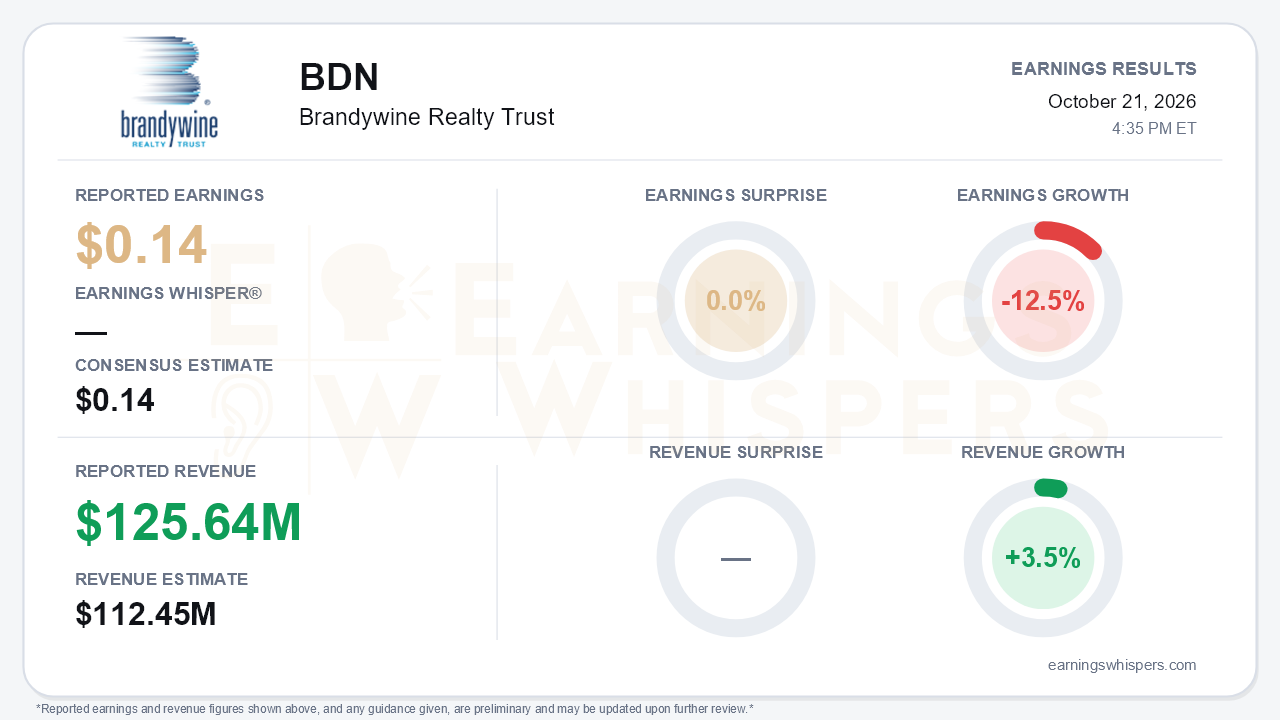
Brandywine Realty Trust reported third-quarter Core FFO of $0.14 per share, exactly matching the consensus estimate. Revenue of $125.64 million beat expectations by 11.7% and grew 3.5% from a year ago. Per-share earnings power is still falling, however. Core FFO declined 12.5% year over year, from $0.16, and nine-month Core FFO is down to $0.38 from $0.44. The quarter's real story was on the balance sheet. Brandywine sold assets at roughly twice the pace it originally planned, cut $390 million of debt, and lowered leverage sharply. That creates the central tension: a much safer company is emerging, but it is also a smaller one, and the earnings it gave up with those sales have not yet been replaced.
The GAAP results show how much transaction activity ran through the quarter. The net loss narrowed to $(0.13) per share from $(0.15). That figure included a $29.1 million impairment, $55.7 million of net disposition gains, and $15.4 million of losses on early debt extinguishment. Management excluded those debt losses from Core FFO. As a result, NAREIT FFO was just $0.05 per share, versus $0.16 a year ago. Full-year GAAP loss guidance widened to $(0.64)-$(0.62) from $(0.45)-$(0.41), which the company attributed to the loss on the $240 million Philadelphia sale and the debt charges.
On Core FFO, the company replaced its prior FFO range of $0.53-$0.57 with a Core range of $0.54-$0.56. That range excludes the $0.09 of extinguishment losses. The midpoint is unchanged at $0.55, where it has been all year, so the guidance was narrowed rather than raised. On an unadjusted basis, full-year FFO guidance is now $0.45-$0.47.
Underlying operations were steady at best:
- Same-store NOI fell 0.6% on an accrual basis and rose 1.7% on a cash basis.
- Property operating expenses rose to $39.2 million from $31.4 million.
- Core occupancy slipped to 89.0%, with 7,000 square feet of negative absorption, compared with positive absorption of 88,000 square feet in the second quarter.
- Retention was 50%.
- Management said NOI came in $1.1 million below its forecast because of weakness in retail and residential.
There were real positives. Leasing of 558,000 square feet, including joint ventures, was the year's best. Accrual mark-to-market reached 10.8%, and the proposal-to-lease conversion rate improved to 49% from 41%. Philadelphia CBD and University City captured 60% of new leasing and are 95% occupied. Austin is a different picture, with occupancy down to 66% from 74% at the end of 2025. The advanced-stage leasing pipeline also shrank to 300,000 square feet from 456,000.
The capital markets side is where management earned credit. Wholly owned sales reached $545 million, and $681 million including joint ventures, against an original plan of $280-$300 million. The 3151 Market Street sale to a Fortune 500 user eliminated roughly $80 million of future capital spending. The Solaris apartment sale closed at a sub-4% cap rate. Brandywine also repurchased $140 million of 8.8%-8.9% bonds, and quarterly net debt/EBITDA fell to 7.6x from 9.0x. Year-end leverage guidance improved to 7.8-8.0x from 8.4-8.8x.
Investors should note a discrepancy in the liquidity figures. The balance sheet shows $313 million of cash and $137 million drawn on the credit line at September 30. Management, by contrast, cited roughly $176 million of cash and a zero line balance. That figure appears to reflect positions after the quarter-end closings. One Uptown is now 97% leased, up from 63% in the first quarter, although its recapitalization slipped to the first quarter of 2027.
The forward risks are concentrated in 2027:
- The IBM lease expiration removes about $11 million of NOI. The company is converting this into a redevelopment opportunity, and the pipeline has grown to 1.5 million square feet.
- Lost income from sold assets will dilute earnings.
- Brandywine plans another $200 million-plus of 2027 sales, and management flagged that office cap rates may be rising.
- Cash available for distribution payout runs at 103%, well above the 70-90% target, even after the quarterly dividend was already reduced to $0.08 from $0.15. Management said the dividend is under review for 2027.
The market is skeptical of the plan. Shares were at $2.70 on the report date, down 11.5% since the open after the July report and about 9.9% below the $3.00 200-day moving average. They also sit below the $3.19 average price the company paid to buy back 4.7 million shares. Investor sentiment weakened from slightly negative (-0.06) to more clearly negative (-0.24). Price and AVWAP trend readings both remain negative. That reaction suggests investors are focused on the earnings-per-share and dividend implications of shrinking, not on the leverage improvement.
The bottom line is that Brandywine executed its deleveraging plan far beyond the original targets, and the balance sheet is materially stronger than it was a quarter ago. The quarter itself was only in line on Core FFO, per-share earnings are still declining, and full-year guidance did not improve. The company now enters 2027 facing IBM-related NOI loss, dilution from asset sales, weak occupancy in Austin, and an openly questioned dividend. Bulls can point to a cleaner capital structure. Bears have legitimate grounds to argue that this improvement is being paid for with future earnings power.
Read our earnings preview for Brandywine Realty Trust: https://www.earningswhispers.com/article/BDN/20442
This earnings review was originally published on Earnings Whispers.
This article is for informational purposes only and is not investment advice. Earnings Whispers and its staff may hold positions in the securities mentioned. It was generated automatically, with the help of AI, from Earnings Whispers and company data, and checked by Earnings Whispers before publication.
Mentioned In This Article
Latest News
| Oct-23 | |
| Oct-22 | |
| Oct-22 | |
| Oct-21 | |
| Oct-21 | |
| Oct-14 | |
| Oct-12 | |
| Sep-15 | |
| Aug-26 | |
| Aug-21 | |
| Aug-21 | |
| Aug-17 | |
| Jul-23 | |
| Jul-22 | |
| Jul-22 |
