TrustCo's 18.6% EPS Jump Leans On Buybacks As Net Income Growth Slows To 6.5%
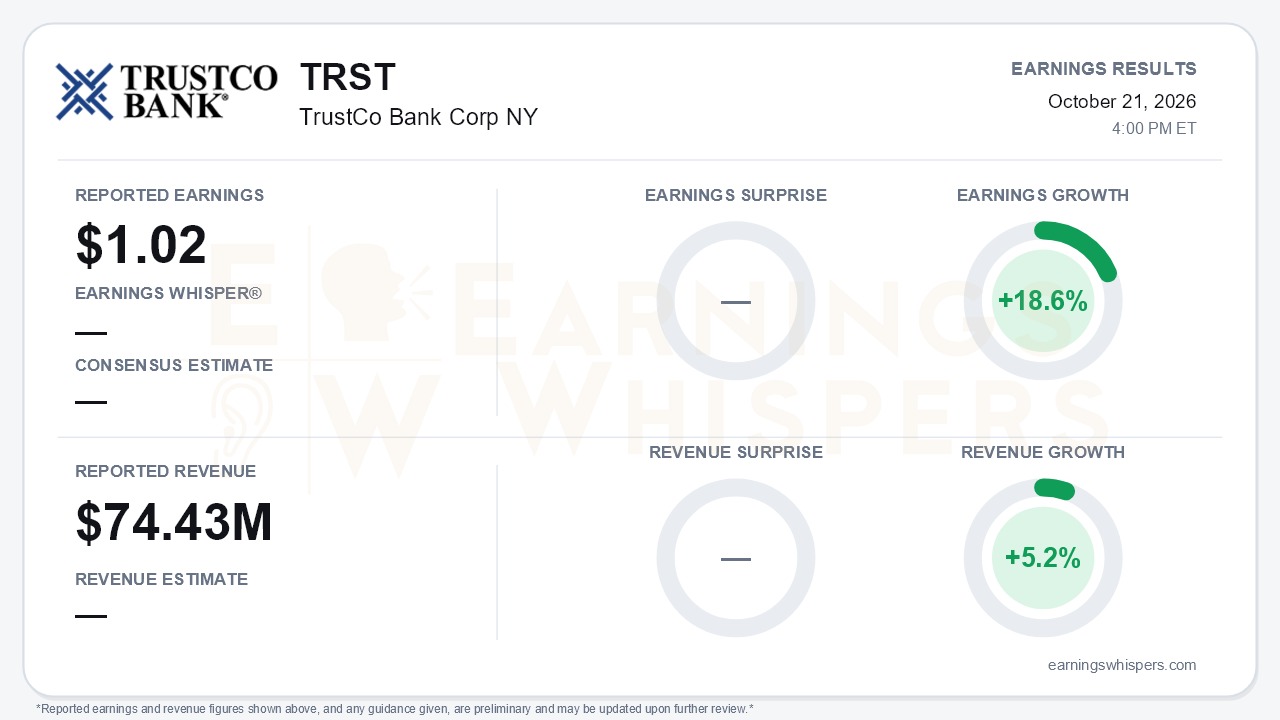
TrustCo Bank Corp NY (NASDAQ: TRST) reported third-quarter earnings of $1.02 per share, up 18.6% from a year ago, on revenue of $74.43 million, up 5.2%. No consensus estimate was available, so the quarter has to be judged on its own trajectory. That trajectory is solid, but less impressive than the headline suggests. Net income rose only 6.5%, to $17.3 million. The rest of the EPS growth came from a share count shrinking quickly. Diluted weighted shares fell to 16.9 million from 18.8 million a year earlier, a reduction of roughly 10%. That gap is the central tension in the quarter. The core franchise is still improving, but the rate of profit growth has slowed for the third straight quarter, from 38% in the fourth quarter of 2025 to 14.1%, then 12.8%, and now 6.5%. Aggressive capital return is increasingly carrying the per-share story.
The underlying spread business remains the clear bright spot. Net interest income rose 9.1% to $47.0 million and increased sequentially for a fourth consecutive quarter. Net interest margin widened to 2.95% from 2.87% in the second quarter and 2.79% a year ago. Two forces drove the improvement:
- Loan yields climbed to 4.49% from 4.32% as older mortgages repriced.
- The cost of interest-bearing liabilities fell to 1.79% from 1.90%, helped by time-deposit costs dropping to 3.34% from 3.63%.
One offset sits beneath the surface. Income from short-term investments fell to $6.1 million from $7.4 million. Yields on those balances dropped to 3.72%, and cash and equivalents shrank by about $100 million in the quarter, partly to fund loan growth and buybacks. The sequential comparison is cleaner than it looks: second-quarter results included $844,000 of equity-security gains, versus just $56,000 this quarter. Expenses tell a less flattering story. Noninterest expense rose 6.8% year over year to $28.0 million, and management raised its recurring expense guidance for a third straight call, to $27.8 million to $28.2 million per quarter. That range is back where it started at the end of 2025.
The call kept a credible growth story intact but introduced real cyclical caution. Year-over-year average loan growth accelerated for a fourth consecutive quarter, to $238 million, or 4.6%. Home equity lines grew 11.4% and residential mortgages grew 4%. Late in the quarter, however, mortgage rates moved from below 6.5% to above 7%. The CEO acknowledged that some loan volumes are down and that some customers are extending CD terms. Longer CD terms could slow the deposit-repricing tailwind that has supported the margin. Sequential loan growth already eased to $77.1 million from $87.1 million. The provision rose to $850,000 from $650,000, which management attributed to loan growth and weaker economic forecasts rather than credit deterioration. Credit metrics largely support that explanation:
- Nonperforming loans eased sequentially to $21.1 million.
- Net recoveries extended to a seventh straight quarter.
- Reserve coverage improved to 262%.
One trend bears watching. Florida nonperforming loans have climbed steadily, from $3.6 million a year ago to $5.0 million.
Capital deployment is both a catalyst and a risk. The dividend rose 5.3% to $0.40 per share. TrustCo has bought back more than 1.5 million of its 2 million authorized 2026 shares and is on pace to retire 15.8% of its stock across 2025 and 2026. The cost shows up on the balance sheet. Equity to assets fell to 9.72% from 10.05% in June and 10.90% a year ago. (The call materials cited a higher second-quarter figure than the release, but the direction is the same.) Book value per share slipped sequentially to $38.20 from $38.53, pressured by buybacks and a sharp decline in accumulated other comprehensive income. Management also teased an "exciting announcement" about its lending operation in the coming months and explicitly framed momentum as continuing into 2027.
The market had already rewarded much of this progress. Shares ended September at $54.29, up from $36.30 a year earlier. That price was little changed from the second-quarter close of $54.91 and slightly below the $55.49 opening after the July report. The stock has stalled over the past quarter even as fundamentals kept improving. It also sat above its 200-day moving average of $50.39, a level reflecting the substantial rerating of the past year.
The bottom line is that TrustCo delivered another quarter of genuine margin and loan-growth progress, but the quality of the 18.6% EPS gain deserves scrutiny. Net income growth has decelerated sharply, expenses keep drifting higher, and rising mortgage rates are starting to soften loan volumes. Buybacks are doing increasingly heavy lifting while capital ratios decline. The upcoming lending announcement and continued repricing give bulls something to point to. Bears, however, have legitimate ammunition in the slowing earnings trajectory and a stock that has already rerated by roughly half in a year.
This earnings review was originally published on Earnings Whispers.
This article is for informational purposes only and is not investment advice. Earnings Whispers and its staff may hold positions in the securities mentioned. It was generated automatically, with the help of AI, from Earnings Whispers and company data, and checked by Earnings Whispers before publication.
Mentioned In This Article
Latest News
| Oct-22 | |
| Oct-21 | |
| Oct-21 | |
| Oct-13 | |
| Sep-16 | |
| Aug-18 | |
| Jul-22 | |
| Jul-21 | |
| Jul-21 | |
| Jul-10 | |
| May-20 | |
| Apr-23 | |
| Apr-21 | |
| Apr-21 | |
| Apr-10 |
