Old Second Misses On EPS As A Final Charge-Off Clouds A Record Margin And A Clear Credit Turn
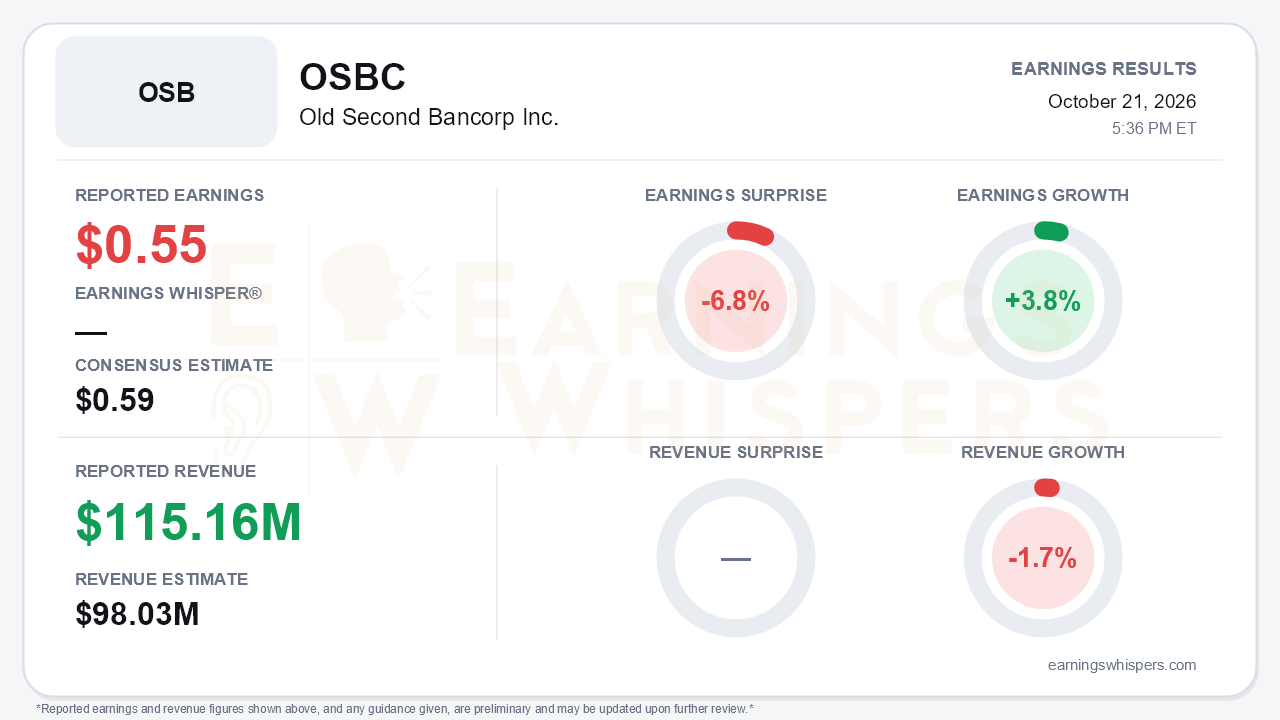
Old Second Bancorp missed on the bottom line. Even so, the quarter looks more like a credit inflection than a deterioration. Adjusted earnings of $0.55 per share fell 6.8% short of the $0.59 consensus, though they grew 3.8% from a year ago. GAAP EPS was $0.56, up from $0.54 in the second quarter and $0.48 in the first. Revenue of $115.16 million beat the $98.03 million consensus by 17.5% but declined 1.7% year over year. That revenue beat deserves context. Net interest income of $84.0 million plus fee income of $13.1 million sits close to the consensus figure, so the beat appears to reflect revenue definition more than an operating surprise. The central tension is clear. A heavy final charge-off and stalled loan growth kept EPS below expectations, while the margin, credit metrics and capital return all moved meaningfully in shareholders' favor.
The miss came from credit costs and adjusted expenses, not core earning power. Net charge-offs rose to $12.7 million from $9.2 million in the second quarter and $9.8 million in the first. That included $9.2 million of C&I losses, mostly from a single warehousing/distribution relationship, of which $6 million had already been reserved, plus $3.1 million in powersport loans. The provision still declined to $6.8 million from $7.5 million. The allowance ratio slipped to 1.23% from 1.34%, a release of cushion that bears can fairly question. On the cost side, the adjusted efficiency ratio rose to 52.06% from 50.80% as salaries, incentive accruals and a brand campaign pushed expenses higher. Tax-equivalent net interest margin, by contrast, rose for a fifth straight quarter to 5.27%. That compares with 5.23% in the second quarter and 5.05% a year ago, and it beat management's own guide of roughly 5.18%. Return on tangible common equity improved to 15.77%.
The credit story is what changed most. Criticized loans fell 38%, or $61.3 million, to 1.88% of total loans from 3.05%. Classified loans dropped from $132.1 million to $74.2 million, their lowest level since 2019. Nonperforming loans fell $16.8 million to 0.76% of loans. The problem C&I credit has been charged down and is under contract to be sold. Management's tone moved from "cautiously optimistic" last quarter to feeling as good about the loan book as it has in several years. CEO Jim Eccher said he believes the bank has "turned the corner on credit." Powersports remains a watch item: the bank is declining about 7% more applications, though charge-offs held steady.
The balance sheet is the real constraint. Loans were essentially flat, down $7.8 million, after growing $60.6 million in the second quarter. Prepayments ran about twice their normal pace, and syndications fell $53 million. Total deposits fell $117.1 million as high-cost brokered and acquired time deposits rolled off. That pushed the loan-to-deposit ratio to 98.3% from 96.4%, leaving incremental growth to be funded at marginal rates. Management's guidance on the margin pulls in two directions. It now expects NIM to stay "solidly above 5.20%," up from a prior fourth-quarter guide near 5.15%, but also flagged a roughly 5-basis-point give-back tied to buybacks and funding needs. Those two statements are reconcilable: a margin near the low 5.20s would still sit above the earlier guide. Investors should expect a plateau rather than further expansion. The loan growth outlook has also drifted down, from mid-single digits to low single digits.
Offsetting that, the catalysts are tangible. These include a new multi-year endorsed lending agreement with Ducati USA, which management expects to lift 2027 originations substantially, and a fourth-quarter pipeline described as one of the strongest in years. Management also expects deposit growth in the fourth quarter. Capital return accelerated: the bank repurchased 1.5 million shares, about 3% of the share count, versus 732,000 last quarter. It raised the dividend 14% and framed roughly 5% annual buybacks as a reasonable expectation. The cost of that pace was a slight dip in tangible book value to $14.75 and in the TCE ratio to 11.00%. A projected 20% rise in employee health insurance costs is a headwind, though the 3-4% expense growth guide held.
Investor sentiment, already negative, weakened further from -0.31 to -0.45 heading into the report. That is a meaningful but not extreme shift toward skepticism. Price action has been more forgiving. Shares are up 5.1% since the open after the July report and trade about 11.4% above the 200-day moving average. The Earnings Whispers trend readings lean negative, with AVWAP negative and price trend neutral, suggesting the advance has lacked conviction.
The bottom line is that Old Second's EPS miss reflects a final large charge-off and a stalled loan book, not erosion in profitability. The margin is near record levels, problem assets are shrinking rapidly, and capital return is accelerating. The open questions are funding and growth. With the loan-to-deposit ratio near its ceiling and management already signaling some margin give-back, the next leg depends on the Ducati partnership, the strong pipeline and deposit gathering actually translating into balance sheet growth.
This earnings review was originally published on Earnings Whispers.
This article is for informational purposes only and is not investment advice. Earnings Whispers and its staff may hold positions in the securities mentioned. It was generated automatically, with the help of AI, from Earnings Whispers and company data, and checked by Earnings Whispers before publication.
Mentioned In This Article
Latest News
| Oct-22 | |
| Oct-21 | |
| Oct-21 | |
| Sep-09 | |
| Sep-02 | |
| Jul-23 | |
| Jul-22 | |
| Jul-22 | |
| Jun-30 | |
| Jun-15 | |
| May-21 | |
| Apr-24 | |
| Apr-22 | |
| Apr-22 | |
| Apr-11 |
