Deckers Beats On Earnings, But Tariff Refunds Cushion A Real Revenue Reset As HOKA And UGG Outlooks Are Cut
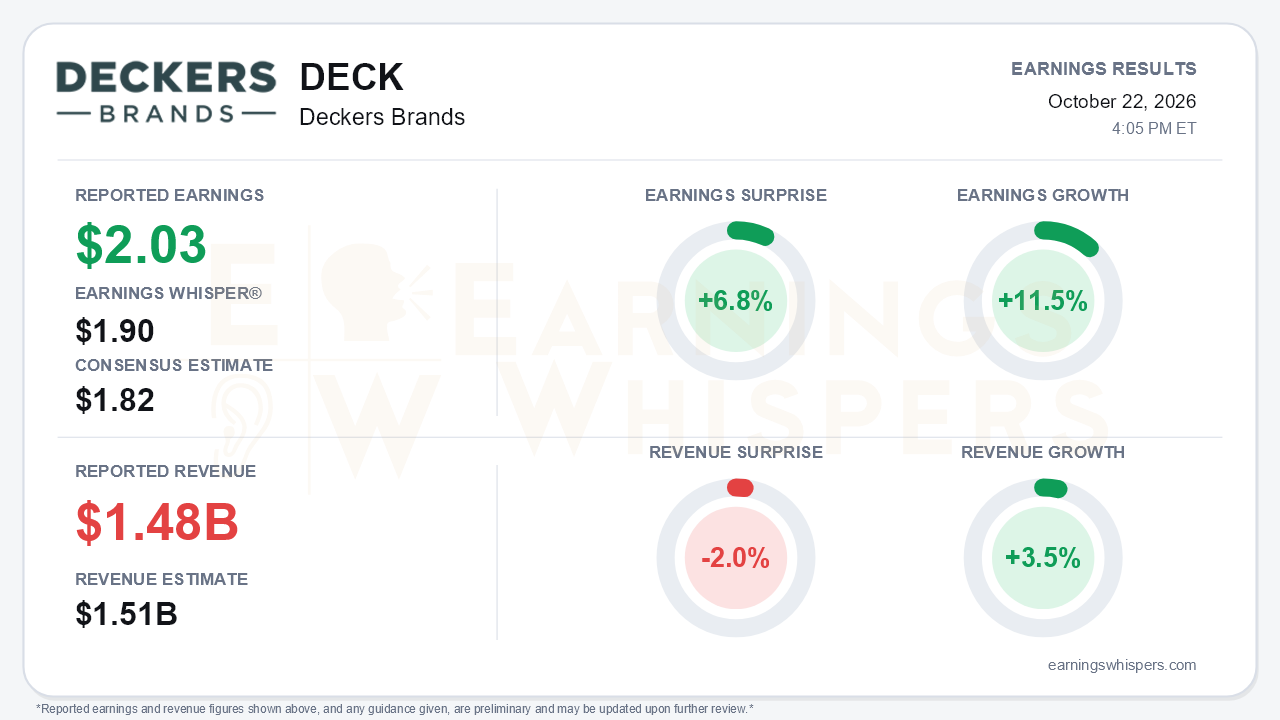
Deckers Brands delivered an earnings beat that looks better on the surface than it does underneath. Excluding a one-time tariff benefit, the company earned $2.03 per share in its fiscal second quarter. That beat the $1.82 consensus by 6.8%, topped the $1.90 Earnings Whisper number and grew 11.5% year over year. Revenue told a different story. Sales rose 3.5% to a record $1.481 billion, but that missed the $1.51 billion consensus by 2.0% and fell short of management's own guidance for roughly 5% growth. That is the central tension of the quarter. Margins and expense control produced the beat, while demand weakened enough to force a meaningful cut to the full-year top-line outlook.
The quality of the beat deserves scrutiny. GAAP diluted EPS was $2.31, up 27%, but that figure includes roughly $0.28 from $46.0 million of IEEPA tariff net refunds booked as a reduction to cost of sales. Reported gross margin jumped to 60.5% from 56.2%, and about 310 basis points of that gain came from the refunds. The underlying improvement of roughly 120 basis points is still genuine and notable, because management had guided gross margin down year over year. Disciplined full-price selling clearly helped.
The channel mix, however, shows a softer consumer. Wholesale rose 5.5%. Direct-to-consumer sales fell 1.8%, and DTC comparable sales dropped 6.4%. HOKA grew 6.8%, below its high-single-digit guide, and HOKA DTC growth slowed sharply to about 4% from 17% in the first quarter. UGG rose 3.5%, but UGG DTC fell about 8%. Domestic sales were flat, while international rose 9.0%. A share count roughly 8% lower than a year ago, driven by aggressive buybacks, also helped per-share results.
The full-year guidance makes the shift explicit:
- **Revenue** was cut to $5.700-$5.725 billion from $5.86-$5.91 billion, a range management had reaffirmed just one quarter earlier.
- **HOKA** growth was lowered to high single digits from low double digits.
- **UGG** growth was lowered to low single digits from mid-single digits.
- **EPS** guidance was raised to $7.80-$7.95 from $7.35-$7.50, but it now includes roughly $0.52 of refund benefit received through October 8.
Stripping out that benefit implies a range of about $7.28-$7.43, slightly below the prior outlook. Underlying operating margin is simply being held at slightly better than 21.5%, and that relies partly on lower SG&A spending. The headline raise therefore masks a modest underlying trim.
The conference call explained why. Management cited a highly promotional U.S. athletic footwear market and said it is avoiding a "race to the bottom" on pricing. It also pointed to consumers buying only for immediate wear and delaying UGG purchases ahead of the peak season. Management acknowledged that several calendar 2026 HOKA franchise updates, including Transport, Kawana and Solimar, failed to resonate, and that HOKA is losing share below the $120 price point. A third-party logistics disruption in EMEA delayed about $22 million of second-quarter shipments, and some of those orders are at risk of cancellation. The tone moved noticeably from earlier confidence in broad-based demand to a "measured approach" and a vision that "remains largely intact."
The forward catalysts are real but back-end loaded. Management pointed to strong Mach Pro bookings and a heavy 2027 HOKA pipeline that includes the Bondi 10 in January, the Mach 8, the $115 FlyPace and the $325 Bondi Ultra X. HOKA is also widening its price range in both directions, and the company has commissioned an external review of how it deploys marketing. Further tariff refunds remain possible but are excluded from guidance. The weakness is that management's third-quarter outlook calls for only low-single-digit growth, so hitting the full-year HOKA target depends on a fourth-quarter acceleration driven by product launches. That adds execution risk.
The market had already turned skeptical before the report. Shares were $85.49 just ahead of the release, down 9.1% from the $94.00 open after July's report. They were also 14.6% below the 200-day moving average and 18.5% below the July 29 high of $104.88. The stock set a 52-week low of $77.20 on September 30 and has recovered about 10.7% from that level. Investor sentiment turned more negative, moving from -0.24 to -0.41. Price and AVWAP trend readings remain negative, although momentum has improved. Low expectations offer some cushion, but bears have legitimate ammunition in the revenue cut. The $637 million of first-half buybacks, about 5% of shares, show management is willing to lean against weakness at these prices.
The bottom line is that Deckers produced a credible profitability quarter while its growth story took a clear step backward. Pricing discipline and expense control are protecting margins, and tariff refunds are flattering the headline numbers. Underlying, the company lowered revenue expectations for both of its core brands and now relies on a launch-driven fourth quarter to stabilize HOKA. Until DTC trends and HOKA's competitive position improve, the earnings beat matters less than the top-line reset.
Read our earnings preview for Deckers Brands: https://www.earningswhispers.com/article/DECK/20563
This earnings review was originally published on Earnings Whispers.
This article is for informational purposes only and is not investment advice. Earnings Whispers and its staff may hold positions in the securities mentioned. It was generated automatically, with the help of AI, from Earnings Whispers and company data, and checked by Earnings Whispers before publication.
Mentioned In This Article
Latest News
| 2 hours | |
| 4 hours | |
| 5 hours | |
| 5 hours | |
| 5 hours | |
| 5 hours | |
| 6 hours | |
| Oct-20 | |
| Oct-16 | |
| Oct-15 | |
| Oct-15 | |
| Oct-12 | |
| Oct-12 | |
| Oct-08 | |
| Oct-08 |
