South Plains Financial Posts Near-Record Quarter As Loan Growth Accelerates, But Credit And Spread Pressures Keep Investors Wary
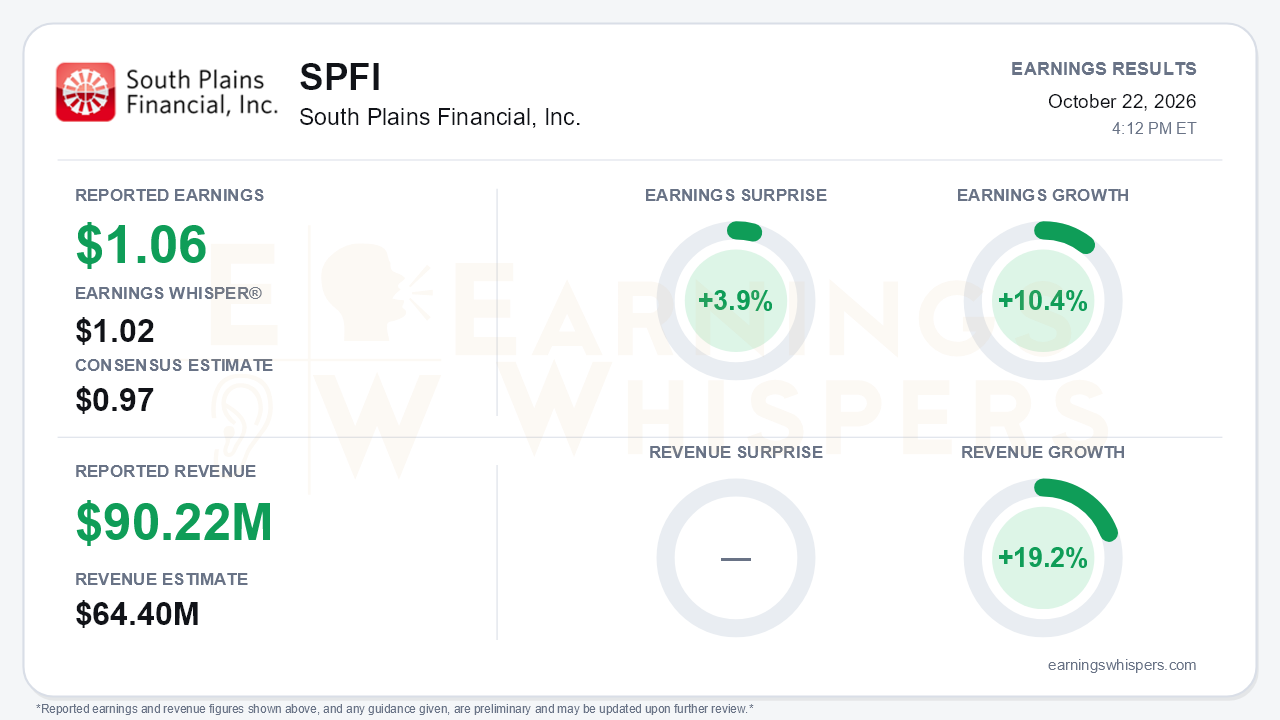
South Plains Financial (NASDAQ: SPFI) delivered the cleanest quarter of its post-acquisition year. Diluted EPS was $1.06, ahead of the $0.97 consensus and the $1.02 Earnings Whisper number, a 3.9% surprise. Earnings grew 10.4% year over year, and the sequential trend accelerated from $0.85 in the first quarter to $0.96 in the second and $1.06 now. Net income rose to $20.8 million from $19.0 million in the prior quarter and $16.3 million a year ago. Organic loan growth also picked up to a 6.3% annualized pace. The central tension is that the earnings recovery is real, but it is arriving alongside rising nonperforming loans, slipping loan yields and a loan-growth outlook that has been walked down all year. Investors appear to be weighing those issues more heavily than the beat.
The quality of the beat holds up better than many bank beats, though it deserves some scrutiny. Pre-tax, pre-provision income climbed to $27.2 million from $24.6 million. The efficiency ratio improved to 58.1% from 61.6% as noninterest expense fell $1.8 million to $38.1 million. Part of that improvement came from the absence of roughly $1.05 million in second-quarter BOH acquisition costs rather than from structural savings. Mortgage banking revenue was helped by a $1.6 million mortgage servicing rights write-up, a rate-driven gain that will not necessarily repeat.
The year-over-year comparison carries a dilution story. Net income rose far faster than EPS because diluted shares increased from about 17.0 million to 19.6 million after the BOH deal. The reported 40.1% revenue surprise should also be read carefully. The $90.22 million revenue figure aligns with gross interest income plus fee income. Net interest income of $51.5 million plus noninterest income of $13.8 million comes to about $65.3 million, much closer to the $64.4 million consensus.
The conference call improved the growth narrative. Management said the BOH integration is complete and Houston bankers have shifted back to business development. It also said portfolio cleanup is finished, so the bank is no longer exiting relationships. Metro markets now make up roughly half or more of the loan pipeline, compared with about one-third historically. Management described the second-half pipeline as "much stronger than the first" and is recruiting bankers in Lubbock and College Station as competitor consolidation disrupts those markets. The roughly $60 million in organic growth compares with $35 million in the second quarter and a $41 million decline in the first. It came despite a $25 million CD-secured payoff and another large payoff during the quarter. Management also guided fourth-quarter expenses lower as the CEO retirement accrual and deal costs roll off.
Bears have legitimate ammunition, however. Full-year loan growth guidance has drifted from "mid-to-high single digits" at the start of the year to the "lower end" of that range and now "mid single digits." Net interest margin held at 4.00%, but loan yield slipped to 6.75% from 6.81%. Management noted that new loans are being booked at upper-6% yields while deposit competition has returned to the mid-4% range, which limits margin expansion. Credit weakened at the margin:
- Nonperforming loans rose to 0.40% of loans from 0.25%, driven by acquired BOH credits, though the largest has since returned to performing status.
- Net charge-offs increased to 0.13% from 0.06%.
- The allowance ratio edged down to 1.38%.
On the balance sheet, a $25.5 million AOCI hit pushed tangible book value per share down to $29.23 from $29.60. More large payoffs are expected in the fourth quarter. Leadership also changes at year-end, when Curtis Griffith hands the CEO role to Cory Newsom, although the transition appears well planned.
The market setup is more complicated than the surprise implies. Earnings Whispers investor sentiment became meaningfully more negative heading into the report, falling from -0.20 to -0.43. The stock has drifted 3.5% lower since opening at $44.99 after the July report. It set a 52-week high of $46.94 on that first post-report day, then slid to a $40.69 low on October 1 before recovering to $43.40. Shares sit about 2.3% above the 200-day moving average, near the middle of the inter-earnings range, and the AVWAP trend remains negative. The market has effectively given back the enthusiasm that followed last quarter's report, even as the earnings run-rate kept improving.
The bottom line is that South Plains produced a genuinely improving quarter, with rising EPS, better operating efficiency, accelerating organic loans and a credible pipeline tied to its metro Texas markets. Those gains come with real offsets. Loan yields are compressing, acquired credits are pushing NPLs higher, tangible book value is sensitive to rates and growth guidance is lower than it was earlier in the year. With sentiment souring and the stock well off its July high, the next test is whether fourth-quarter expense relief and pipeline conversion can outrun payoffs and spread pressure.
Read our earnings preview for South Plains Financial, Inc.: https://www.earningswhispers.com/article/SPFI/20586
This earnings review was originally published on Earnings Whispers.
This article is for informational purposes only and is not investment advice. Earnings Whispers and its staff may hold positions in the securities mentioned. It was generated automatically, with the help of AI, from Earnings Whispers and company data, and checked by Earnings Whispers before publication.
Mentioned In This Article
Latest News
| Oct-22 | |
| Oct-22 | |
| Oct-22 | |
| Oct-22 | |
| Oct-08 | |
| Jul-17 | |
| Jul-17 | |
| Jul-17 | |
| Jul-17 | |
| Jul-16 | |
| Jul-07 | |
| Jun-17 | |
| Apr-29 | |
| Apr-28 | |
| Apr-28 |
