Newmont Beats On By-Product Strength And Lowers 2026 Cost Guidance, But Gold Ounces And 2027 Costs Temper The Story
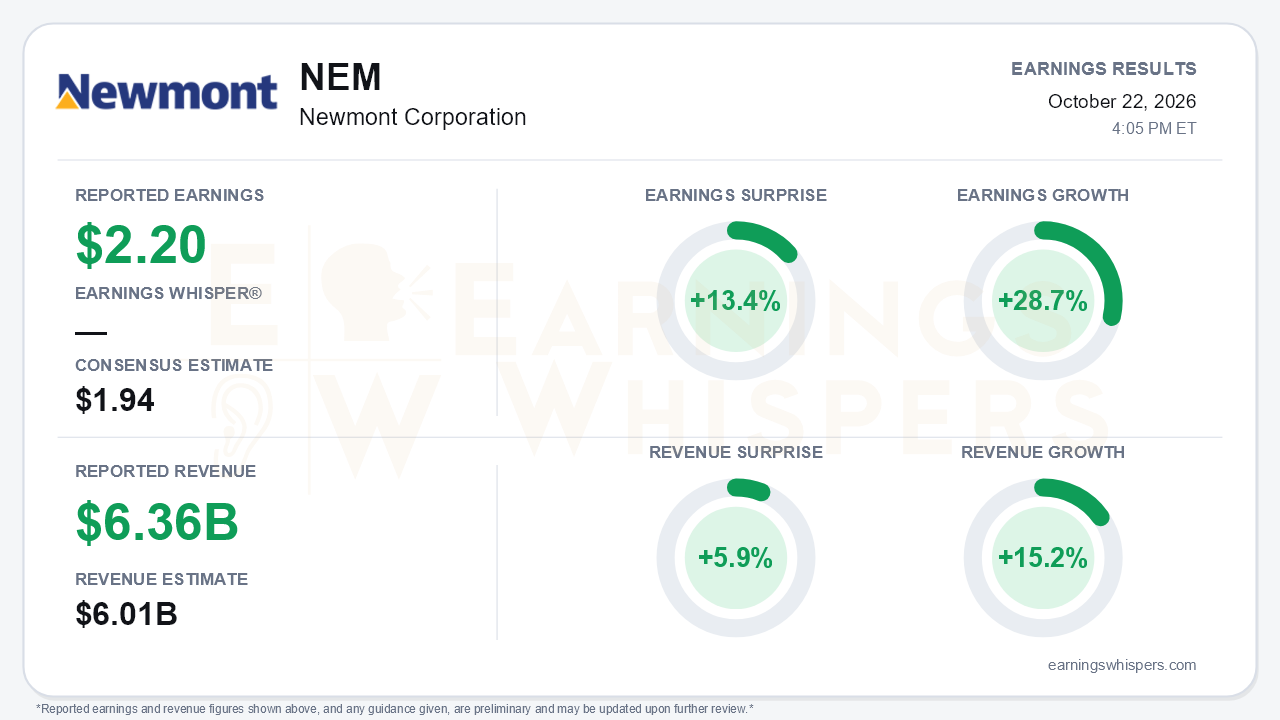
Newmont delivered a clean headline beat for the third quarter. Adjusted earnings of $2.20 per share topped the $1.94 consensus by 13.4% and grew 28.7% year over year. Revenue of $6.363 billion beat the $6.01 billion estimate by 5.9% and rose 15.2%. Management also cut full-year gold by-product AISC guidance to about $1,520 per ounce from $1,680, roughly a 10% improvement. The central tension is that much of the quarter's strength came from metals other than gold and from a shrinking share count, not from the gold business itself. Earnings growth has also cooled sharply from the first half, when adjusted EPS of $2.90 and $2.10 compared with $1.25 and $1.43 a year earlier.
The quality of the beat deserves scrutiny. Consolidated gold sales fell to 1,211 thousand ounces from 1,319 thousand a year ago, and the realized gold price slipped $97 sequentially to $4,317. What filled the gap was Peñasquito and Cadia. Silver production jumped 57% sequentially to 11 million ounces, copper rose 35% to 23 thousand tonnes after Cadia recovered from the April seismic event, and realized copper reached $6.91 per pound. Those credits cut by-product AISC to $1,454 from $1,621 in the second quarter. The co-product view tells a less flattering story: gold co-product AISC climbed to $1,963 from $1,566 a year earlier, a sign that underlying gold unit costs are still inflating. GAAP EPS of $2.35 ran above the adjusted figure, helped by roughly $215 million of valuation-allowance and other tax adjustments that Newmont stripped out.
Cash generation has also lost some momentum. Free cash flow of $1.9 billion was down from $2.2 billion in the second quarter and $3.1 billion in the first. The drivers were a $565 million working-capital drain, including a $318 million receivables swing and $256 million of reclamation spending, along with higher capital investment. Year-to-date free cash flow of $7.3 billion still roughly matches all of 2025. Newmont repurchased $1.6 billion of stock since the last call and has now retired more than 115 million shares, about 10% of the count, since February 2024. Net cash of $3.2 billion is stated before the $1.95 billion payment to Barrick due in the fourth quarter. That payment will pull the balance much closer to the company's $1 billion net-cash target.
The call did preserve a credible growth story. Management turned its earlier "trough year" framing into a quantified outlook, guiding 2027 gold production up by a low-to-mid single-digit percentage. The drivers are higher grades at Lihir and Boddington and Tanami Expansion 2, whose commercial production was pulled forward to around the end of the first half of 2027. Cadia PC1-2 regained its regulatory approvals and is back on schedule. Red Chris now has defined parameters:
- $4.2 to $4.8 billion of development capital on a 100% basis, net of a CAD$500 million Canadian grant;
- 275 to 325 thousand ounces of gold and 65 to 85 thousand tonnes of copper per year;
- commercial production in 2033, with an investment decision in early 2027.
The amended Nevada Gold Mines agreement appears to resolve the friction with Barrick, though at a meaningful cash cost.
Bears have legitimate ammunition in the forward cost picture. Fourth-quarter AISC is guided to about $1,900 per ounce, the highest of the year, as sustaining capital peaks and Peñasquito silver output falls to roughly half of third-quarter levels. Management expects 2027 unit costs to rise on several fronts:
- inflation above the 3% assumption used for 2026;
- higher diesel prices, now with an added roughly $50 million indirect sensitivity per $10 per barrel of oil;
- Australian dollar strength;
- lower co-product credits from Peñasquito.
Development capital is also set to rise by about $500 million in 2027. El Niño-driven water constraints at Lihir add near-term risk to fourth-quarter output. Full-year production guidance of 5.3 million ounces was reaffirmed, not raised.
The market setup is more complicated than the surprise implies. Shares closed at $117.18 the day before the report, up 25.0% from the open after the July release, and sit about 4.3% above the 200-day moving average. However, the stock remains 13.4% below the 52-week high of $135.29 set on August 25, meaning it has given back a sizable portion of its late-summer run. Investor sentiment moved from slightly negative (-0.03) to slightly positive (+0.06), a modest improvement rather than a decisive shift. The internal trend readings are largely neutral, with AVWAP still negative.
The bottom line is that Newmont delivered a solid beat, lower 2026 cost guidance, aggressive capital returns, and a clearer 2027 growth path. However, the quarter leaned heavily on by-product credits and buybacks while gold volumes and co-product costs moved the wrong way. With fourth-quarter costs peaking, 2027 cost guidance pointing higher, and the Barrick payment set to absorb much of the cash cushion, investors will need sustained gold prices and clean project execution to carry the story forward.
Read our earnings preview for Newmont Corporation: https://www.earningswhispers.com/article/NEM/20579
This earnings review was originally published on Earnings Whispers.
This article is for informational purposes only and is not investment advice. Earnings Whispers and its staff may hold positions in the securities mentioned. It was generated automatically, with the help of AI, from Earnings Whispers and company data, and checked by Earnings Whispers before publication.
Mentioned In This Article
Latest News
| 1 hour | |
| 3 hours | |
| 4 hours | |
| 4 hours | |
| 9 hours | |
| 15 hours | |
| 17 hours | |
| Oct-20 | |
| Oct-09 | |
| Oct-08 | |
| Oct-06 | |
| Oct-06 | |
| Sep-29 | |
| Sep-28 | |
| Sep-25 |
