First Interstate Misses As Provision Swing Overshadows A 10th Straight Quarter Of Margin Expansion While Loans Keep Shrinking
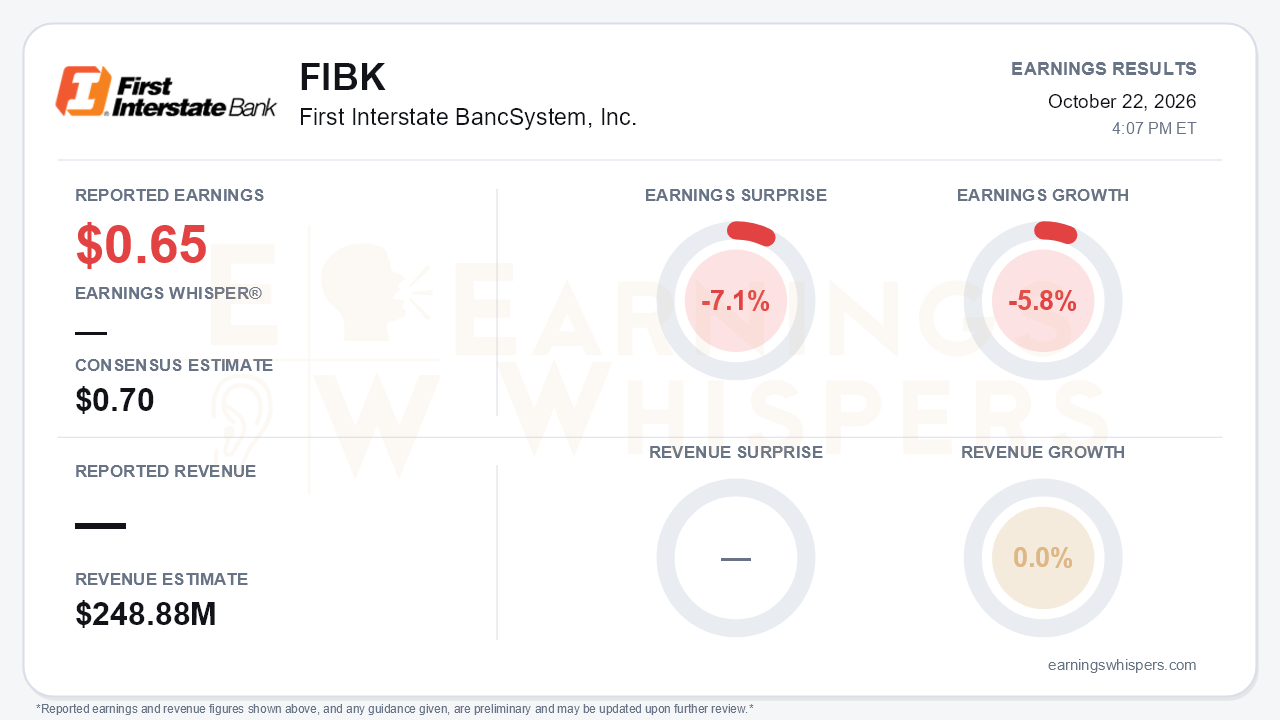
First Interstate BancSystem (NASDAQ: FIBK) reported third-quarter earnings of $0.65 per diluted share, missing the $0.70 consensus by 7.1%. Earnings fell 5.8% year over year. The sequential drop from $0.87 looks steeper than it is, because the second quarter included a $19.5 million gain on the sale of eleven Nebraska branches. Even so, the miss is real, and it came primarily from credit costs rather than core revenue. That is the central tension in the quarter. The spread business keeps improving, but the balance sheet keeps shrinking, and credit metrics have stopped getting better.
The swing in provisioning explains most of the shortfall. FIBK booked a $10.5 million provision after releasing $3.2 million in the second quarter, a pre-tax swing of roughly $13.7 million. Strip that out and the core engine looks healthier. Net interest income rose $4.0 million to $206.2 million. The net FTE margin climbed to 3.55% from 3.48%, and the adjusted margin, which excludes purchase accounting accretion, rose 9 basis points to 3.51%. Noninterest expense edged down to $157.1 million. Pre-provision earnings, excluding the Nebraska gain from the prior quarter, therefore improved sequentially. The cost of funds fell to 1.19%, time deposit costs dropped to 2.60% from 2.72%, and noninterest-bearing deposits grew 2.5%. The buyback magnifies the per-share benefit. The diluted share count is down 8% from a year ago, and management cited net interest income per share up 8% year over year, compared with 4% last quarter.
The problem is the denominator. Loans held for investment fell another $296 million to $13.99 billion. That follows declines of $447 million in the second quarter and $473 million in the first. The loan portfolio is now down 11.7% from a year ago, with construction off 43.6% and the runoff indirect auto book off 40.5%. Management had targeted back-half loan stabilization on its fourth-quarter 2025 call. That inflection slipped once and still has not arrived. Some expected payoffs moved into the fourth quarter, so management is guiding to further declines, and it described the underlying commercial book as still modestly declining. Earning assets are rotating toward securities, and the loan-to-deposit ratio has fallen to 65.4%. Total deposits slipped $52.8 million, and the full-year deposit outlook was trimmed slightly, which management attributed to the exit of a large, high-cost collateralized deposit. That exit added about 3 basis points to the margin.
Credit adds to the case for caution. Nonperforming assets fell 6.1% to $155.0 million, and reserve coverage of nonperforming loans improved to 120%. Underneath, however, criticized loans ticked up $2.1 million after falling 9.3% in the second quarter. Substandard loans rose 4.8%, and accruing loans 30 to 89 days past due jumped to $36.2 million from $24.3 million. Net charge-offs held at 28 basis points, well above the 6 basis points of a year ago. None of this signals acute stress, but the clean-up narrative has stalled.
The forward catalysts are credible but back-end loaded. Management said the September rate increase is lifting asset yields and that the balance sheet is now broadly neutral to rate moves. New loans are coming on in the mid-6% range against a 5.67% portfolio yield. Unfunded construction commitments rose and are expected to fund in 2027, when management sees fixed-asset repricing as potentially more meaningful. Two Colorado branches are planned for the first half of 2027, alongside three more consolidations in the fourth quarter. Management also said the current expense base and relationship-manager capacity can support growth without a step-up in investment. Near term, though, it expects a smaller fourth-quarter margin gain because deposit repricing lags the rate hike. Higher rates also cut the other way. A $147.6 million decline in securities fair value pushed tangible book value down to $21.20 from $22.47 and lowered tangible common equity to 8.06% of tangible assets. Buybacks of $76.3 million also reduced CET1 by 18 basis points to 14.36%, though that remains ample.
Investors entered the report already skeptical, and that skepticism deepened. Earnings Whispers sentiment remained negative and weakened modestly, moving from -0.18 to -0.25. Shares at $36.88 are down 2.1% since the open following the July report and sit just 1.7% above the 200-day moving average of $36.26. Price and AVWAP trend readings are negative. Notably, the company repurchased stock this quarter at an average of $37.37, above where shares now trade.
The bottom line is that FIBK delivered another quarter of genuine margin progress, but a provision-driven miss, persistent loan shrinkage, stalled credit improvement, and a muted fourth-quarter margin outlook leave the earnings-growth story waiting on 2027. Until loan balances stabilize, margin expansion and buybacks are doing the heavy lifting on a shrinking base, and the market has so far shown little willingness to pay ahead of that inflection.
Read our earnings preview for First Interstate BancSystem, Inc.: https://www.earningswhispers.com/article/FIBK/20566
This earnings review was originally published on Earnings Whispers.
This article is for informational purposes only and is not investment advice. Earnings Whispers and its staff may hold positions in the securities mentioned. It was generated automatically, with the help of AI, from Earnings Whispers and company data, and checked by Earnings Whispers before publication.
Mentioned In This Article
Latest News
| Oct-23 | |
| Oct-22 | |
| Oct-22 | |
| Oct-05 | |
| Jul-24 | |
| Jul-23 | |
| Jul-23 | |
| Jul-01 | |
| Apr-29 | |
| Apr-29 | |
| Apr-01 | |
| Feb-10 | |
| Feb-09 | |
| Feb-09 | |
| Feb-04 |
