First Hawaiian Misses As A Credit Blip And Loan-Growth Cut Offset A Steadily Improving Margin Story
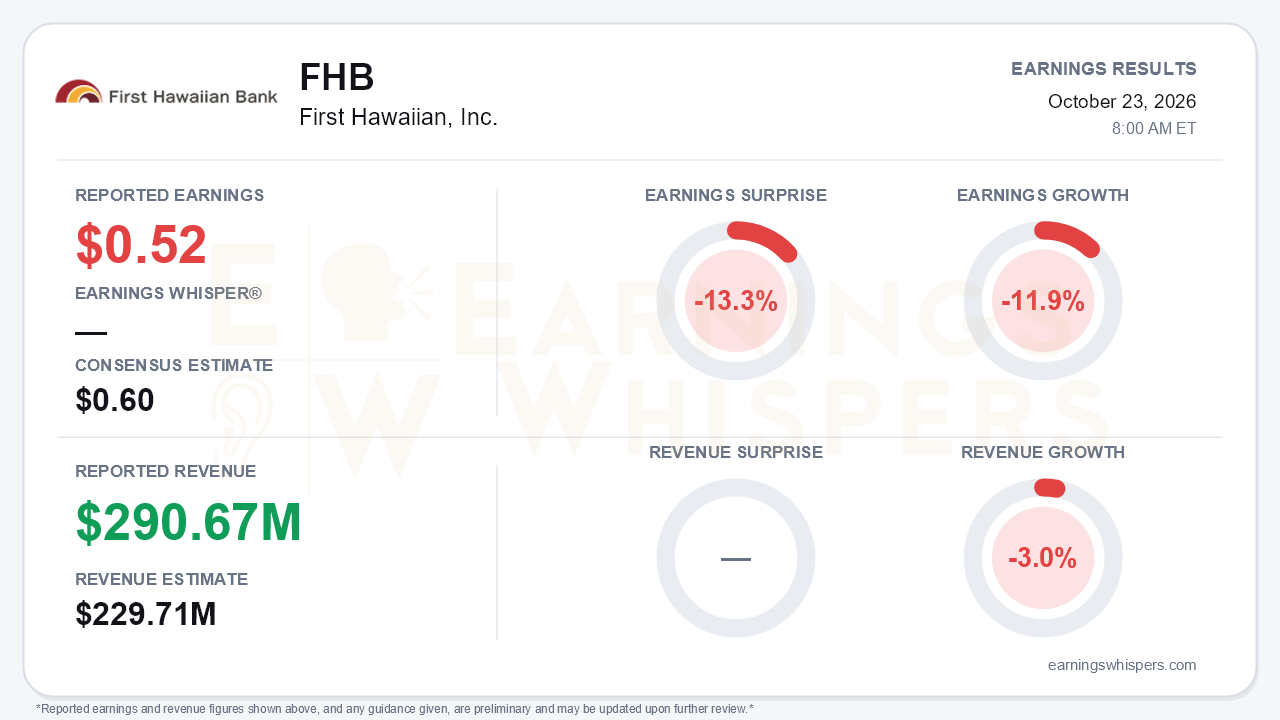
First Hawaiian (NASDAQ: FHB) reported third-quarter earnings of $0.52 per share, missing the $0.60 consensus by 13.3% and falling 11.9% from a year earlier. Revenue of $290.67 million beat the $229.71 million consensus by 26.5% but fell 3.0% year over year. That headline beat deserves context. The normalized figure appears to include gross interest income. Net interest income plus fees came to about $230 million, close to the consensus figure. The more important story is the split inside the quarter. The spread business keeps improving, while credit and loan growth gave investors their first real reasons for caution this year.
The miss came from the credit line, not from one-time items. A settlement of tax liabilities from the 2016 corporate reorganization added a $24.3 million noninterest expense. It also produced a $31.0 million income tax benefit, so the settlement was a net positive. That benefit pushed the effective tax rate to -27.8%. It roughly offset the $6.7 million of merger-related costs, so the special items largely washed out. The real damage was a $20.3 million provision, up from $5.6 million in the second quarter. That provision helped cut pre-tax income nearly in half, to $49.9 million from $95.2 million. Net charge-offs jumped to $21.9 million, or 0.60% of average loans, from 0.11%. The increase was driven by a $12.5 million partial charge-off on a single CRE loan. Management identified it as a participated downtown Seattle office credit. The headline efficiency ratio of 69.2% is inflated by the special items and says little about core cost control.
Beneath the noise, the margin engine is working. The net interest margin rose 5 basis points to 3.30%, up from 3.19% a year ago. Net interest income climbed to $174.1 million from $171.0 million. The gain was helped by a lower cost of interest-bearing deposits, which fell to 1.72% from 1.75%. The spot deposit cost reached 1.17%. Management raised its full-year margin outlook for the third consecutive call, to 3.26%–3.27%, and guided fourth-quarter margin to 3.34%–3.35%. It also lowered its expense outlook to $510–$515 million, excluding merger and tax items, and held fee guidance near $220 million. Repricing spreads on fixed-rate cash flows widened to roughly 160–170 basis points.
The weaker side of the ledger is harder to dismiss. Loans fell $115 million in the quarter, after gains of $137 million in the second quarter and $128 million in the first. Management cited unexpected CRE payoffs to aggressive mainland lenders, lower dealer floor-plan balances and residential runoff. Full-year loan growth guidance was cut to 1%–2% from the 3%–4% held all year. Credit metrics also softened beyond the Seattle loan:
- Criticized assets rose 72 basis points on four non-office CRE downgrades, three of them tied to a shared national credit exam.
- Non-accrual loans increased to $46.0 million.
- Residential loans 90 days or more past due jumped to $15.0 million from $0.8 million. Management attributed this partly to operational problems at a newly outsourced mortgage servicer.
- Reserve coverage slipped to 1.14% of loans.
Management also said deposit costs are likely at a trough and acknowledged a slowing Hawaii economy. Its framing shifted from describing a "strong quarter" to acknowledging "noise."
The forward catalyst is the Trico Bancshares (Tri Counties Bank) acquisition. Shareholder meetings are set for October 29, and the deal is targeted to close in the fourth quarter, pending final regulatory approvals. Management pointed to possible buyback resumption after the close and expected Basel III revisions to add roughly 100 basis points to CET1. CET1 already improved to 13.50%. Management also flagged cross-selling opportunities in agriculture and oil-and-gas lending, and plans to shrink credit-only mainland participations, the category behind the Seattle loss. Integration risk is real, however. Management expects about $25 million of merger costs in the fourth quarter, and core conversion is not targeted until the second half of 2027.
Investor sentiment improved from -0.12 to +0.03 heading into the report. That is a meaningful move toward neutral, but hardly enthusiastic. Price action has been less forgiving. Shares at $25.34 are 10.4% below the $28.28 open following the July report and about 4.7% below the 200-day moving average of $26.59. The stock traded as high as $30.58 during the quarter before closing September at $24.62, so much of the earlier rally has already been surrendered. The Earnings Whispers trend readings are mixed: momentum and AVWAP are positive, while the price trend remains negative.
The bottom line is that First Hawaiian's core earnings power, measured by margin, deposit costs and expense discipline, keeps getting better, and management keeps raising those targets. But this quarter introduced a credible bear argument built on shrinking loans, a guidance cut, mainland CRE losses and rising problem assets in a slowing local economy. Bulls need the Seattle charge-off to prove isolated and the Trico close to restore growth. Until then, the miss is less about one bad loan than about whether credit and balance-sheet momentum have turned.
Read our earnings preview for First Hawaiian, Inc.: https://www.earningswhispers.com/article/FHB/20605
This earnings review was originally published on Earnings Whispers.
This article is for informational purposes only and is not investment advice. Earnings Whispers and its staff may hold positions in the securities mentioned. It was generated automatically, with the help of AI, from Earnings Whispers and company data, and checked by Earnings Whispers before publication.
Mentioned In This Article
Latest News
| 5 hours | |
| Oct-23 | |
| Oct-23 | |
| Oct-02 | |
| Sep-29 | |
| Aug-17 | |
| Aug-06 | |
| Jul-24 | |
| Jul-24 | |
| Jul-24 | |
| Jul-24 | |
| Jul-21 | |
| Jul-16 | |
| Jul-14 | |
| Jul-13 |
