Atlas Energy's Sand Pricing Standoff Faces Its Test As Power Ambitions Strain The Balance Sheet
Atlas Energy Solutions walked into the third quarter having told investors to brace for a weaker stretch, and it did so on purpose. Management chose to hold the line on sand pricing rather than chase volume, betting that a temporary sacrifice would force competitors to reveal how much capacity they really have before the 2027 contracting season. The quarter ending in September is when that gamble starts to show up in the numbers. Meanwhile, the company is spending heavily to build a behind-the-meter power business that will not produce cash until 2027. The report due after the close on November 2 will show how much pain the strategy costs in the meantime and whether the payoff still looks credible.
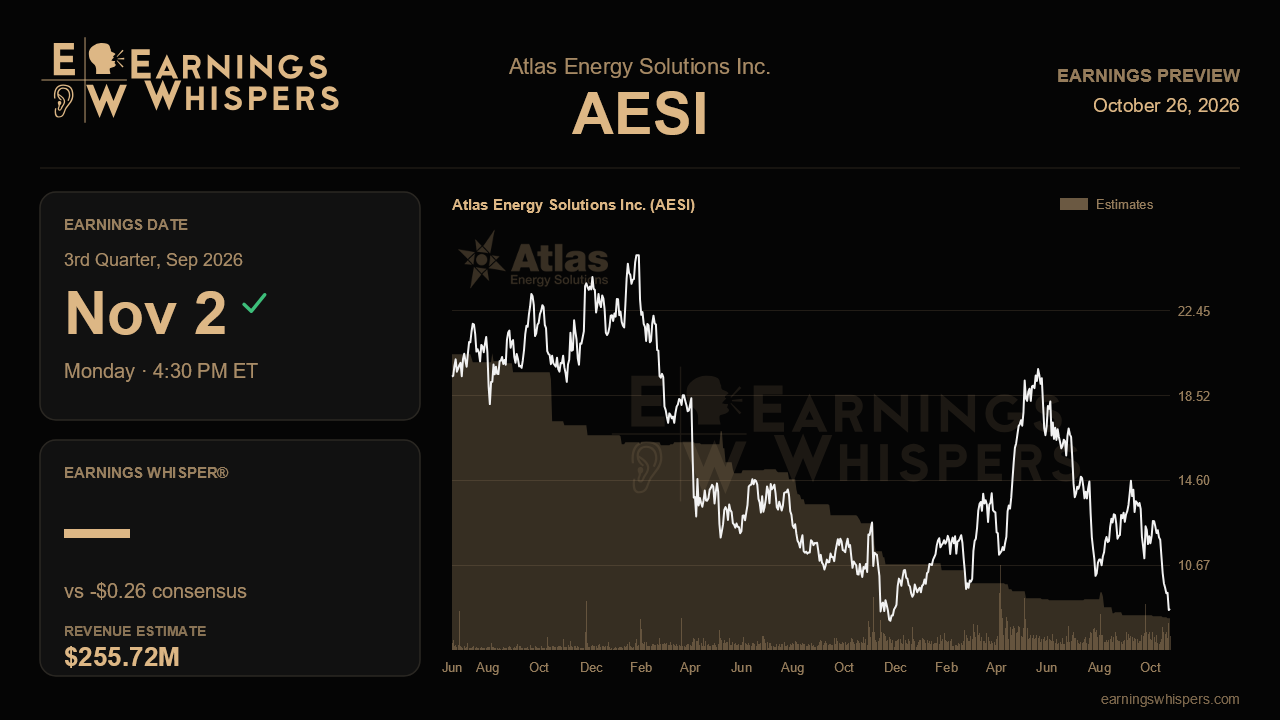
The Street expects a loss of $0.26 per share on revenue of about $255.7 million. That would be a wider loss than the $0.18 posted last quarter and roughly double the $0.13 loss from a year ago. Revenue would be essentially flat to slightly lower year over year, down about 1.5%, but a sharp sequential drop from the $293.2 million reported in the second quarter. That decline matches what management signaled. It guided third-quarter adjusted EBITDA to $30 million to $45 million, well below the roughly $50 million delivered in the second quarter. It also projected sand volumes of 5.3 million to 6.0 million tons, compared with 5.6 million tons last quarter. The width of those ranges is itself a message. Management was not sure how customers would respond to firm pricing, and it expected customer crew breaks of 30 to 45 days to create an air pocket before a fourth-quarter ramp.
What would validate the plan? Average selling price is the first test. It has slid from $19.85 a ton in the fourth quarter of 2025 to roughly $17.70 in the second quarter. If pricing stabilizes near that level while volumes land near the middle of the guided range, the discipline story holds. Evidence that rivals are struggling would also help. Last quarter Atlas cited competitors unable to find truck drivers and described taking over two well-site jobs mid-completion. A third proof point is cost. Plant operating expense fell to $12.39 a ton from $13.86, and holding those gains on lower volume would show real operating leverage. Results challenge the story if EBITDA lands near the $30 million floor, if volumes slip below 5.3 million tons, or if prices erode anyway. In that case Atlas would have given up both volume and price.
The power business carries the longer-term narrative. Atlas signed its first behind-the-meter contract, a 120-megawatt agreement in Socorro, Texas, with an investment-grade technology counterparty. The project calls for about $190 million of capital, electrification at the end of the first quarter of 2027, and revenue beginning in the second quarter of 2027. Management also described a pipeline of 8 to 10 gigawatts, prospective contract terms stretching to 15 to 20 years, and data center campuses of 500 megawatts or more. A second signed contract, or clear progress toward the 180 to 200 megawatt oilfield power target for year-end, would add weight to that pipeline. The counterweight is leverage. Debt rises while the build-out precedes the cash flow, and with the dividend still suspended, any slip in the project timeline will draw scrutiny. Diesel costs and driver shortages remain an added squeeze on logistics margins.
The market has not been patient. Shares are down 12.6% since the last report against a flat S&P 500. At $8.66, the stock sits just above its post-earnings low of $8.45 and far below its 200-day moving average of $13.45. Bearish sentiment has climbed to 55.8% from 31.4% a quarter ago, so expectations look washed out, though that guarantees nothing.
The central question is whether the third-quarter trough looks deliberate and temporary or like a business losing ground. If pricing holds, the fourth-quarter ramp looks intact, and power milestones remain on schedule, the strategy survives its hardest quarter. If any of those slip, investors may doubt both halves of the story at once.
This earnings preview was originally published on Earnings Whispers.
This article is for informational purposes only and is not investment advice. Earnings Whispers and its staff may hold positions in the securities mentioned. It was generated automatically, with the help of AI, from Earnings Whispers and company data, and checked by Earnings Whispers before publication.
Mentioned In This Article
Latest News
| Oct-26 | |
| Oct-22 | |
| Oct-16 | |
| Sep-25 | |
| Sep-25 | |
| Sep-25 | |
| Sep-24 | |
| Aug-25 | |
| Aug-04 | |
| Aug-03 | |
| Aug-03 | |
| Jul-31 | |
| Jul-31 | |
| Jul-15 | |
| Jun-02 |
