AI Headlines Pile Up as Wall Street Navigates a Volatile Week
Things are happening, folks.
Anthropic officially filed for its IPO this morning, SpaceX secured $40 billion in debt financing for GPUs, Meta announced plans for a $95 billion equity offering, and concerns surrounding the neocloud industry continue to intensify.
And that's just the AI news.
We also have five major central banks meeting this week, including the Federal Reserve on Wednesday, followed by GDP and PCE inflation data on Thursday. Meanwhile, roughly 25% of the S&P 500 by market capitalization is set to report earnings, including three of the largest AI hyperscalers, the oil majors and several major pharmaceutical companies.
All of this comes as the major indexes are navigating elevated volatility, trading near the lower end of their recent ranges as the midterm elections approach and geopolitical tensions continue to rise.
There is a lot to cover, so let's get into it.
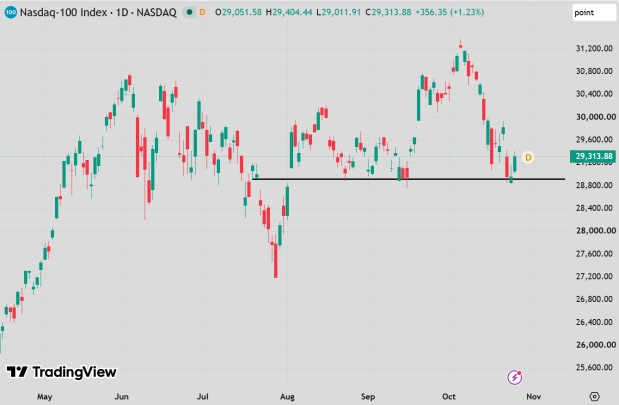
Image Source: TradingView
Anthropic Opens Its Books: The First Look at Frontier AI Economics
One of the biggest developments this morning was Anthropic's public S-1 filing, officially setting the stage for its initial public offering later this year. The company, best known for its Claude family of AI models, plans to list on the Nasdaq under the ticker ANT.
The short version is that the numbers are quite good. Really, they're extraordinary.
Revenue increased from just $41 million in 2023 to $386 million in 2024, before surging to approximately $4.6 billion in 2025. In the first six months of 2026 alone, revenue reached $16.3 billion, roughly 14 times the level generated during the same period last year.
Of course, the company is spending enormous sums to support that growth, but the underlying business economics appear considerably more compelling than many had anticipated.
Anthropic reported a $693 million operating loss during the first half of 2026, narrowing sharply from $2.1 billion in the prior-year period. Gross margins are also reportedly approaching 85%, suggesting an increasingly attractive revenue model as the business scales.
There was also a staggering $80.7 billion net loss, but that figure is somewhat misleading. Roughly $72.4 billion came from a noncash accounting adjustment required to revalue outstanding convertible notes as Anthropic's valuation surged.
Meanwhile, the company reported an enormous $112.4 billion cash reserve as of June 30, alongside another $19.3 billion in short-term investments.
This was all better than I had expected.
For several years, one of the biggest uncertainties hanging over the AI trade has been the lack of visibility into the economics of the companies actually developing these frontier models.
We have been able to see the enormous revenues flowing to Nvidia, the semiconductor manufacturers and infrastructure providers, but had very little insight into whether their customers were building sustainable businesses.
Now, for the first time, we have a detailed look at one of the leading AI developers, and the initial picture is encouraging.
There are still plenty of questions about future computing obligations, operating expenses and long-term profitability. But Anthropic's extraordinary revenue growth, improving operating results and substantial liquidity suggest the commercial opportunity is very real.
And as more of these businesses move toward public ownership, the additional transparency could remove a meaningful source of uncertainty surrounding the entire AI investment cycle.
SpaceX Raises $40 Billion While Neoclouds Struggle
SpaceX (SPCX) announced over the weekend that it had secured approximately $40 billion in debt financing to purchase AI chips, highlighting the extraordinary scale of investment still flowing into the industry.
The announcement follows SpaceX's third-quarter earnings report last week, which revealed an explosion in AI-related revenue that increasingly complements its established Starlink and rocket-launch businesses.
Of the approximately $14.6 billion in quarterly revenue, $7.56 billion came from its AI business, which expanded nearly tenfold year over year.
That diversification is becoming an increasingly important advantage.
Musk also had some interesting comments on X regarding AI infrastructure financing and the neocloud industry.
According to Musk, debt markets have become far less willing to lend to businesses without substantial revenue streams outside AI data centers. He argued that SpaceX was able to secure financing because of its investment-grade balance sheet and established Starlink and launch revenues.
He also predicted substantial failures and consolidation among the more than 200 neocloud operators, describing the coming shakeout as "guppy-level death and consolidation."
Those are pretty stark comments, but the market has already been signaling growing concerns about the industry's financial sustainability.
For those unfamiliar, neoclouds are specialized cloud computing businesses that build data centers and rent computing capacity to AI developers and enterprise customers.
Companies such as CoreWeave (CRWV), Nebius (NBIS) and IREN (IREN) have been among the biggest beneficiaries of the AI infrastructure boom, but their expansion strategies require enormous amounts of capital, much of it financed through debt.
As interest rates have risen and lenders have become more concerned about the durability of these business models, the sustainability of that approach has come into question.
CoreWeave has been at the center of the turmoil.
Some of the company's unsecured bonds have fallen below 80 cents on the dollar, levels typically associated with distressed debt, while yields on certain issues have climbed above 15%.
That is a significant warning sign.
A company whose business model depends on continuously borrowing billions of dollars to expand computing capacity faces a much more difficult environment when lenders suddenly demand substantially higher returns.
CoreWeave and other neocloud operators have substantial contracted revenue backlogs, and demand for computing capacity remains extremely strong. That is the bullish side of the argument.
But strong demand does not necessarily guarantee a sustainable business model, particularly when financing costs, equipment depreciation and future capital requirements are all moving targets.
I continue to believe the AI infrastructure boom has considerable room to run, but the market is increasingly distinguishing between companies with strong balance sheets and established cash flows and those dependent on continued access to external capital.
That distinction could become one of the defining themes of the next phase of the AI investment cycle.
Meta Turns to Equity Markets to Finance Its AI Expansion
Also this morning, Meta Platforms (META) announced plans to raise as much as $95 billion through equity issuance to help finance its enormous AI expansion.
The announcement follows last week's earnings report, when Meta beat estimates on both the top and bottom lines and raised its expected 2026 capital expenditures to between $135 billion and $145 billion.
That is an extraordinary amount of money, even for a company of Meta's size.
The financing plan begins with approximately $35 billion in common and preferred stock offerings, followed by an additional $60 billion that could be raised through an at-the-market equity program next year.
What makes this development particularly interesting is the change in how Meta is financing its investments.
Until recently, the company had largely funded its capital expenditures through the enormous cash flows generated by its advertising business. Now, it is turning directly to shareholders for additional capital.
It is also a different approach from SpaceX, which has relied heavily on debt financing.
And Meta is not alone.
Alphabet (GOOGL) completed a similar $90 billion multi-tranche equity and equity-linked capital-raising program in June, including common equity, convertible preferred shares, a private placement and an at-the-market offering.
We are now seeing some of the largest and most profitable companies in the world turn to external financing to support their AI ambitions.
There is nothing inherently wrong with that. In fact, issuing equity can be a more conservative approach than taking on excessive debt, particularly when the returns on these investments remain uncertain.
But it does introduce dilution risk for existing shareholders, and it illustrates just how much capital the AI industry is consuming.
Another interesting detail is that Nvidia, AMD and Broadcom have reportedly expressed interest in purchasing up to $5 billion of Meta's offering collectively.
In other words, some of the companies supplying AI infrastructure are now potentially helping finance the customers buying their products.
Taken together, these announcements highlight an important evolution in the AI investment cycle.
For the last several years, the primary focus has been on how quickly companies can build out computing infrastructure. Increasingly, the questions are shifting toward how that expansion will be financed, what the capital will cost and whether the eventual returns will justify the investment.
The demand side of the equation still looks exceptionally strong. But financing is becoming an increasingly important consideration, and the market is beginning to take notice.
Five Central Banks, Three Days and Another Critical Fed Decision
Beyond the AI headlines, the macroeconomic calendar is exceptionally busy this week.
Five major central banks are scheduled to announce interest rate decisions over the next three days, including the Federal Reserve, Bank of Canada, Reserve Bank of New Zealand, European Central Bank and Bank of Japan.
The general expectation is for most policymakers to leave rates unchanged, although New Zealand and Canada could potentially deliver additional hikes.
In the United States, the Federal Reserve is widely expected to hold its benchmark policy rate at 3.75% to 4.00%, with fed funds futures pricing approximately an 89.5% probability of no change as of this writing.
That makes the decision itself somewhat less important than the accompanying commentary from Fed Chair Kevin Warsh, although he has generally been reluctant to offer much in the way of explicit forward guidance.
The more important question is whether the Fed sees enough evidence of persistent inflation to justify another rate hike before year-end.
Recent economic resilience, rising energy prices and stubborn inflation pressures have complicated the outlook considerably.
And given the growing concerns surrounding debt-financed AI expansion, the direction of interest rates is becoming even more consequential for the technology sector.
We also have two important economic releases on Thursday morning, with the advance estimate for third-quarter GDP and the September Personal Consumption Expenditures inflation report.
The GDP report should offer another useful indication of the economy's underlying momentum, while PCE remains one of the Fed's preferred measures of inflation.
A hotter-than-expected inflation print immediately following Wednesday's Fed decision could quickly shift expectations for December and put additional pressure on the bond market.
With interest rates already elevated and financial conditions becoming more restrictive, these releases have the potential to generate meaningful volatility across asset classes.
Big Tech Earnings Take Center Stage
Finally, we have another exceptionally important week of corporate earnings.
The third-quarter reporting season is moving into full swing, with more than 130 S&P 500 companies expected to release results over the coming days.
Several of the world's largest technology companies will be reporting, including Alphabet, Microsoft (MSFT) and Amazon (AMZN).
Of course, investors will be watching the traditional metrics, including cloud revenue growth, operating margins, earnings guidance and the performance of each company's core businesses.
But I suspect the biggest questions will center around capital expenditures.
How much more are these companies planning to spend on AI infrastructure? Are they beginning to see meaningful returns from their investments? And perhaps most importantly, how much additional financing will they need to support their expansion plans?
After the developments at Meta, SpaceX and across the neocloud industry, those questions are likely to receive considerably more attention.
The hyperscalers have been the primary drivers of the enormous capital investment cycle supporting semiconductor manufacturers, data center operators, power infrastructure providers and countless other businesses.
As long as that spending continues to grow, it should remain a powerful tailwind for the broader AI ecosystem.
However, any suggestion that these companies are becoming more cautious could create another round of volatility, particularly among the more speculative infrastructure providers.
Outside technology, we also have major earnings reports from Eli Lilly (LLY), Mastercard (MA), Exxon Mobil (XOM) and Chevron (CVX), among many others.
Energy and technology have been major contributors to S&P 500 earnings growth, making these reports particularly important for assessing the strength of corporate profits.
I'll also be watching for continued signs of earnings growth broadening beyond the technology sector, which would be an encouraging development for the sustainability of the bull market.
What to Expect in the Stock Market This Week
There is a lot for investors to digest this week, and given the recent volatility, I wouldn't be surprised to see some sharp market reactions to the incoming headlines.
My broader outlook remains constructive. The AI infrastructure boom, substantial fiscal spending and relatively abundant liquidity continue to provide important support for economic activity and corporate earnings.
However, the latest financing developments are worth taking seriously.
The scale of capital investment is becoming extraordinary, borrowing costs are rising, and investors are beginning to distinguish more carefully between companies with sustainable cash flows and those heavily dependent on external financing.
I don't see these developments as evidence that the AI boom is ending. Rather, they suggest the investment cycle is entering a more mature and potentially more selective phase.
And despite the recent selling, there is still plenty of evidence that underlying demand remains exceptionally strong. Anthropic's financial disclosures were a particularly encouraging development on that front.
With central bank decisions, major economic reports and hyperscaler earnings all arriving over the next few days, we should have a much clearer picture of where the market stands by the end of the week.
For now, I think patience and selectivity remain important. We could certainly see additional volatility as the midterm elections approach, but I continue to believe the underlying bull-market drivers are intact.
And if those fundamentals continue to hold up, the recent selling could ultimately create some very attractive opportunities.
Want the latest recommendations from Zacks Investment Research? Today, you can download 7 Best Stocks for the Next 30 Days. Click to get this free report
Chevron Corporation (CVX): Free Stock Analysis Report
Mastercard Incorporated (MA): Free Stock Analysis Report
ExxonMobil Holdings Corporation (XOM): Free Stock Analysis Report
Eli Lilly and Company (LLY): Free Stock Analysis Report
Alphabet Inc. (GOOGL): Free Stock Analysis Report
Space Exploration Technologies Corp. (SPCX): Free Stock Analysis Report
Meta Platforms, Inc. (META): Free Stock Analysis Report
IREN Limited (IREN): Free Stock Analysis Report
Nebius Group N.V. (NBIS): Free Stock Analysis Report
CoreWeave Inc. (CRWV): Free Stock Analysis Report
Amazon.com, Inc. (AMZN): Free Stock Analysis Report
Microsoft Corporation (MSFT): Free Stock Analysis Report
This article originally published on Zacks Investment Research (zacks.com).
Mentioned In This Article
Latest News
| 9 min | |
| 14 min | |
| 14 min | |
| 23 min | |
| 30 min | |
| 31 min | |
| 40 min |
SpaceX Merger Could Accelerate Tesla's Push Into AI and Autonomous Driving: Barclays
SPCX
Benzinga Prediction Markets
|
| 47 min | |
| 50 min | |
| 53 min | |
| 54 min | |
| 1 hour | |
| 1 hour | |
| 1 hour | |
| 1 hour |
