Amkor Misses And Guides Lower As Smartphone Weakness Offsets A Strengthening AI Compute And Margin Story
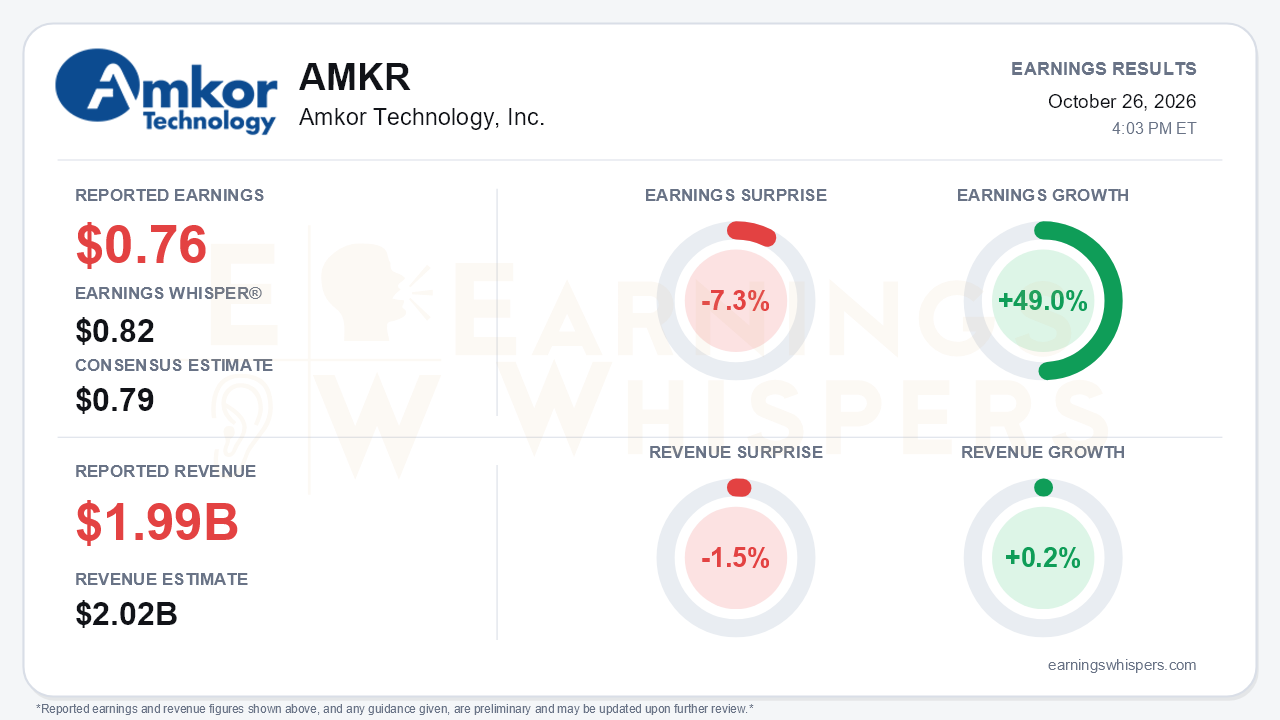
Amkor Technology delivered a quarter in which the business improved in important ways but still fell short of what investors were paying for. Third-quarter earnings of $0.76 per share missed the $0.79 consensus by 7.3% and fell further below the $0.82 Earnings Whisper number. Revenue of $1.991 billion trailed the $2.02 billion consensus by 1.5%. The year-over-year comparison looks very different: earnings grew 49.0% while revenue grew just 0.2%. That is the central tension. Amkor is earning substantially more on essentially flat sales, which means the improvement is about mix and margin rather than volume. The fourth-quarter outlook, which came in below estimates, suggests the volume problem is not yet resolved.
The quality of the margin gain is real. Gross margin reached 18.3%, up from 16.8% in the second quarter and 14.3% a year ago. Operating margin was 11.3%, compared with 8.0% a year earlier. The cost breakdown shows where the gain came from. Materials fell to 50.7% of sales from 57.5% a year ago, a sign of a richer, less pass-through-heavy mix. Depreciation rose to 8.6% from 7.5%, so heavier investment is already weighing on the cost structure. The end-market shift is striking. Communications fell to 37% of sales from 51% a year ago, while computing rose to 26% from 19% and automotive and industrial rose to 22% from 16%. Advanced products revenue was actually lower year over year at $1.632 billion versus $1.684 billion. Top-ten customer concentration dropped to 66% from 73%, which is healthier, but it also reflects the shrinking smartphone franchise.
The miss is easier to understand against Amkor's own guidance. Gross margin landed below the 18.5% to 19.5% guide. Management attributed roughly 60 basis points to currency and the July Kumamoto earthquake. Computing rose 25% sequentially to a record but trailed the roughly 30% management had guided, because loading the 300-plus-step HDFO process took longer than expected. Consumer grew 10% against a mid-teens guide, and communications fell 8%. None of these shortfalls was large, but together they produced EPS just under the guidance midpoint and well below the whisper.
The forward-looking evidence is better than the quarter. Management now expects 2026 computing growth above 30%, up from above 20% at the start of the year, and said 2027 should be similar or higher. Fourth-quarter computing is guided up low double digits sequentially and more than 50% year over year. A hyperscaler HDFO CPU program began ramping, and two new 2.5D networking and data center programs come online in the fourth quarter. Advance-payment arrangements now cover a dozen customers, which analysts put at roughly $3 billion, with more under discussion. Management also framed packaging as an industry bottleneck with a constructive pricing environment.
Bears still have legitimate ammunition. The fourth-quarter guide of $1.9 billion to $2.0 billion in revenue and $0.65 to $0.75 in EPS implies a sequential step down. Communications is expected to fall high single digits and consumer mid-teens. New component shortages in premium smartphones and wearables add to memory-pricing pressure and an SIP migration headwind that extends into the first half of 2027. The capital burden is also escalating. The Arizona campus is now a roughly $12 billion, two-phase commitment, up from a $7 billion framework. Capex intensity is expected to exceed 30% of sales into 2028-29, and depreciation is set to rise further in 2027. Over nine months, $868 million of operating cash flow did not cover $1.24 billion of capex payments. Long-term debt rose to $2.32 billion from $1.28 billion at year-end, and total debt of $2.5 billion now slightly exceeds $2.4 billion in cash and investments.
The market had already turned skeptical before the report. Shares entered earnings at $39.30, down 24.1% from the open after the July report. That left them 36.8% below the August 17 inter-earnings high of $62.23 and just 2% above the low set on October 23. The stock sits 31.7% below its 200-day moving average. Investor sentiment moved from essentially neutral at 0.02 to modestly negative at -0.19, a meaningful but not extreme deterioration. In short, expectations were deflating, yet the whisper number still sat above consensus, and Amkor missed both.
The bottom line is that Amkor's quarter was a near-term disappointment wrapped around a strengthening long-term thesis. Margins, compute momentum, customer prepayments and capacity commitments all moved in the right direction. Execution slipped modestly, however, and the fourth-quarter guide shows that smartphone and consumer weakness can still overwhelm AI-driven growth at the revenue line. With the stock near its lows and sentiment soured, the debate now centers on whether the compute ramp can outrun a heavier capex and depreciation burden before investor patience runs thinner.
Read our earnings preview for Amkor Technology, Inc.: https://www.earningswhispers.com/article/AMKR/20640
This earnings review was originally published on Earnings Whispers.
This article is for informational purposes only and is not investment advice. Earnings Whispers and its staff may hold positions in the securities mentioned. It is AI-assisted, based on proprietary Earnings Whispers data and company reports, and edited by Earnings Whispers staff.
Mentioned In This Article
Latest News
| 1 hour | |
| 2 hours | |
| 5 hours | |
| 5 hours | |
| Oct-21 | |
| Oct-21 | |
| Oct-21 | |
| Oct-21 | |
| Oct-16 | |
| Oct-05 | |
| Sep-08 | |
| Sep-08 | |
| Sep-02 | |
| Aug-27 | |
| Aug-12 |
