Mosaic Faces A Sulfur Squeeze As Wall Street Braces For A Near-Breakeven Quarter
Three months ago, Mosaic stopped talking like a company in recovery and started talking like one managing a siege. A sulfur supply shock tied to the Strait of Hormuz and a new Kazakhstan blockade pushed the company into deeper phosphate curtailments, and the third-quarter report will be the first full look at what that defensive posture costs. The question is not whether earnings collapse from a year ago. Everyone already expects that. It is whether the cost cuts, potash strength and balance-sheet moves are enough to keep a bad quarter from becoming a worse one.
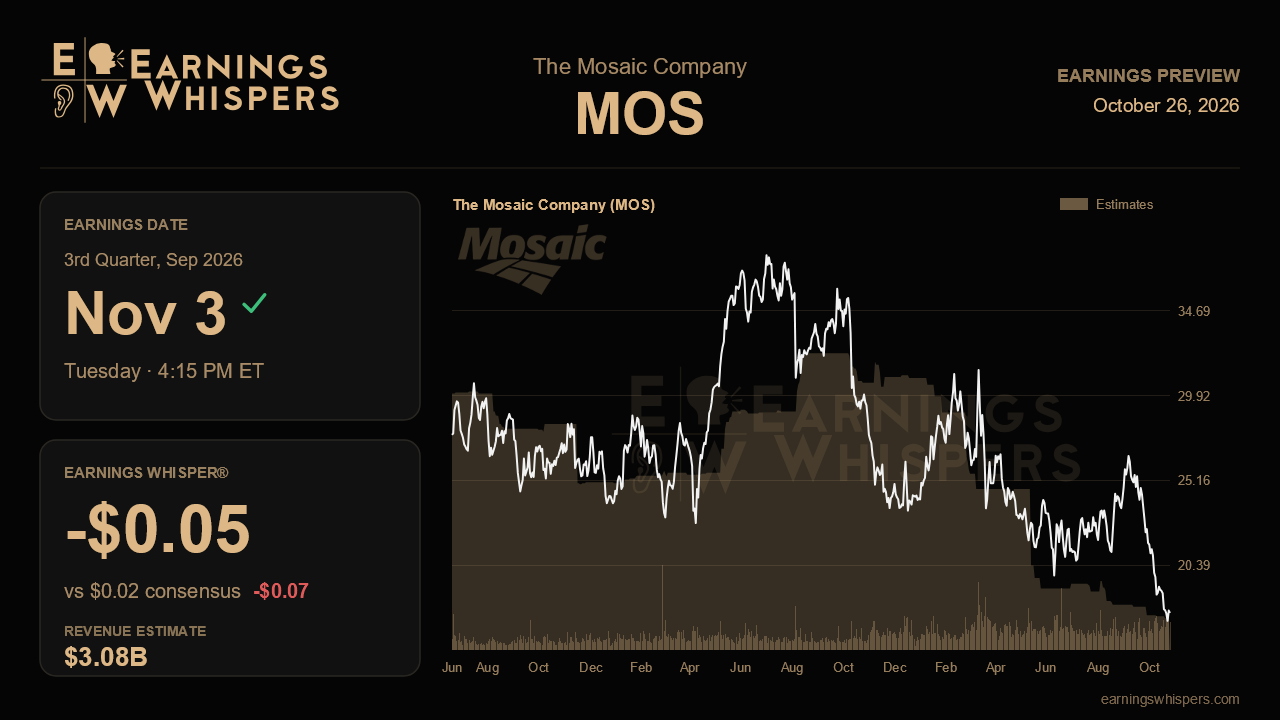
The Street is looking for earnings of about $0.02 a share on revenue of roughly $3.08 billion. That implies a 98% plunge in profit from the $1.04 earned a year earlier and an 11% revenue decline, a clear contraction rather than a soft patch. The whisper number sits at a loss of $0.05, below consensus. The gap is only a few cents, but on a base this close to zero it changes the story: the informal bar assumes Mosaic slips into the red. Revenue is expected to rise from the $2.82 billion booked last quarter, which is worth scrutinizing given that management guided phosphate shipments down to 1.1 million to 1.4 million tons from 1.4 million. Any sequential top-line gain likely has to come from higher prices and potash rather than phosphate volume.
Phosphate economics are the heart of the matter. Sulfur settled at roughly $700 to $710 a ton for the quarter, up from $522 realized in the second quarter and $379 in the first. Management raised its DAP price outlook to $820 to $840 a ton, which kept stripping margins above historical norms, but it also guided those margins lower from the $422 realized last quarter. With Louisiana fully idled and Bartow running about 40% down, idle and turnaround costs plus weak fixed-cost absorption will weigh on unit costs. A phosphate result where stripping margins hold closer to last quarter's level would validate the argument that pricing can absorb the sulfur spike. A sharper squeeze, or shipments at the bottom of the guided range, would suggest the curtailments are doing more damage than the temporary framing implies.
Brazil is the second pressure point. Fertilizantes EBITDA fell to $60 million last quarter, far from the $120 million-plus quarterly ambition voiced a year ago, and management guided lower still. Prepayments from Brazilian buyers dropped to near zero. Management did point to rising crop prices and stronger recent Brazil shipments as early green shoots, so any sign that prepayments are returning or that farmer purchasing is stabilizing would be the most meaningful evidence that the pent-up demand thesis has legs. The counterweights are the controllables: SG&A down 20% and described as permanent, capital spending trimmed to $1.2 billion, a $1 billion term loan with the $2.5 billion revolver untouched, and a promise of sequential free cash flow improvement. Potash, with summer fill fully subscribed and low-cost Hydrofloat tons at Esterhazy, should again provide ballast.
The market has not waited for the numbers. Shares have fallen about 18% since the last report while the S&P 500 dipped roughly 1%, and sentiment has turned more bearish than it was heading into the prior quarter. At $17.71, the stock sits only about 4% above its post-earnings low of $16.99 and well beneath the $26.96 high, so it is pressing against the bottom of its range with a lot of pessimism already priced in.
That setup means the headline EPS figure may matter less than the trajectory. If Mosaic shows stripping margins resisting the sulfur surge, delivers the promised cash flow improvement and signals that curtailed capacity can restart as raw material costs normalize, the crisis-management narrative stays intact as a temporary detour. If sulfur keeps climbing, demand stays more than 30% below normal in North America and Brazil fails to turn, the market will start to treat this as something longer lasting.
This earnings preview was originally published on Earnings Whispers.
This article is for informational purposes only and is not investment advice. Earnings Whispers and its staff may hold positions in the securities mentioned. It is AI-assisted, based on proprietary Earnings Whispers data and company reports, and edited by Earnings Whispers staff.
Mentioned In This Article
Latest News
| Oct-26 | |
| Oct-22 | |
| Oct-14 | |
| Oct-13 | |
| Sep-23 | |
| Sep-21 | |
| Sep-21 | |
| Sep-21 | |
| Sep-21 | |
| Sep-10 | |
| Sep-07 | |
| Aug-27 | |
| Aug-27 | |
| Aug-18 | |
| Aug-17 |
