United Fire Heads Into Q3 Testing Whether Investment Income Can Outrun Fading Rate Gains
United Fire Group enters its third-quarter report with an unusual combination: shares pressing against fresh highs and a consensus that calls for earnings to fall by roughly a fifth. That tension defines the setup. Last quarter management described the best first-half return on equity in two decades and the highest quarterly investment income since 2016. It also acknowledged that the pricing cycle is cooling, and that the main earnings engine is shifting from underwriting rate toward portfolio yield. This report should show whether that handoff is happening smoothly.
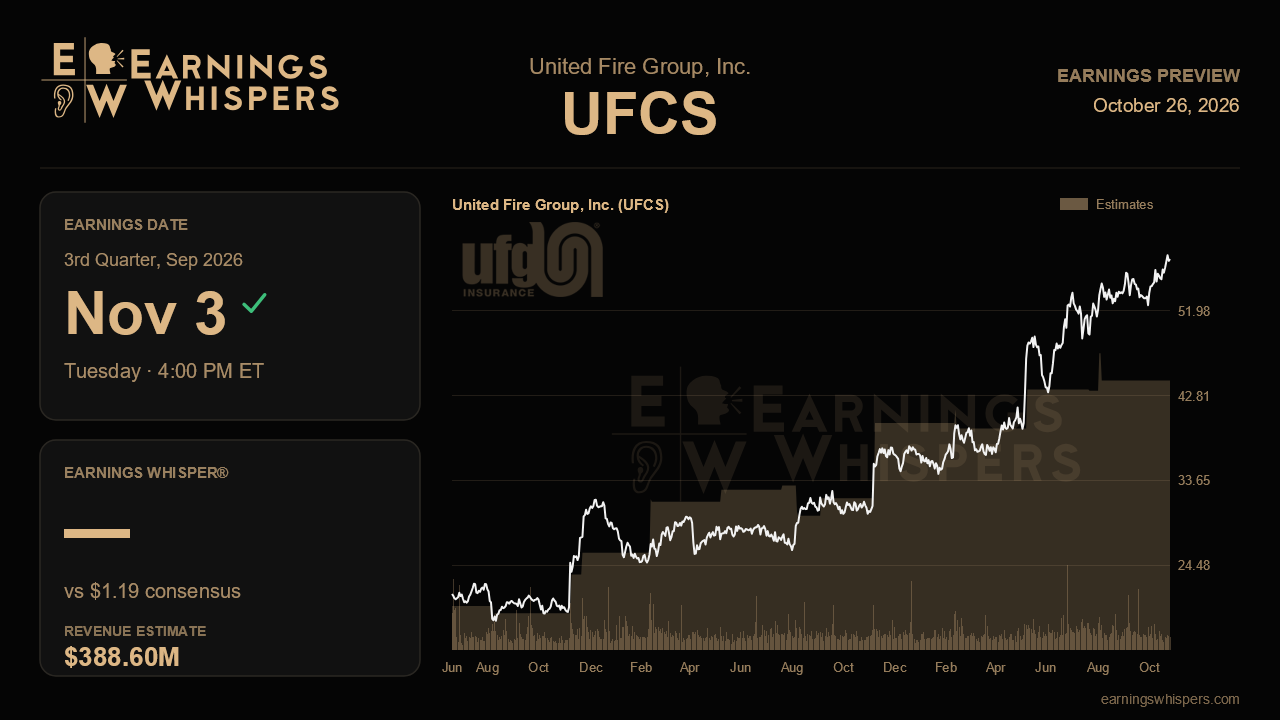
Wall Street expects earnings of $1.19 per share on revenue of $388.6 million when the company reports after the close on November 3. Revenue would be up nearly 10% from the year-ago $354.0 million, consistent with the 9% net written premium growth posted last quarter. Earnings per share, however, would fall about 21% from $1.50 and slip below the $1.30 earned in the second quarter. Analysts are effectively assuming that top-line growth and higher investment income will not fully offset a thinner underwriting margin. As a property and casualty insurer, United Fire does not issue formal guidance. The qualitative message from management was confident, which leaves room for a beat if the underlying loss ratio holds near the 57% range it has occupied for two quarters.
The most important number may be renewal rate change. It has stepped down every quarter, from 5.8% to 4.8%, then 4.3%, then 2.9% in the second quarter, with property under pressure and some softening emerging in general liability. Another sharp drop would raise the question of when loss cost trends start to exceed pricing, which is how underwriting margins usually erode in a softening market. A stabilization near 3%, alongside a steady underlying loss ratio, would support management's argument that the 2024-and-later business vintages, now more than half the portfolio, are structurally better risks. Specialty E&S also needs attention after its premium declined in the second quarter amid competition for larger accounts, as does assumed reinsurance, which continues to weigh on results in a crowded treaty market.
The offsets are investment income and expenses. Net investment income reached $29 million last quarter, up 33%, with new money yields around 5.1%, roughly half a point above the portfolio average, and a fixed maturity book that grew about 16% over the year. Holding that run rate would confirm that the yield tailwind is durable rather than a one-quarter spike. On expenses, the ratio rose to 35.4%, although about a quarter point came from a one-time Houston lease buyout. Management committed to improving the ratio by half a point to a full point per year through technology modernization, so a move back toward the 34.5% to 35% area would be early evidence that the promise has substance. Book value bears watching too, since rate moves cut about 15 cents per share in the second quarter. Any progress on the expanded two-million-share buyback authorization would be a secondary signal.
The market has already moved ahead of the report. Shares have gained 7.6% since the last release against 0.6% for the S&P 500. At $57.58, the stock sits about 25% above its 200-day moving average and within roughly 1% of its post-earnings high of $58.20, effectively testing a breakout. Sentiment, meanwhile, has turned noticeably more skeptical, moving from mildly bearish before the last report to clearly bearish now. That combination suggests a crowded rally with nervous holders, leaving little cushion for a disappointment.
In the end, the story rests on whether investment yield and expense discipline can absorb the slide in pricing. If rate declines level off and the underlying loss ratio holds, the reduced earnings bar looks beatable and the record-margin narrative survives. If rate change drops well below 3% and loss ratios start to rise, the market may conclude that the soft market is finally catching up with United Fire.
This earnings preview was originally published on Earnings Whispers.
This article is for informational purposes only and is not investment advice. Earnings Whispers and its staff may hold positions in the securities mentioned. It is AI-assisted, based on proprietary Earnings Whispers data and company reports, and edited by Earnings Whispers staff.
Mentioned In This Article
Latest News
| Oct-26 | |
| Oct-21 | |
| Aug-21 | |
| Aug-04 | |
| Aug-03 | |
| Aug-03 | |
| Aug-03 | |
| Jul-31 | |
| Jul-17 | |
| May-20 | |
| May-05 | |
| May-05 | |
| Apr-21 | |
| Mar-02 | |
| Feb-13 |
