Westlake Faces Test Of How Much Middle East Pricing Lift Survives Into Third Quarter
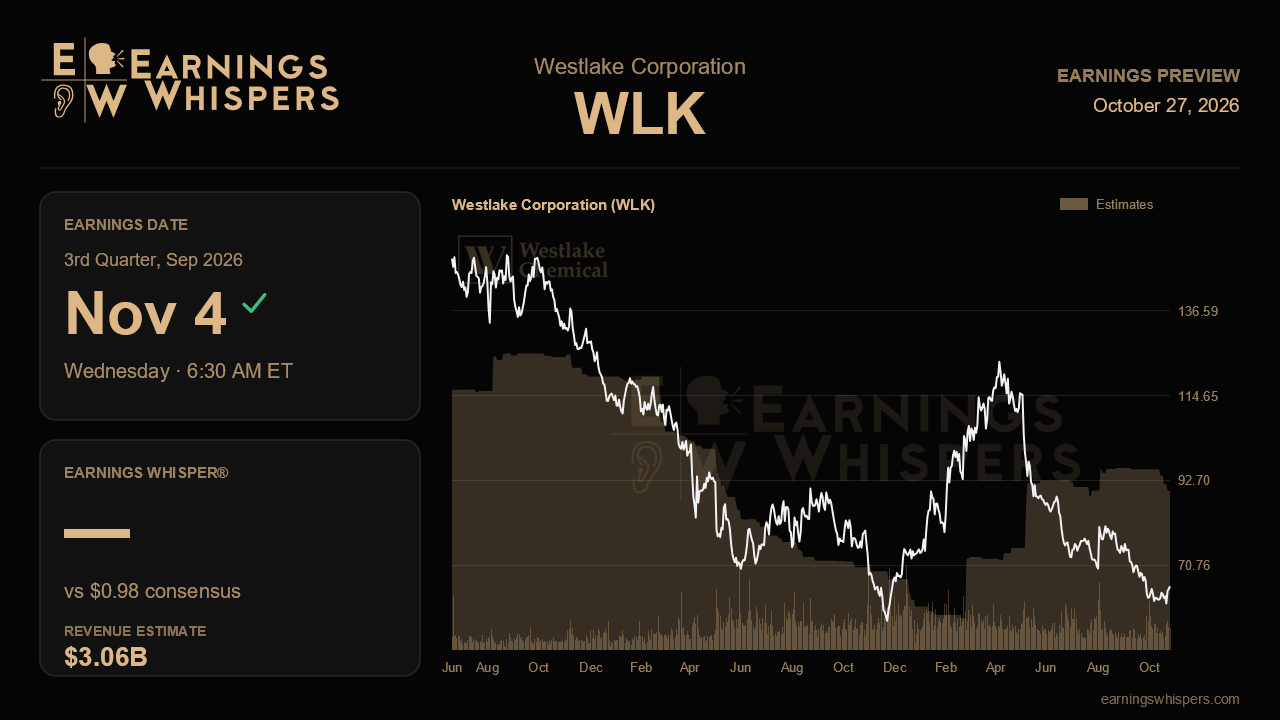
Westlake's second quarter looked like the moment the chemical cycle finally turned in its favor. Earnings swung from a loss to $2.01 a share, its petrochemical segment went from barely profitable to a powerhouse, and management sounded confident for the first time in a year. Wall Street, however, is betting that a good chunk of that windfall was borrowed from a geopolitical shock. When Westlake reports before the bell on November 4, the core question is how much of the second quarter's earnings power was durable and how much depended on conflict-driven pricing that was already slipping as the quarter ended.
Consensus calls for earnings of $0.98 a share on revenue of $3.06 billion. That would be a dramatic improvement from the loss of 29 cents a year ago, which explains the eye-catching expected growth rate of more than 400%, and revenue growth of about 7.8% is respectable for a commodity producer. But the more telling comparison is sequential. Analysts are essentially forecasting that earnings will be cut in half from the second quarter, with revenue sliding from $3.27 billion. The Street has already priced in a meaningful fade, which sets a lower bar than the headline growth figures suggest.
The Performance and Essential Materials segment is where that bar will be tested. Its EBITDA jumped to $416 million from $36 million one quarter earlier, powered by a 21% sequential jump in average selling prices as the Middle East conflict raised global costs while Westlake kept running on cheap North American gas and ethane. Management acknowledged that polyethylene prices exited the quarter below the quarterly average, so some giveback is expected. What would validate the bull case is evidence that prices held up better than feared and that operating rates, which were running full out in polyethylene, epoxy and olefins with PVC climbing into the mid-80s, stayed high. A sharp drop in utilization alongside lower prices would suggest the second quarter was more spike than recovery. Investors should also look for any early signs of caustic soda pressure from new North American chloralkali supply due later this year.
The self-help story offers a cushion. Westlake reported roughly $300 million in savings from its three-pillar profitability program in the first half and reaffirmed a $600 million target for the full year, implying something close to $150 million a quarter going forward. Confirming that pace matters because it is the part of the improvement management controls. Progress on plant reliability, the pillar that has lagged, would strengthen the argument that margins can stay above trough levels even as pricing normalizes. The epoxy turnaround from heavy losses to profitability is another piece that needs to prove it was not a one-quarter event.
Housing and Infrastructure Products remains the soft spot. Guidance sits at the low end of $4.4 billion to $4.6 billion in revenue with 19% to 21% EBITDA margins, and management warned that some third-quarter pipe orders may have been pulled into the second quarter. A dip in pipe volumes would be expected; a margin print below the guided range or another cut to the outlook would not. Updates on the PVCO plant in Wichita Falls slated for year-end startup, the ACI integration and data center-driven pipe demand will help gauge whether this segment can rebuild momentum into 2027.
The market has been unforgiving. Shares have fallen 10.4% since the last report, trailing the S&P 500 by 11 points, and at $65.31 the stock sits well below its 200-day moving average of $87.29 and much closer to its post-earnings low of $58.95 than its high near $81. Sentiment has also cooled, turning more bearish than it was heading into the second quarter. That skepticism means Westlake does not need to repeat its blowout quarter. It needs to show that cost savings and steady operating rates can hold earnings well above trough levels once the pricing tailwind fades, and that housing weakness is stabilizing rather than spreading.
This earnings preview was originally published on Earnings Whispers.
This article is for informational purposes only and is not investment advice. Earnings Whispers and its staff may hold positions in the securities mentioned. It is AI-assisted, based on proprietary Earnings Whispers data and company reports, and edited by Earnings Whispers staff.
Mentioned In This Article
Latest News
| Oct-27 | |
| Oct-21 | |
| Sep-29 | |
| Sep-29 | |
| Sep-24 | |
| Sep-09 | |
| Aug-21 | |
| Aug-14 | |
| Aug-04 | |
| Aug-04 | |
| Aug-04 | |
| Aug-04 | |
| Jul-21 | |
| Jun-15 | |
| May-15 |
