Alexandria Edges FFO Estimates As Leasing Rebounds, But Heavy Impairments And A 2027 Trough Keep The Recovery Story Unproven
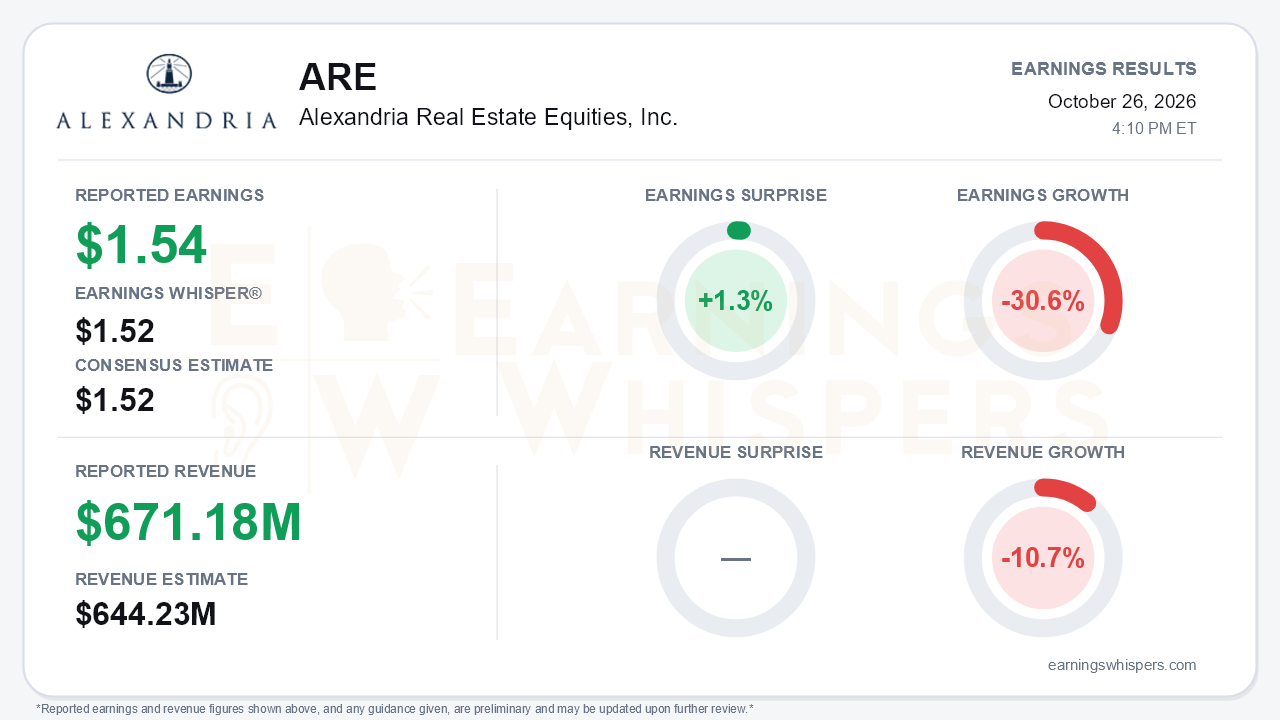
Alexandria Real Estate Equities delivered a narrow beat in a quarter that showed real operating progress inside a business still shrinking. FFO per share, as adjusted, came in at $1.54, two cents above both the $1.52 consensus and the Earnings Whisper number, a 1.3% surprise. Revenue of $671.18 million beat consensus by 4.2%. The year-over-year comparison remains harsh: earnings fell 30.6% and revenue declined 10.7%. Sequentially, FFO slipped from $1.73 in each of the first two quarters. The central tension is that leasing, same-property trends and the balance sheet all improved, while the earnings base kept eroding and management pointed to 2027 as another year of pressure.
The quality of the beat deserves scrutiny. On a GAAP basis, Alexandria lost $3.74 per share, driven by $637.9 million of real estate impairments on assets moved to held for sale. These included $343.3 million on the Fenway development at 421 Park Drive and $135.3 million on vacant Palo Alto office buildings. The charges are excluded from FFO, but they show how much capital went into projects the company no longer expects to finish or lease profitably. Several items also weighed on the run rate. Interest expense jumped to $79.7 million from $64.3 million in the second quarter. G&A rose to $40.9 million, and tenant wind-down charges took about $16 million. Adjusted EBITDA margin slid to 65%, down from 67% in the second quarter and 70% at the end of 2025. Capitalized interest is also fading: the qualifying real estate basis fell to $4.46 billion from a $5.87 billion third-quarter average, a mounting headwind as projects are sold or delivered. Management narrowed 2026 FFO guidance to $6.38 to $6.42 and held the $6.40 midpoint. That midpoint implies a fourth quarter well below the $1.54 just reported.
The operating story was considerably better. Leasing reached 1.236 million square feet, up from 1.039 million in the second quarter and well above the roughly 950,000 indicated on the prior call. That included 451,000 square feet of previously vacant space, the second-highest amount in company history. Same-property NOI improved to -6.7%, or -2.8% on a cash basis, from -10.6% and -8.6% in the second quarter. Renewal spreads were still negative but far milder than the 15% declines of the first quarter. Occupancy rose modestly to 87.1%, though this partly reflects accounting: reclassifying 311 Arsenal Street cost 0.9 points, while moving vacant assets to held for sale added 0.6 points. Management indicated fourth-quarter leasing near 1.25 million square feet and expects a pickup in public biotech demand. Bears have legitimate ammunition, however. The list of tenants in the market declined 5% after two quarters of growth, and free rent rose back to 2.0 months per year. Expected rent from signed-but-not-commenced leases fell to $52 million from $69 million, with average commencement pushed out to June 2027.
The capital plan is where the setup changed most. The $1 billion hybrid note issue, which receives 50% equity credit from rating agencies, and the $475 million Campus Point joint venture lifted liquidity to $4.56 billion. Completed and pending dispositions now total $2.62 billion, against a disposition target that was cut to a $1.9 billion midpoint because the hybrid notes replaced part of it. The 421 Park sale and the pivot at 311 Arsenal reduce future construction spending by roughly $356 million combined. The trade-off is cost: the hybrid notes carry a 7.25% coupon, leverage stood at 6.9x (6.6x pro forma) against a 5.6x to 6.2x year-end target, and disposition timing slipped again.
Looking ahead, 2027 remains the overhang. About 1.4 million square feet of key expirations, carrying $100.5 million of annual rent, face 9 to 24 months of downtime. Management expects same-property NOI to improve but stay negative in 2027, and another $30 million or more of wind-down charges is possible. A newly disclosed 718,000 square feet of 2028 move-outs adds to the list. Partly offsetting this, more than 60% of the 2027 roll is in active discussions, including roughly 200,000 square feet of Bristol-Myers space at Campus Point. The December 2 Investor Day should clarify how much of this converts.
Investors have not been rewarding the progress. Sentiment improved only marginally, to -0.48 from -0.50, and remains firmly negative. The stock is down 16.4% since opening at $51.90 after the August report and trades about 13% below its $49.85 200-day moving average. Most Earnings Whispers trend signals remain negative, with price and sequential growth still deteriorating.
The bottom line is that Alexandria's third quarter supported a credible case that leasing and same-property trends have bottomed. The financial results, however, still describe a shrinking FFO base, rising interest costs and repeated write-downs. Until the 2027 lease roll and the Investor Day outlook show earnings stabilizing rather than merely declining more slowly, the two-cent beat is unlikely to settle the debate.
Read our earnings preview for Alexandria Real Estate Equities, Inc.: https://www.earningswhispers.com/article/ARE/20641
This earnings review was originally published on Earnings Whispers.
This article is for informational purposes only and is not investment advice. Earnings Whispers and its staff may hold positions in the securities mentioned. It is AI-assisted, based on proprietary Earnings Whispers data and company reports, and edited by Earnings Whispers staff.
Mentioned In This Article
Latest News
| 14 hours | |
| Oct-27 | |
| Oct-27 | |
| Oct-27 | |
| Oct-26 | |
| Oct-26 | |
| Oct-20 | |
| Oct-14 | |
| Sep-28 | |
| Sep-23 | |
| Sep-17 | |
| Sep-04 | |
| Sep-01 | |
| Aug-25 | |
| Aug-19 |
