Hanmi Financial Misses By A Penny As Margin Strength Collides With A Trimmed Loan Outlook And New Credit Noise
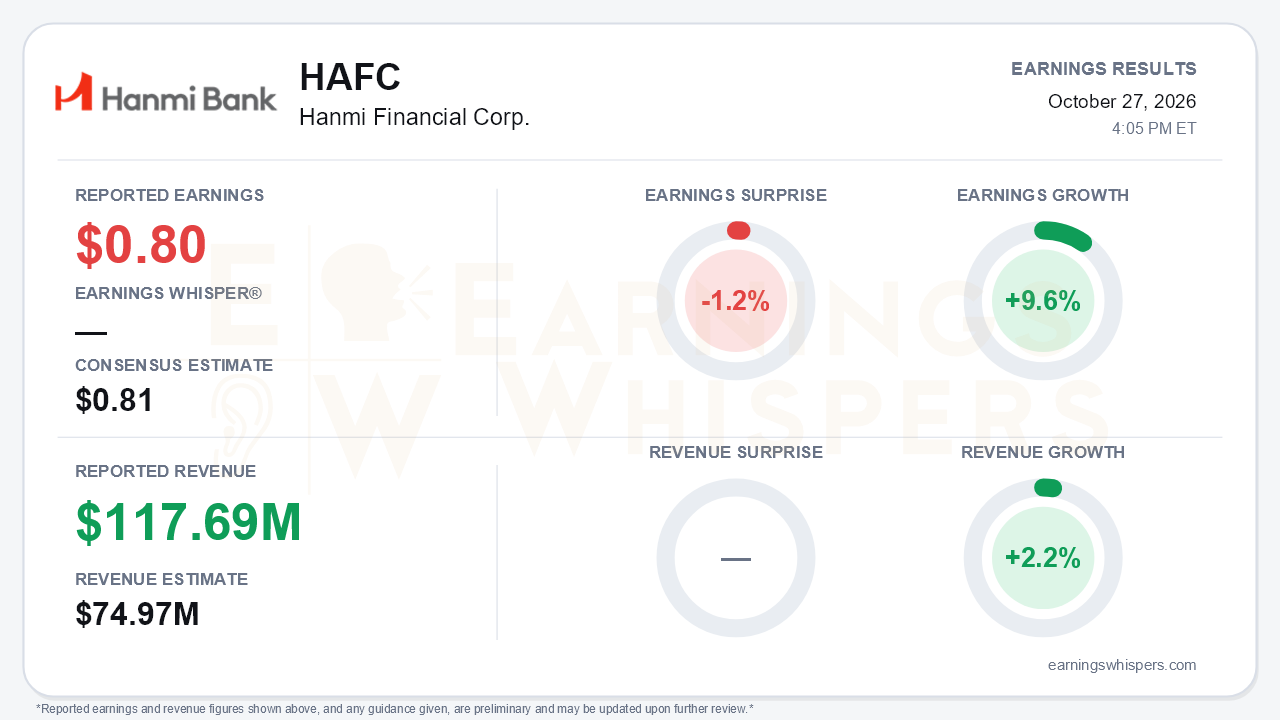
Hanmi Financial (NASDAQ: HAFC) reported third-quarter earnings of $0.80 per share, a penny short of the $0.81 consensus, a 1.2% miss. Earnings still grew 9.6% year over year and edged up from $0.79 in the second quarter. Reported revenue of $117.69 million topped the $74.97 million consensus by 57.0% and grew 2.2% year over year. The miss was too small to matter much. What matters is the split beneath it: core earnings power improved materially, while the balance-sheet growth story and parts of the credit picture weakened. That is the central tension of the quarter.
For a bank, the more useful operating lens is net interest income. It rose 5.8% sequentially to $67.6 million, and preprovision net revenue jumped 10.8% to $36.8 million. Net interest margin widened eight basis points to 3.44%, compared with 3.36% in Q2 and 3.22% a year ago. The efficiency ratio improved to 52.0% from 54.1%. The quality of that expansion deserves scrutiny, however. Management attributed roughly four basis points of the margin gain to one-time items, including $1.2 million of prepayment and accelerated fee income from loan payoffs and a special FHLB dividend. Loan-yield improvement was similarly flattered by payoff fees.
Other one-time items worked against earnings. Hanmi absorbed $1.1 million of accelerated debt-cost amortization from redeeming its 2031 subordinated notes. Credit loss expense also rose $3.3 million to $4.5 million, driven by a $3.2 million partial charge-off on a $21.2 million commercial real estate loan moved to held-for-sale. Strip out the noise on both sides and the run-rate is solid but less spectacular than the headline margin jump suggests.
The call sharpened the growth debate. Loan production reached a record $544 million, up 46% from Q2, with every category higher. Commercial real estate production was $227 million and C&I production was $170 million. Payoffs nearly matched that strength, however, at $283 million. Management said payoffs are up 65% year to date, partly because competitors are refinancing borrowers on looser terms. Period-end loans rose just 0.5%, and loans are essentially flat for the year. As a result, management trimmed its 2026 loan growth outlook to low single digits from the low-to-mid single-digit range it had reiterated in each of the prior three quarters. Management framed 2027 as low-to-mid single-digit growth, or better if higher rates slow payoffs. That is a credible setup, but it is a forecast contingent on rate behavior rather than something the quarter demonstrated.
On funding, the news was mostly constructive. Deposits grew 1.4% to $7.06 billion, led by money market and savings balances. The loan-to-deposit ratio eased to 93.1%. USKC (U.S. Korea Corporate) deposits climbed 12% to a record $1.3 billion, or 19% of deposits. The sub-debt refinancing should save about $550,000 a year, and management added a rate cap on trust preferred securities and a swap on state time deposits. Not everything moved in the right direction, though. USKC loan balances fell 5% to $780 million. Management also indicated deposit costs crept up to 3.22% in October, a sign the margin tailwind may not compound easily.
Bears have legitimate ammunition on credit. Headline asset quality remains clean, with nonperforming assets steady at 0.12% of assets and the allowance unchanged at 1.08% of loans. Net charge-offs, however, rose to 27 basis points from 8, and criticized loans climbed to $134.4 million, or 2.05% of loans. Classified loans jumped to $78.2 million from $45.7 million, mainly because of two New York City multifamily relationships totaling $51.4 million that were downgraded after rent-control changes. On the positive side, an agreement to sell the problem CRE loan should close in Q4. Separately, a $16.5 million after-tax increase in unrealized securities losses nudged the tangible common equity ratio down to 9.93%. Tangible book per share held at $27.03.
Investor sentiment entered the report negative and became somewhat more so, slipping to -0.31 from -0.23. The stock told a different story. Shares were up 1.8% from the open after the July report and closed at $32.17 the day before the release, 8% above the 200-day moving average. That left them just 1.6% below the inter-earnings high set that same day. In other words, the stock went into the print near the top of its quarterly range despite cooler sentiment. With a fractional EPS miss, a lower loan growth outlook, and new criticized-loan exposure, the market setup is more complicated than the margin headline implies.
The bottom line is that Hanmi delivered a better core-earnings quarter than the penny miss suggests, with strong revenue momentum, a wider margin, and improving efficiency. Those gains were partly flattered by one-time items and came alongside a trimmed loan growth outlook, payoff pressure, and a new pocket of New York rent-control credit risk. The stock entered earnings near its quarterly high, so the burden now shifts to proving that record production can finally translate into balance growth and that the multifamily downgrades stay contained.
Read our earnings preview for Hanmi Financial Corp.: https://www.earningswhispers.com/article/HAFC/20762
This earnings review was originally published on Earnings Whispers.
This article is for informational purposes only and is not investment advice. Earnings Whispers and its staff may hold positions in the securities mentioned. It is AI-assisted, based on proprietary Earnings Whispers data and company reports, and edited by Earnings Whispers staff.
Mentioned In This Article
Latest News
| 35 min | |
| 2 hours | |
| Oct-13 | |
| Sep-23 | |
| Aug-17 | |
| Aug-11 | |
| Aug-03 | |
| Jul-30 | |
| Jul-27 | |
| Jul-23 | |
| Jul-22 | |
| Jul-21 | |
| Jul-21 | |
| Jul-07 | |
| Apr-23 |
