Landstar's Freight Upcycle Accelerates, But The Insurance Bill Clouds The Quality Of The Beat
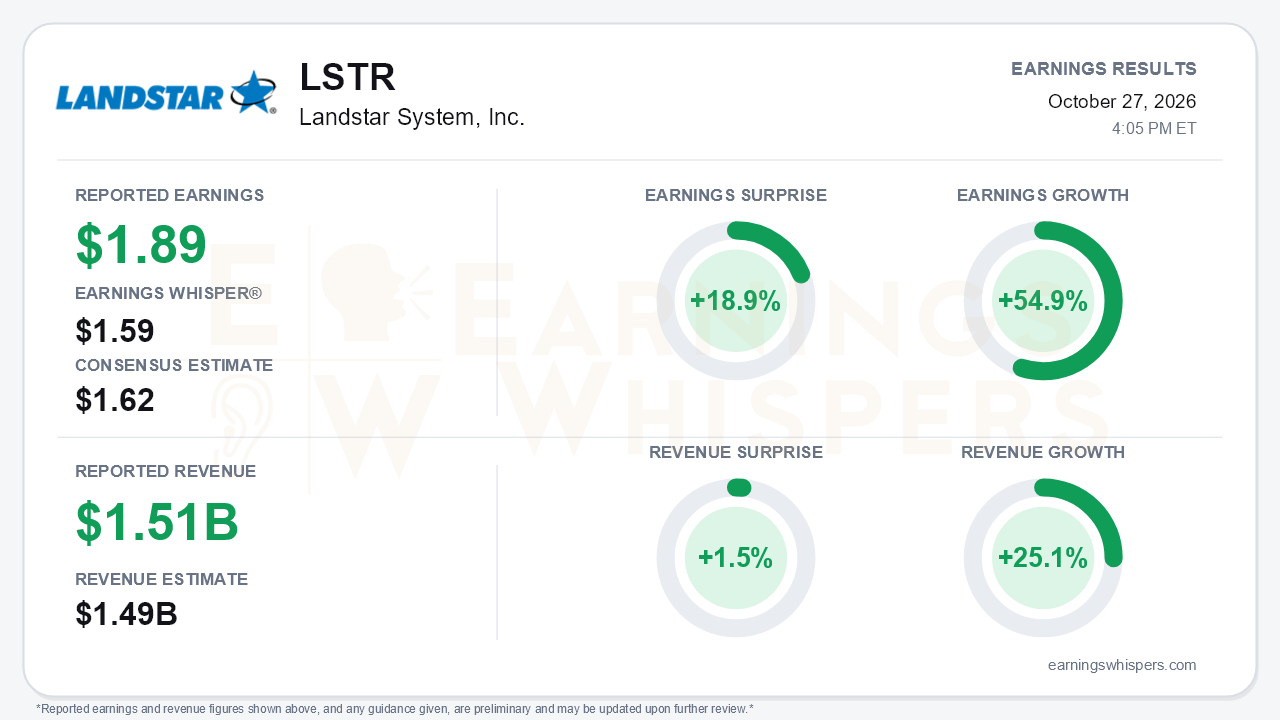
Landstar System (NASDAQ: LSTR) delivered the clearest evidence yet that a freight upcycle is underway, but the quarter also exposed a cost problem that looks increasingly structural. Earnings Whispers puts third-quarter earnings at $1.89 per share, 18.9% above the $1.62 consensus and the $1.59 Earnings Whisper number, with earnings up 54.9% from a year ago. Revenue of $1.512 billion rose 25.1% and topped the $1.49 billion consensus by 1.5%. Top-line growth is accelerating sharply. Revenue growth went from 2% in the first quarter to 18% in the second and 25% in the third, and October trends point higher still. That is the bull story. The central tension is that insurance and claims costs are rising nearly as quickly as the pricing environment is improving.
The quality of the beat deserves scrutiny. Landstar's GAAP EPS was $1.42, up 154% from $0.56. That comparison is flattered by $0.66 per share of impairment charges in last year's quarter. The gap between the GAAP figure and the $1.89 normalized result is $0.47 per share. That amount reflects about $13.0 million of adverse actuarial reserve adjustments and $8.0 million of prior-year claim settlements. Total insurance and claims expense reached $55.3 million, up from $33.0 million a year ago and from $35.6 million and $39.4 million in the first two quarters of 2026. Prior-year development has roughly doubled each quarter, from $4.9 million to $10.5 million to $21.9 million. Non-current insurance claim liabilities have climbed to $103 million from $63 million at year-end. On a GAAP basis, $1.42 sits below the $1.62 consensus. The beat therefore depends on treating these charges as one-time, and the CFO's own commentary undercuts that framing.
Beneath the claims noise, the operating trends are genuinely strong. Truck revenue rose 29% to $1.407 billion. Van and unsided/platform revenue each grew more than 30%. Pricing did most of the work. Truck revenue per load rose 25%, accelerating from 5.6% in the first quarter and 17% in the second, and reached 29% in October. Volume is now joining in. Truck loads rose 3% in the third quarter and about 7% in October, which management said outperforms seasonality. Management described a return of a traditional peak season and a demand narrative shifting from supply-driven to demand-driven. Heavy haul revenue reached about $185 million, up 25%, with a data center customer the largest grower. Capacity is also building. Net BCO truck additions of 165 were the strongest since the third quarter of 2021, and BCO turnover fell to 26.6% from 31.4% at the end of 2025.
Margins are where bears have legitimate ammunition. Gross margin slid to 8.4% from 9.2% a year ago and has compressed each quarter from 9.6% in the first quarter. Brokerage purchased transportation costs rose 161 basis points as a share of revenue. Variable contribution margin held relatively steady at 14.0% versus 14.1%. That suggests the deterioration is concentrated in insurance and carrier costs rather than agent economics. On insurance, the CFO said higher loss burn rates will be booked prospectively. He framed a quarterly run-rate somewhere between $35 million, which he called too light, and $55 million, which he called too heavy. He also flagged the Montgomery decision as raising broker liability exposure. Other weak spots include:
- non-truck revenue down 13% on ocean weakness;
- softness in automotive, government and housing freight;
- a sequential dip in agent count;
- cash and short-term investments falling to $351 million from $452 million as receivables swelled.
The forward catalysts are tangible, though management again offered commentary rather than formal guidance. The agent pipeline is accelerating. Show Me Global, worth about $20 million, has signed, another sizable agent has joined, and two more are near closing. The CFO framed a potential new-agent revenue tailwind of roughly $100 million. Management also introduced a 'little M&A' strategy to attract agent candidates and has deployed agentic AI in eight agent offices. Capital return continues, with $41.4 million of buybacks in the quarter and a $0.44 dividend.
Investors entered the report cautious. Earnings Whispers sentiment remained positive but weakened, slipping to 0.17 from 0.28. Shares closed at $165.17 ahead of the release, down 8.5% since the post-July open. They sat 6.6% below the 200-day moving average and just 1.9% above the September 25 inter-earnings low, after giving back nearly 15% from the August high. Price and AVWAP trend readings remain negative, even as fundamental momentum has turned positive. The market had clearly been discounting the cost side of the story more than the freight recovery.
The bottom line is that Landstar's demand, pricing and capacity trends are accelerating into what management calls the first real peak season in years, and the agent pipeline adds a credible growth lever. The headline beat, however, rests on excluding claims charges that management itself suggests are partly recurring. Until insurance costs settle into a predictable run-rate and gross margin stops compressing, the stronger freight cycle will be fighting a higher cost base.
Read our earnings preview for Landstar System, Inc.: https://www.earningswhispers.com/article/LSTR/20771
This earnings review was originally published on Earnings Whispers.
This article is for informational purposes only and is not investment advice. Earnings Whispers and its staff may hold positions in the securities mentioned. It is AI-assisted, based on proprietary Earnings Whispers data and company reports, and edited by Earnings Whispers staff.
Mentioned In This Article
Latest News
| Oct-28 | |
| Oct-28 | |
| Oct-27 | |
| Oct-27 | |
| Oct-27 | |
| Oct-13 | |
| Aug-26 | |
| Aug-24 | |
| Aug-10 | |
| Aug-10 | |
| Aug-10 | |
| Jul-29 | |
| Jul-28 | |
| Jul-28 | |
| Jul-28 |
