Lufax's Q3 Loss Quadruples As Credit Recovery Stalls And Tax Charges Pile On, Overshadowing Consumer Finance Growth
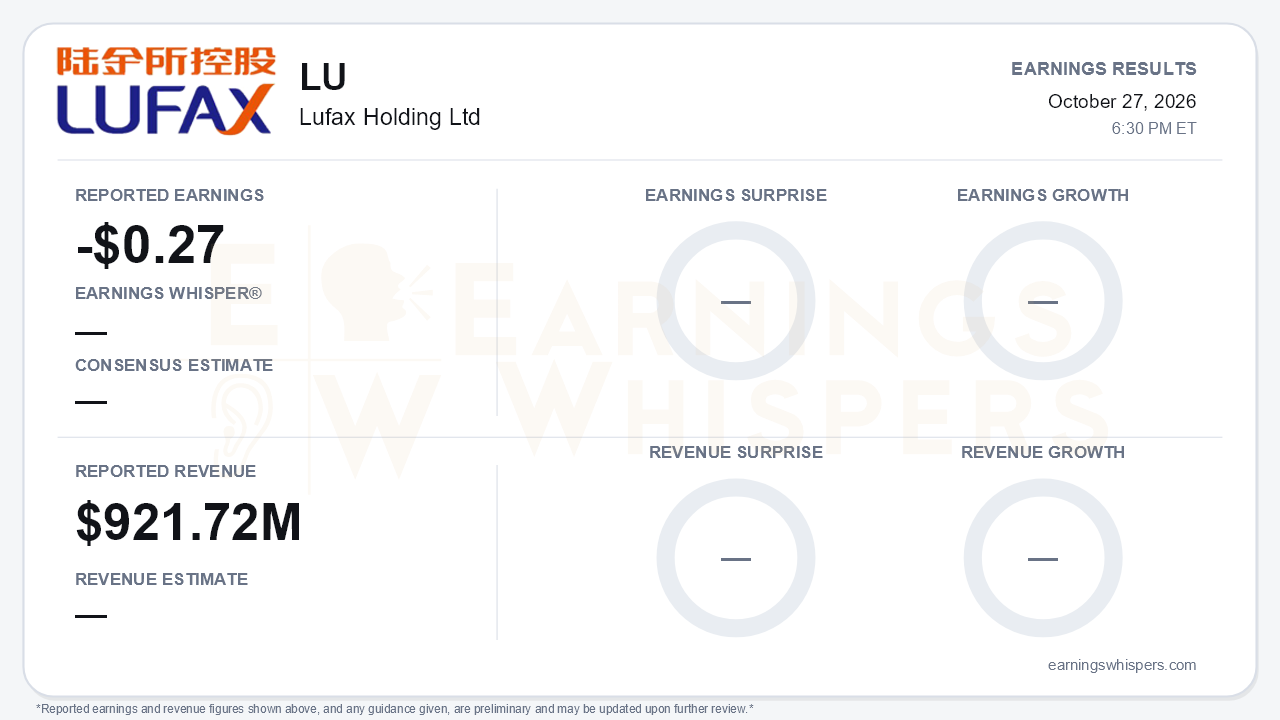
Lufax Holding (NYSE: LU) reported a third-quarter loss of $0.27 per ADS on revenue of $921.72 million. There was no consensus estimate to measure it against. The more important comparison is with the company's own recent narrative. In the second quarter, management pointed to an asset-quality recovery and said improvement in its C-M3 flow rate would continue through the second half. Instead, the flow rate climbed back to 1.2% from 1.0%. Net loss widened to RMB1,494 million from RMB380 million a year earlier and from RMB725 million in the third quarter of 2024. On a per-ADS basis, the loss deepened to RMB1.78 from RMB0.50. That reversal of the credit story is the central development of the quarter.
The quality of the loss deserves scrutiny, because roughly half of it was tax-driven. Income tax expense jumped to RMB773 million from RMB74 million. The increase reflects a deferred tax asset write-down at the financing guarantee subsidiary and withholding taxes on dividends moved offshore to meet funding needs. According to the call, those offshore funds are going toward convertible note redemptions. Some investors may be tempted to treat the charge as noise, but the write-down rests on management's own reassessment of that subsidiary's outlook, which is not a neutral signal. Even setting taxes aside, the core trend worsened. Pre-tax loss more than doubled to RMB721 million from RMB306 million, and credit impairment losses rose 10.3% to RMB4.51 billion on legacy loan losses. Impairments now consume 73% of total income, versus 63% a year ago. Cost control was genuine: expenses excluding credit, finance costs and other items fell 13.4%. However, those savings were overwhelmed. Operating cash flow also swung to an outflow of RMB225 million from an inflow of RMB3.09 billion.
Beneath the headline, Lufax is rapidly becoming a different business. Consumer finance new loans rose 25.2% to RMB39.7 billion, or 68.1% of total originations. Total new loans of RMB58.3 billion rose 14.1% sequentially and 2.5% year over year. Net interest income grew 10.3%. Meanwhile, the platform and guarantee businesses are shrinking quickly, with technology platform income and guarantee income each down about 24%. The total loan balance fell 11.9% to RMB167.1 billion, and total income slid 4.6%. The shift also concentrates risk on Lufax's own books: the company now bears risk on 95.8% of loans enabled, up from 87.3%. Retail credit take rate improved to 14.0% from 13.0%, but consumer finance loan pricing dropped sharply to 16.4% from 19.0% in Q2. That compresses yields in the very segment carrying growth.
There were real positives. Funding costs excluding consumer finance fell to 3.6%, down 20 basis points sequentially and 80 basis points year over year, and management described bank partner quotas as stable. Lagging delinquency metrics improved: DPD 30+ eased to 5.5% from 5.8%, and DPD 90+ to 3.2% from 3.7%. Consumer finance NPLs held at 1.3%, and management said 2026 vintages are outperforming legacy loans. Hong Kong trading resumed September 24, a new CFO joined, and the company is pushing AI-driven risk models, in-house collection and judicial recovery channels. Bears still have legitimate ammunition. Intensified regulatory enforcement against the debt-collection industry is hurting recoveries, and some banks are pulling back from loan facilitation. Household consumer loans fell 3.6% industry-wide, worse than Q2's 1.7% decline. Management also warned that risk volatility may persist through year-end and offered no recovery-rate forecast. The rising forward-looking flow rate matters more than the improving backward-looking delinquency ratios.
Investor sentiment improved meaningfully heading into the report, rising from -0.26 to roughly neutral at +0.03, likely helped by the Hong Kong relisting. The price data are harder to read. The supplied figures show a 465% gain from a $1.50 opening after the August report. That conflicts with the recorded inter-earnings high of $15.40 on that same first trading day. The range data are more consistent with the rest of the technical picture. On that basis, shares slid about 45% from that high to a 52-week low of $8.05 on October 23 and entered earnings at $8.48, about 51% below the $17.42 200-day average. Trend readings are mixed, with price and AVWAP trends positive but sequential growth negative.
The bottom line is that Lufax delivered volume growth and cost discipline but lost the asset-quality argument that underpinned the second-half recovery case. Consumer finance growth, cheaper funding and governance milestones keep a rebuild story alive. However, rising flow rates, a tax write-down that reflects weaker subsidiary expectations, regulatory pressure on collections and management's own cautious year-end framing mean improving sentiment is running ahead of the fundamentals. The next quarter's flow rate matters more than any headline number.
Read our earnings preview for Lufax Holding Ltd: https://www.earningswhispers.com/article/LU/20818
This earnings review was originally published on Earnings Whispers.
This article is for informational purposes only and is not investment advice. Earnings Whispers and its staff may hold positions in the securities mentioned. It is AI-assisted, based on proprietary Earnings Whispers data and company reports, and edited by Earnings Whispers staff.
Mentioned In This Article
Latest News
| Oct-27 | |
| Oct-27 | |
| Oct-26 | |
| Oct-20 | |
| Oct-16 | |
| Oct-08 | |
| Sep-30 | |
| Sep-10 | |
| Aug-18 | |
| Aug-13 | |
| Jul-24 | |
| Jun-30 | |
| May-06 | |
| Apr-30 | |
| Apr-27 |
