UMC Misses EPS Consensus, But A 2027 Pricing Reset And AI-Driven Capex Shift The Story From Volume To Value
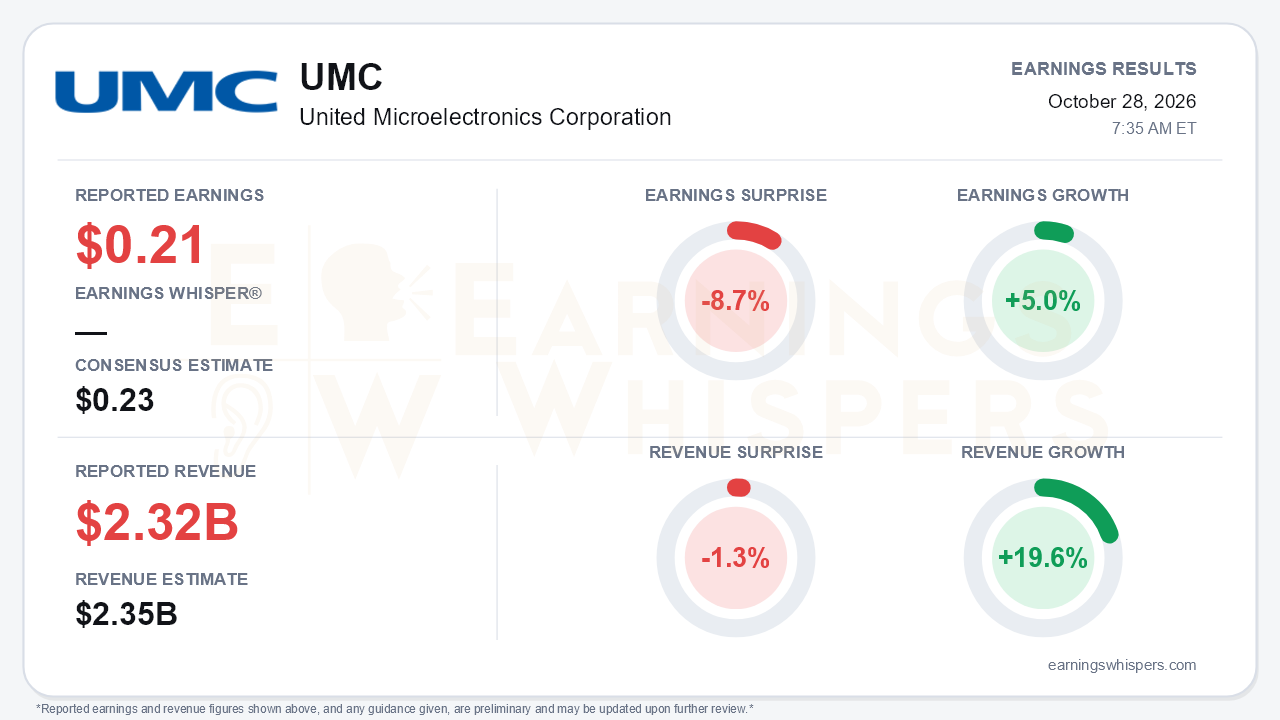
United Microelectronics (NYSE: UMC) reported third-quarter earnings of $0.21 per ADS on revenue of $2.32 billion. Consensus was $0.23 on $2.35 billion, so earnings missed by 8.7% and revenue fell 1.3% short. Earnings grew only 5.0% year over year while revenue grew 19.6%. That gap between top-line and bottom-line growth looks unflattering, but it understates what happened inside the business. The central tension is that a headline miss sits on top of the strongest operating quarter UMC has posted in this upcycle, plus a call that reframed the 2027 setup around pricing rather than volume.
The quality of the miss matters. In local currency, revenue rose 8.0% sequentially and 25.6% from a year ago. The lower dollar-based growth figure reflects a weaker Taiwan dollar versus the prior-year translation rate. Below revenue, the picture improved further:
- Gross margin expanded to 34.0% from 32.5% in Q2 and 29.8% a year ago.
- Operating income jumped 24.7% sequentially and 67.7% year over year, to NT$18.64 billion, for a 25.1% operating margin.
The drag sat below the operating line. A year ago, UMC booked a small tax benefit; this quarter it recorded NT$3.52 billion of tax expense. Non-operating income also fell to NT$1.27 billion from NT$3.53 billion. Those two items compressed 67.7% operating income growth into single-digit net income growth.
The sequential comparison needs similar care. Net income fell 61% from Q2, but only because Q2 included a NT$30 billion investment gain.
Some of the margin help may not repeat. Operating expenses fell 8.0% sequentially, led by a 16.2% drop in G&A, which may not be a durable run rate. Cash generation was solid: free cash flow of NT$18.09 billion, cash up to NT$142.6 billion, and debt-to-equity down to 44%.
The operating trajectory is clearly improving:
- **Utilization** climbed from 79% in Q1 to 85% in Q2 and 92% in Q3, with several 12-inch fabs running full and 8-inch operations recovering.
- **Wafer shipments** hit a record 1.21 million 12-inch equivalents, up 7.3% sequentially.
- **22nm** rose to 18.3% of wafer sales, from roughly 14% in Q1, on tape-outs in display drivers, automotive radar and Wi-Fi.
The bigger change was in pricing. Management's language has moved over successive calls from a "more favorable" environment, to price-increase letters, to an expected "meaningful uplift." This quarter it put a number on it: blended ASPs up roughly 10% in 2027, with negotiations at a late stage. That marks the turn from a volume-led recovery to a value-led one.
The call also sharply expanded the growth narrative:
- **Capex:** The board approved roughly $3.2 billion in additional spending, on top of about $5 billion approved last quarter. The money targets silicon photonics, deep trench capacitor and TFLN modulator capacity, and management said it is backed by customer commitments.
- **AI ambition:** The AI target moved from more than $1 billion in three years to more than a quarter of total revenue by around 2029.
- **Commercial milestones:** The 1.6T optical platform was qualified with multiple hyperscalers, and some existing 8-inch capacity is being converted to TFLN to meet unfulfilled near-term demand.
Management described demand as exceeding planned capacity and said the new businesses carry above-average margins.
Bears still have legitimate ammunition:
- **A Q4 plateau:** Shipments are guided up only low single digits, ASPs "firm" rather than higher, gross margin flat, and utilization in the low 90s.
- **Capacity limits:** With utilization already above 90%, 2027 volume growth is capacity-constrained. New-business revenue next year will be "not significant," and the new capacity does not arrive until late 2028.
- **Margin ceiling:** Depreciation is set to rise at a low-teens pace for years, and raw-material costs are climbing. The CFO said gross margin is unlikely to regain prior-cycle peaks above 40%.
- **End-market and execution risk:** PC-related demand has softened, 2027 consumer units are a risk, and the spending runs well ahead of the revenue it is meant to generate.
The market setup is more complicated than the miss implies. Shares stood at $19.45 before the report, 14.1% above the open following the July release and 15.3% above the 200-day moving average. However, the stock had peaked at $26.37 on October 2 and entered earnings 26.2% below that high. In other words, much of the AI-optics enthusiasm had already been given back. Investor sentiment edged up to 0.28 from 0.27, essentially steady and modestly positive. Trend readings were mixed, with momentum positive but AVWAP negative, consistent with a stock that has cooled after a sharp run.
The bottom line is that UMC's EPS miss was driven mainly by taxes and non-operating comparisons, not by the core business, where margins, utilization and operating income all improved meaningfully. The more consequential news is a quantified 2027 price increase and a much larger AI-linked capacity bet. Investors now have to weigh that against a flat Q4, capacity limits on 2027 volumes, rising depreciation, and a payoff that is still two to three years away.
Read our earnings preview for United Microelectronics Corporation: https://www.earningswhispers.com/article/UMC/20888
This earnings review was originally published on Earnings Whispers.
This article is for informational purposes only and is not investment advice. Earnings Whispers and its staff may hold positions in the securities mentioned. It is AI-assisted, based on proprietary Earnings Whispers data and company reports, and edited by Earnings Whispers staff.
Mentioned In This Article
Latest News
| 4 hours | |
| 6 hours | |
| Oct-22 | |
| Oct-20 | |
| Oct-19 | |
| Oct-14 | |
| Oct-05 | |
| Oct-05 | |
| Oct-05 | |
| Sep-04 | |
| Sep-01 | |
| Aug-31 | |
| Aug-23 | |
| Aug-12 | |
| Aug-11 |
