Parsons Beats On Record Margins And Cash, But Narrowed Guidance And A CFO Exit Keep The Rebuild Unfinished
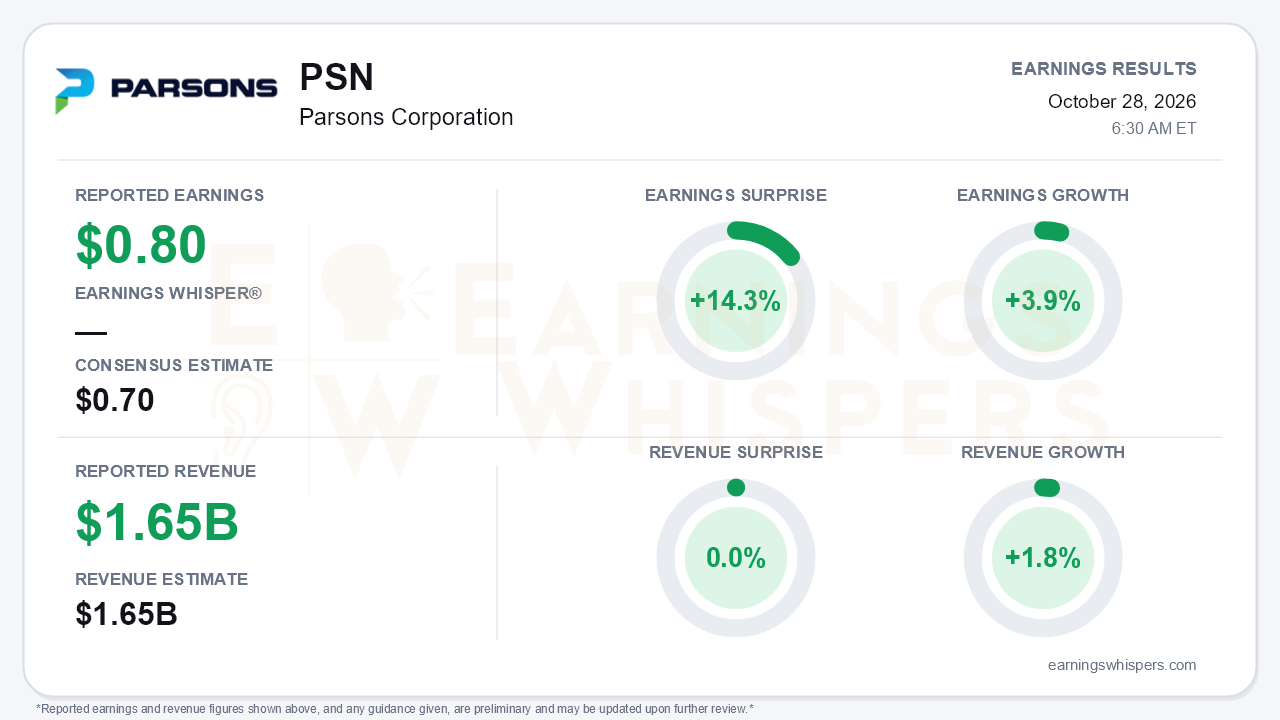
Parsons Corporation delivered the clean quarter investors needed after a bruising second quarter, but it did not deliver the inflection the stock's recent rally may have been pricing in. Earnings Whispers reported EPS of $0.80, which beat the $0.70 consensus by 14.3% and rose 3.9% from a year earlier. Revenue of $1.651 billion matched the $1.65 billion consensus exactly and grew 1.8%. The company's own adjusted EPS was $0.89, versus $0.86 a year ago. GAAP diluted EPS fell to $0.51 from $0.59 as transaction-related costs tripled to $16.2 million. The central tension is that profitability, cash, and bookings all looked better, while the top line and full-year outlook barely moved. This was a beat-and-hold quarter, not a beat-and-raise.
The quality of the beat is mostly a margin story. Adjusted EBITDA rose 6% to a record $168 million, and margin expanded 40 basis points to a record 10.2%. Critical Infrastructure did the heavy lifting: segment EBITDA rose 9%, and margin reached a record 11.1%, helped by ramping awards, accretive acquisitions, and better execution. Federal Solutions margin was flat at 9.2%, which is below the 9.4% second-half target management had set. That implies Q4 federal margins of roughly 9.7%. Growth beneath the headline was thin. Consolidated organic revenue declined 1%. Excluding the confidential contract, which is still a drag, organic growth was only 2%. Critical Infrastructure organic growth slowed to 1% from 4% in the second quarter, reflecting lower North American pass-through work and Saudi re-phasing. Cash was the clear standout. Operating cash flow of $269 million compared with $163 million a year earlier, and trailing free-cash-flow conversion jumped to 130% from 74% at Q2.
Demand indicators remain the strongest part of the bull argument. Total contract awards rose 14%. Federal Solutions awards jumped 53%, extending an acceleration from 38% in Q1 and 51% in Q2, and that segment's book-to-bill reached 1.2x. Total backlog hit a record $9.4 billion, and funded backlog rose 7% to $6.8 billion, now 73% funded versus 71% previously. Awarded-not-booked climbed to $12 billion from $11 billion. The product thesis also became more concrete. The JCHK cyber ceiling rose to $750 million, with full-rate production underway. Management also quantified products at roughly $350 million annually and guided 20–30% growth in 2027 at margins above 20%. That target is ambitious, but it is lower than the 30–40% framing cited on the Q2 call, a detail bulls should not overlook.
Bears still have legitimate ammunition. Consolidated book-to-bill has eased from 1.4x in Q1 to 1.2x in Q2 and 1.1x now. Middle East book-to-bill fell to 0.8x on Saudi PIF re-phasing. More than $850 million of federal wins are under protest, and another $495 million award remains in its protest window, which delays conversion of the backlog story into revenue. The troubled Canada joint venture slipped again: it is now targeted at more than 80% complete by year-end, versus 90% guided in Q2, with completion forecast for June 2028 and overrun risk if it is delayed further. Management also cautioned that 2026 macro headwinds could persist into 2027, with a continuing resolution and possible shutdown looming. The CFO departure adds execution uncertainty, although bringing back longtime former CFO George Ball as interim softens it.
Guidance reinforced the hold narrative. Revenue guidance narrowed to $6.25–$6.45 billion and adjusted EBITDA guidance to $510–$550 million, both around unchanged midpoints. Both remain well below February's original $6.5–$6.8 billion and $615–$675 million targets. Operating cash flow guidance was held at $430–$490 million despite the Q3 beat. Capital allocation was more assertive: buybacks rose to $60 million in the quarter from $15 million in Q2.
The market setup is more complicated than the surprise implies. Shares collapsed to a 52-week low of $36.26 on the day after the Q2 report. They then recovered nearly 40% and closed at $50.73 on the eve of this release, essentially at the inter-earnings high and 8% above the post-Q2 opening price. Even so, the stock remains 6.6% below its 200-day moving average of $54.33. Investor sentiment improved modestly, from -0.36 to -0.28, but it is still negative. The Earnings Whispers trend readings are mixed, with momentum negative while AVWAP is positive.
The bottom line is that Parsons proved its Q2 stumble was not a structural break. Record margins, strong cash conversion, and accelerating federal awards rebuilt credibility. But flat organic revenue, decelerating infrastructure growth, a reset guide that only narrowed, protests, the Canada JV, and a CFO transition mean the recovery case still rests on backlog conversion that has yet to show up in revenue. With shares entering the report near their quarterly high, Parsons now needs evidence of organic growth, not just margin discipline.
Read our earnings preview for Parsons Corporation: https://www.earningswhispers.com/article/PSN/20875
This earnings review was originally published on Earnings Whispers.
This article is for informational purposes only and is not investment advice. Earnings Whispers and its staff may hold positions in the securities mentioned. It is AI-assisted, based on proprietary Earnings Whispers data and company reports, and edited by Earnings Whispers staff.
Mentioned In This Article
Latest News
| 4 hours | |
| 8 hours | |
| 12 hours | |
| 13 hours | |
| Oct-21 | |
| Oct-06 | |
| Sep-29 | |
| Sep-29 | |
| Sep-14 | |
| Sep-03 | |
| Aug-31 | |
| Aug-27 | |
| Aug-26 | |
| Aug-26 | |
| Aug-25 |
