Oatly Misses On EPS As A US Freight Shock Forces A Steep EBITDA Guidance Cut, Even As European Growth Accelerates
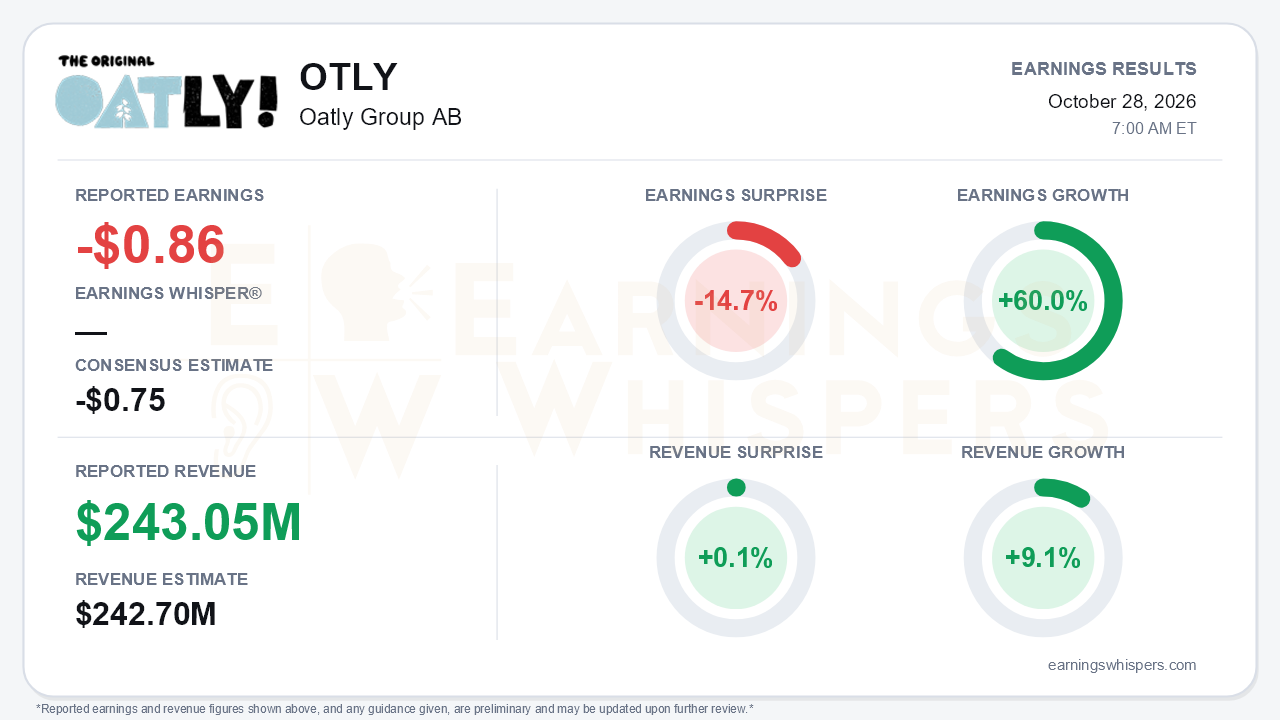
Oatly's third quarter showed a demand story getting stronger and a profit story getting weaker. The company reported a loss of $0.86 per ADS, missing the consensus estimate of a $0.75 loss by 14.7%. That was still a sharp improvement from the $2.15 loss a year earlier, which the supplied figures put at 60.0% earnings growth. Revenue of $243.05 million rose 9.1% and edged past the $242.7 million consensus by 0.1%. The development that matters most, however, is guidance. Management reaffirmed 8% to 10% constant-currency revenue growth for 2026 but cut its full-year Adjusted EBITDA outlook to $16 million to $20 million from $25 million to $35 million. Management had already steered investors toward the low end of the old range in the first and second quarters, so even measured against that point, the cut is roughly 40%. This is the first guidance reduction after three straight calls of reaffirming or raising. A label of "reaffirmed" applies only to the top line.
The quality of the improvement deserves scrutiny. The GAAP net loss narrowed to $27.5 million from $65.3 million, but much of that came below the operating line. Fair-value losses on the Convertible Notes fell to $0.9 million from $32.2 million. Operating performance did improve, though less dramatically: the operating loss shrank to $9.2 million from $16.9 million. Gross margin was the bright spot. It reached 34.1%, up 436 basis points year over year, an acceleration from gains of 140 basis points in Q2 and 188 basis points in Q1. Adjusted EBITDA rose to $9.4 million from $3.1 million a year ago and from just $0.4 million in Q2. Selling, general and administrative expense, however, climbed $10.2 million on brand investment and higher distribution costs, and inflation linked to the Middle East conflict ate into the gross-profit gains.
Beneath the consolidated numbers, the regions are moving in different directions. Europe & International is now the engine. Constant-currency growth accelerated to 20.4%, up from 18% in Q2 and 14.5% in Q1, on 17.6% volume growth led by Barista products, and the segment EBITDA margin expanded to 21.4% from 17.5%. North America slowed to 2.9% constant-currency growth from 5.9% in Q2 and produced only $0.3 million of segment EBITDA. There was still competitive progress there: retail volume grew about 8% in a category declining mid-single digits, the share gap to the category leader narrowed to roughly 2 points from about 8 points in summer 2025, and distribution reached a record. Greater China deteriorated sharply. Revenue fell 19.3% in constant currency, after a 5.6% gain in Q2, as foodservice competition intensified, and segment EBITDA swung to a $1.9 million loss.
Management attributed the guidance cut entirely to US diesel and freight costs. Diesel is up roughly 83% year to date, about two-thirds of that since July, and fourth-quarter US freight per liter is expected to run 12.5% above the first-half average. Because nine-month Adjusted EBITDA already stands at $14.8 million, the new range implies only about $1 million to $5 million in the fourth quarter. Management also said it is planning 2027 costs at the "worst of 2026," with no easing assumed. The company has levers to offset the pressure. US pricing takes effect in Q1 2027, paired with a pack change from 64oz to 48oz, and European pricing is under review. That pricing carries real elasticity risk with stretched consumers. The new Fiber wellness platform, teased for several quarters, is now launching in 11 European markets by year-end and in the US in January 2027. Expansion markets such as France, Spain, and Mexico have turned Adjusted EBITDA positive, and the Greater China strategic review is expected to conclude within 2026.
The balance sheet gives bears legitimate ammunition. Third-quarter free cash flow was an outflow of $18.4 million, compared with $5.4 million a year earlier and $0.6 million in Q2. Management attributed the swing to the timing of capex, an inventory build, and payables. Cash fell to $23.3 million against $523.2 million of debt, total equity is now negative, and liquidity including undrawn facilities is about $95 million. With that cushion, a profit shortfall carries more weight than it would for a better-capitalized company.
The market setup is more complicated than the narrowing loss implies. Investor sentiment improved meaningfully heading into the report, rising from slightly negative (-0.07) to clearly positive (0.33). The stock entered earnings at $11.75, up 19.7% since the open after the prior report, which was also the inter-earnings low. Shares had spiked to a 52-week high of $16.20 in late August and then surrendered much of that move, finishing 27.5% below the peak and only 3.4% above the 200-day moving average. Sequential-growth and momentum readings were positive, while AVWAP remained negative. Taken together, the stock arrived with improved expectations and only a modest technical cushion, and the guidance cut challenges those expectations directly.
The bottom line is that Oatly's brand momentum, especially in Europe, looks better than at any point this year, but the investment case has shifted from "profitable growth is arriving" to "can pricing outrun freight before the cash runs thin." Revenue guidance held, and gross-margin execution was strong. Still, an EPS miss, a roughly 40% EBITDA guidance cut, weakness in North America and China, and a widening cash burn mean the profit inflection has been pushed further out on a balance sheet with limited room for error.
Read our earnings preview for Oatly Group AB: https://www.earningswhispers.com/article/OTLY/20871
This earnings review was originally published on Earnings Whispers.
This article is for informational purposes only and is not investment advice. Earnings Whispers and its staff may hold positions in the securities mentioned. It is AI-assisted, based on proprietary Earnings Whispers data and company reports, and edited by Earnings Whispers staff.
Mentioned In This Article
Latest News
| 37 min | |
| 4 hours | |
| Oct-22 | |
| Sep-28 | |
| Sep-24 | |
| Jul-23 | |
| Jul-22 | |
| Jul-22 | |
| Jul-22 | |
| Jul-22 | |
| Jul-22 | |
| Jun-24 | |
| Jun-17 | |
| Jun-09 | |
| May-20 |
