VF Corp Beats On Margin And Leverage, But Vans Wholesale Leaves The Second-Half Story Unproven
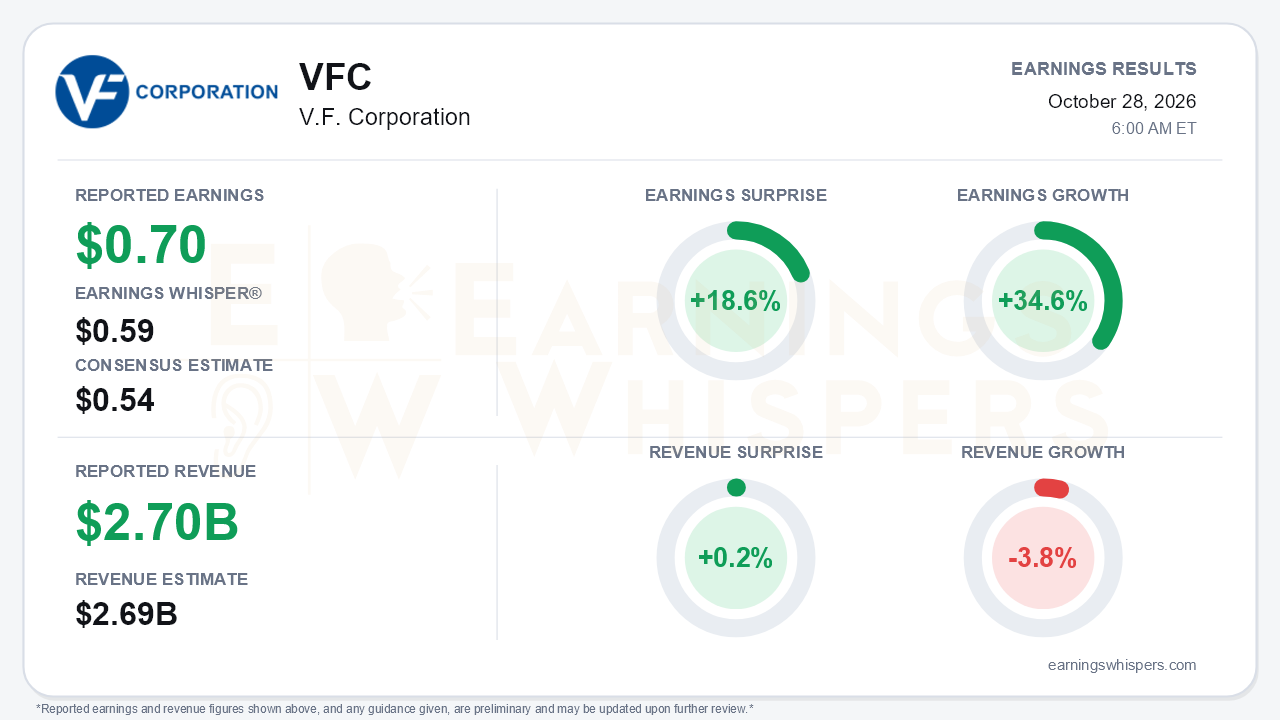
VF Corporation delivered a clean beat on the line that matters most to its turnaround: profitability. Adjusted earnings of $0.70 per share topped the $0.54 consensus by 18.6% and cleared the $0.59 Earnings Whisper number. Earnings grew 34.6% year over year. Revenue of $2.695 billion edged past consensus by 0.2% but fell 3.8% from a year ago, a decline driven by the absence of Dickies, which was sold last November. Excluding Dickies, revenue rose 1% in constant currency against guidance of roughly flat, a modest step up from a flat first quarter. The central tension is that VF is now proving it can manufacture earnings growth from margins, interest savings and a lower tax rate, while the top-line recovery still hinges on Vans, the brand that has resisted repair the longest.
The quality of the beat deserves scrutiny. Adjusted operating income ex Dickies reached $364 million, well above the roughly $315 million guide, and adjusted operating margin expanded 170 basis points to 13.5%. On the call, however, management indicated that about $25 million of SG&A shifted from the second quarter into the third, so roughly half of the operating income upside was timing. Gross margin is the more durable story. Adjusted gross margin ex Dickies rose 290 basis points to 55.4%, of which 180 basis points were structural and 110 came from currency. That compares with only a 10 basis point gain in the first quarter, when FX was a headwind. Below the operating line, deleveraging is doing real work. Net interest expense fell to $23.7 million from $46.2 million, and net debt is down $1.1 billion, or 20%, year over year. GAAP EPS of $0.71 was slightly above the adjusted figure because of small Reinvent and pension benefits.
Beneath the headline, the brand picture diverged sharply. The North Face grew 4%, with the Americas up 8%, against an internal expectation of roughly flat. Timberland also grew 4%, accelerating from 3% in the first quarter, behind a 15% gain in the Americas. Altra grew more than 40%. Management said 75% of the business is now growing, up from 70% at the end of fiscal 2026. Vans fell 9.8%, slightly worse than the roughly 9% decline management had indicated. The release emphasized that global Vans DTC turned positive for the first time in almost five years. The call was more candid about the weak spot: Vans wholesale deteriorated from the first quarter amid continued destocking, and Active segment wholesale fell about 18%. Geography is a second soft spot. APAC declined 7% in constant currency ex Dickies, compared with a 1% decline in the first quarter, and Timberland APAC was down about 20%.
The forward setup is constructive but backloaded. For the third quarter, management guided revenue up 3% or better and operating income of about $390 million or better, with Vans down 4% or better. Reaching the second-half Vans target of down 2% or better now depends more heavily on a fourth-quarter wholesale inflection. Bears have legitimate ammunition:
- inventories rose 7%, after falling 4% in the first quarter;
- first-half free cash flow was negative $323 million;
- $70–80 million of unmitigated tariffs will narrow third-quarter gross margin expansion;
- management flagged contagion concerns from footwear liquidations across lifestyle and sporting goods channels.
There is a factual conflict worth naming. Earnings Whispers' guidance note characterizes the outlook as raised, but the release explicitly says VF reaffirmed its fiscal 2027 targets: revenue up 2% or better in constant currency, adjusted operating margin near 8%, and leverage of 2.6x to 2.9x. The genuine upgrade was the effective tax rate, lowered to the high 20s from the low 30s, which lifts the earnings outlook without changing the operating guide. Management's tone was noticeably more assertive, framing the story around operating, tax and interest leverage. Medium-term targets of a 10%+ operating margin by fiscal 2029 and leverage at or below 2.5x by fiscal 2028 remain intact.
Investor expectations had already shifted ahead of the print. Earnings Whispers sentiment moved from -0.09 to +0.11, a meaningful but not euphoric swing from mildly negative to mildly positive. The shares tell a similar story. VF set a 52-week low of $12.46 on September 10, then rallied 36.7% into the report. The stock closed at $17.03, up 6.2% from the open after the July release, sitting almost exactly on its $16.99 200-day moving average and just 2.9% below the quarter high of $17.55. Momentum and AVWAP trend readings are positive, but much of the recovery was priced in before results arrived.
The bottom line is that VF delivered the margin and balance-sheet progress turnaround believers wanted, and The North Face and Timberland are carrying the portfolio credibly. Half the operating beat was timing, however, the full-year operating guide was only reaffirmed, and Vans wholesale moved the wrong way just as the second-half plan leans on it. With the stock already back at its long-term average, the next leg depends less on cost leverage and more on whether Vans' order book actually turns.
Read our earnings preview for V.F. Corporation: https://www.earningswhispers.com/article/VFC/20889
This earnings review was originally published on Earnings Whispers.
This article is for informational purposes only and is not investment advice. Earnings Whispers and its staff may hold positions in the securities mentioned. It is AI-assisted, based on proprietary Earnings Whispers data and company reports, and edited by Earnings Whispers staff.
Mentioned In This Article
Latest News
| 1 hour | |
| 2 hours | |
| 3 hours | |
| 5 hours | |
| 7 hours | |
| 8 hours | |
| 9 hours | |
| Oct-20 | |
| Oct-20 | |
| Oct-19 | |
| Oct-16 | |
| Oct-15 | |
| Oct-14 | |
| Oct-13 | |
| Oct-12 |
