Aon's Organic Growth Hits A 2026 High At 6%, But USI Leverage Keeps The Stock Below Its 200-Day Average
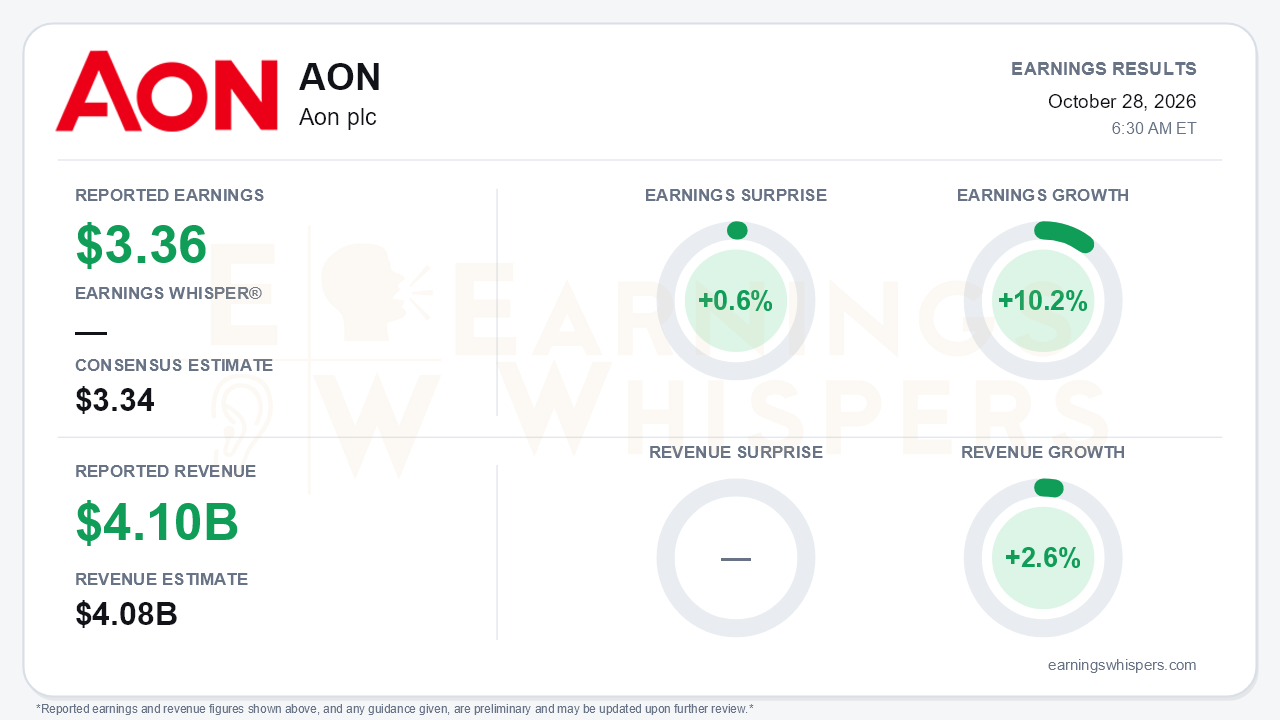
Aon delivered its cleanest operating quarter of 2026, but the stock is trading on the balance sheet more than the income statement. Adjusted EPS of $3.36 edged past the $3.34 consensus by 0.6% and grew 10.2% year over year. Revenue of $4.101 billion topped the $4.08 billion estimate by 0.5% and rose 2.6%. The more meaningful number is organic revenue growth of 6%, up from 5% in the second quarter and the best of the year. That acceleration came just as Aon is about to more than double its quarterly interest bill to fund the USI acquisition. That is the central tension: the core brokerage engine is speeding up while the capital structure is becoming considerably heavier.
The quality of the beat deserves some scrutiny. Headline revenue growth lagged organic growth by roughly three points, mostly because of the NFP Wealth and Stroz Friedberg divestitures. On a GAAP basis, operating income slipped 1% to $809 million and operating margin contracted 70 basis points to 19.7%. The main drivers were Accelerating Aon United restructuring expense, which nearly tripled to $93 million, and $25 million of USI transaction costs. GAAP diluted EPS rose a more modest 6% to $2.23. Adjusted operating margin expanded 70 basis points to 27.0%, matching the pace of the first two quarters. Several below-the-line items also shaped the bottom line:
- A $24 million interest-income gain from cash raised ahead of the USI close.
- A share count about 2% lower than a year ago, even though Aon bought back no stock in the quarter.
- A $0.02 currency tailwind.
- An adjusted tax rate that rose to 20.2% from 19.2%, which partly offset those benefits.
The beat was real, but it was not entirely operational.
The call nonetheless preserved a credible organic growth story, and the improvement was broad:
- **Commercial Risk** accelerated to 7% from 5% in the second quarter. M&A services swung from a drag to double-digit growth.
- **Reinsurance** also reached 7%, up from 5%. However, part of that figure reflects a $24 million reversal of previously constrained revenue, and net market impact was unfavorable.
- **Health** improved to 6% from 5%.
- **New business** contributed 11 points of growth, up from 10 in the second quarter.
- **Recent hire cohorts** added roughly 115 basis points, compared with about 100 basis points in the second quarter and roughly 50 basis points for all of 2025.
- **Revenue-generating headcount** is up 4% year to date, placing it inside management's 4%-8% target.
The soft spots were narrower. Wealth slowed to 4% from 5%. Construction was no longer described as growing at a double-digit rate, as data-center projects ran into permitting and energy-cost delays. Fiduciary investment income fell to $69 million from $75 million.
The forward picture is dominated by USI, which Aon expects to close in the fourth quarter. Management outlined:
- A roughly $6.5 billion U.S. middle-market platform alongside NFP.
- $395 million of identified run-rate EBITDA synergies, split between $280 million of cost and $115 million of revenue.
- A promise to report synergy progress quarterly.
Bears have legitimate ammunition on the other side:
- **Interest costs** are expected to reach about $410 million in the fourth quarter, compared with $206 million in the third quarter and $179 million in the second.
- **Debt load:** long-term debt has already climbed to $26.3 billion from $14.7 billion at year-end.
- **Capital allocation:** debt repayment now takes priority over buybacks. Aon targets a return to 2.8x-3.0x leverage in about 24 months, after repurchasing $1.1 billion of stock in the first half.
- **Cash flow:** USI transaction costs of about $160 million held third-quarter free cash flow growth to 2%.
- **Guidance:** full-year 2026 guidance was reaffirmed, not raised, and is now framed on a standalone basis that excludes USI.
- **Management:** the CFO role is held on an interim basis after Edmund Reese's departure.
- **Reinsurance pricing:** management expects another double-digit decline in property-cat rates at the January 1, 2027 renewals.
The market has treated the deal harshly. Shares opened at $367.64 after the July report and touched an inter-earnings high of $379.50 that day. By October 5 they had fallen to a 52-week low of $266.33. At $302.50 entering the report, the stock was down 17.7% since the prior release, 7.3% below its $326.29 200-day moving average, and 20.3% below the quarterly high. It has recovered 13.6% from the low. Price trend and AVWAP readings remain negative. Investor sentiment, by contrast, has improved noticeably, moving from slightly negative (-0.045) to modestly positive (+0.125). That suggests expectations have reset enough for steady organic execution to register.
The bottom line is that Aon's third quarter strengthened the operating case: organic growth accelerated across Commercial Risk, Reinsurance, and Health, and adjusted margins kept expanding. The investment debate has nonetheless shifted to integration and leverage. Narrow beats, a reaffirmed standalone outlook, and a doubling of interest expense mean the next leg of the story depends on proving the USI synergies and delivering on deleveraging. Continued 6% organic growth alone may not settle it.
Read our earnings preview for Aon plc: https://www.earningswhispers.com/article/AON/20822
This earnings review was originally published on Earnings Whispers.
This article is for informational purposes only and is not investment advice. Earnings Whispers and its staff may hold positions in the securities mentioned. It is AI-assisted, based on proprietary Earnings Whispers data and company reports, and edited by Earnings Whispers staff.
Mentioned In This Article
Latest News
| Oct-28 | |
| Oct-28 | |
| Oct-28 | |
| Oct-23 | |
| Oct-22 | |
| Oct-14 | |
| Oct-13 | |
| Oct-13 | |
| Oct-09 | |
| Oct-09 | |
| Sep-28 | |
| Sep-22 | |
| Sep-18 | |
| Sep-18 | |
| Sep-17 |
