JLL Beats And Raises Again On A Leasing Surge, But Rising Yields Cloud The Capital Markets Outlook
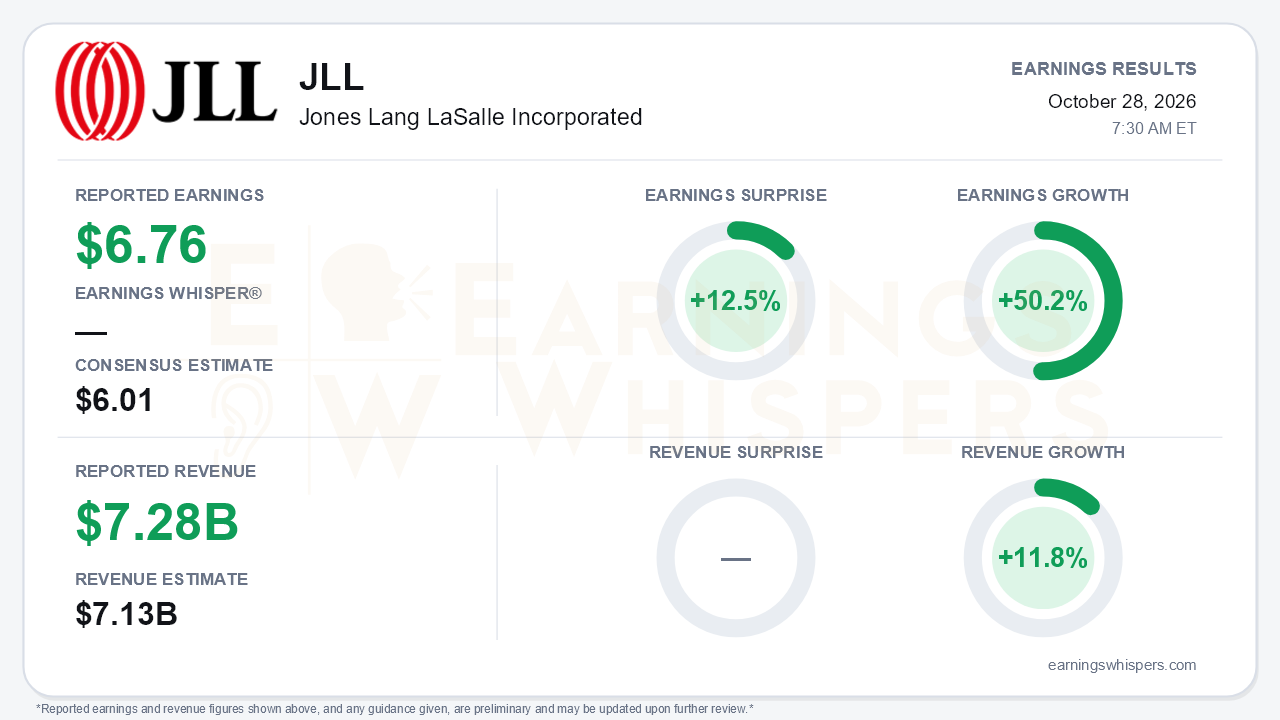
Jones Lang LaSalle delivered a third quarter that would ordinarily end the debate about where commercial real estate services sit in the cycle. Adjusted EPS of $6.76 topped the $6.01 consensus by 12.5% and rose 50.2% year over year. Revenue of $7.281 billion beat expectations by 2.1% and grew 11.8%. GAAP diluted EPS was a record $6.85. Management raised its full-year adjusted EPS target for the second consecutive quarter, to $25.20-$26.30, implying 37% growth at the midpoint. That compares with $24.60-$25.90 after Q2 and $21.80-$23.50 after Q1. The central tension is that the business is accelerating just as the rate backdrop turns hostile to the transactional engine that has driven much of this year's earnings leverage.
The quality of the beat holds up well. Top-line growth improved from roughly 10-11% in Q2 to 12%, and Advisory revenue growth edged up to 22%. Adjusted EBITDA rose 33% to $460.2 million, driven mainly by operating leverage in the transactional businesses:
- **Leasing Advisory:** EBITDA jumped 48% on 27% revenue growth.
- **Capital Markets:** EBITDA rose 47% on 21% revenue growth.
Two items deserve scrutiny. First, Capital Markets margins benefited from $6.8 million of lower loan-related expenses, including the absence of a prior-year loan loss. Second, higher commission tiers are absorbing part of the revenue upside in both brokerage segments. Adjusted EPS growth also decelerated to 52% from 61% in Q2 by the company's measure, a reminder that comparisons are getting harder. Restructuring charges rose to $19.3 million, mostly severance, but those charges sit outside adjusted results.
Leasing was the standout. Growth accelerated to 27% from 24% in Q2, with U.S. leasing up 39% on larger average deal sizes and sizable data center transactions. Data centers now account for a mid-single-digit share of quarterly revenue. JLL is also taking share:
- U.S. office leasing revenue rose 18% against market volumes up 2%.
- U.S. industrial leasing revenue climbed 56% against volumes up 38%.
Management lifted its full-year leasing target again, to high-teens growth. The Resilient side also firmed. Project Management accelerated to 14% from 3% in Q2, and management expects Workplace Management, up 10%, to accelerate further in Q4. Property management contract exits are about 80% complete, with better-than-expected retention at improved margins.
The bears have legitimate ammunition, and nearly all of it ties back to bond yields. Management said the 10-year Treasury's move toward 5%, which peaked near 5.3%, has caused repricing, longer deal timelines and some fallen deals, with U.S. multifamily hit hardest. Within Capital Markets, the picture is uneven:
- Investment sales rose a strong 33%.
- Debt advisory slowed sharply to 13% from 44% in Q2.
- Pipeline conversion moderated slightly.
Most tellingly, JLL held its full-year Capital Markets target at mid-teens growth despite roughly 25% growth year to date. That implies close to flat Q4 growth against a mid-20s prior-year comparison. Investment Management remains a drag, with revenue down 7% on a 40% drop in incentive fees and flat advisory fees. Management also flagged tough 2027 comparisons, expects leasing and capital markets growth to moderate, and declined to give granular 2027 guidance.
Capital allocation is where management is signaling confidence. Net leverage fell to 0.5x from 0.7x in Q2 and 1.0x in Q1. JLL plans an imminent $500 million accelerated share repurchase, more than 3% of shares, which would push full-year buybacks above $1 billion. Q3 free cash flow of $556 million was roughly flat year over year after strong Q2 growth, but year-to-date free cash flow of $174 million is far ahead of last year's $44 million. Management also set a target of more than 20 basis points of annual margin expansion from platform efficiency and AI initiatives.
The market has been far less generous than the fundamentals. Shares opened at $350 after the July report and ran to a 52-week high of $393.84 in mid-August. They then fell to a low of $286.49 on October 7 and closed at $299.93 heading into the report. That is down 14.3% since the prior earnings open, 7.5% below the 200-day moving average and less than 5% above the inter-earnings low. Investor sentiment slipped from roughly neutral (-0.03) to a clearly negative -0.23. The Earnings Whispers trend readings are mixed: sequential growth and momentum are positive, while price and AVWAP trends remain negative. Investors appear to be pricing the rate risk to 2027 rather than the 2026 earnings trajectory.
The bottom line is that JLL produced a clean beat-and-raise driven by share gains in leasing, a firmer Resilient base and real operating leverage, then backed it with a large buyback from a strong balance sheet. The stock's slide reflects a credible concern, not a misread. The implied flat Q4 in Capital Markets, the debt advisory slowdown and management's caution on 2027 show rising yields are already biting. Whether leasing strength and margin initiatives can offset a cooling transaction market is now the key question for the stock.
Read our earnings preview for Jones Lang LaSalle Incorporated: https://www.earningswhispers.com/article/JLL/20859
This earnings review was originally published on Earnings Whispers.
This article is for informational purposes only and is not investment advice. Earnings Whispers and its staff may hold positions in the securities mentioned. It is AI-assisted, based on proprietary Earnings Whispers data and company reports, and edited by Earnings Whispers staff.
Mentioned In This Article
Latest News
| 1 hour | |
| Oct-28 | |
| Oct-28 | |
| Oct-28 | |
| Oct-28 | |
| Oct-22 | |
| Oct-14 | |
| Oct-13 | |
| Oct-10 | |
| Oct-01 | |
| Sep-24 | |
| Sep-24 | |
| Sep-18 | |
| Sep-18 | |
| Sep-16 |
