Wingstop Beats On EPS, But A Third Straight Comp Cut And First Unit-Growth Trim Undercut The Quarter
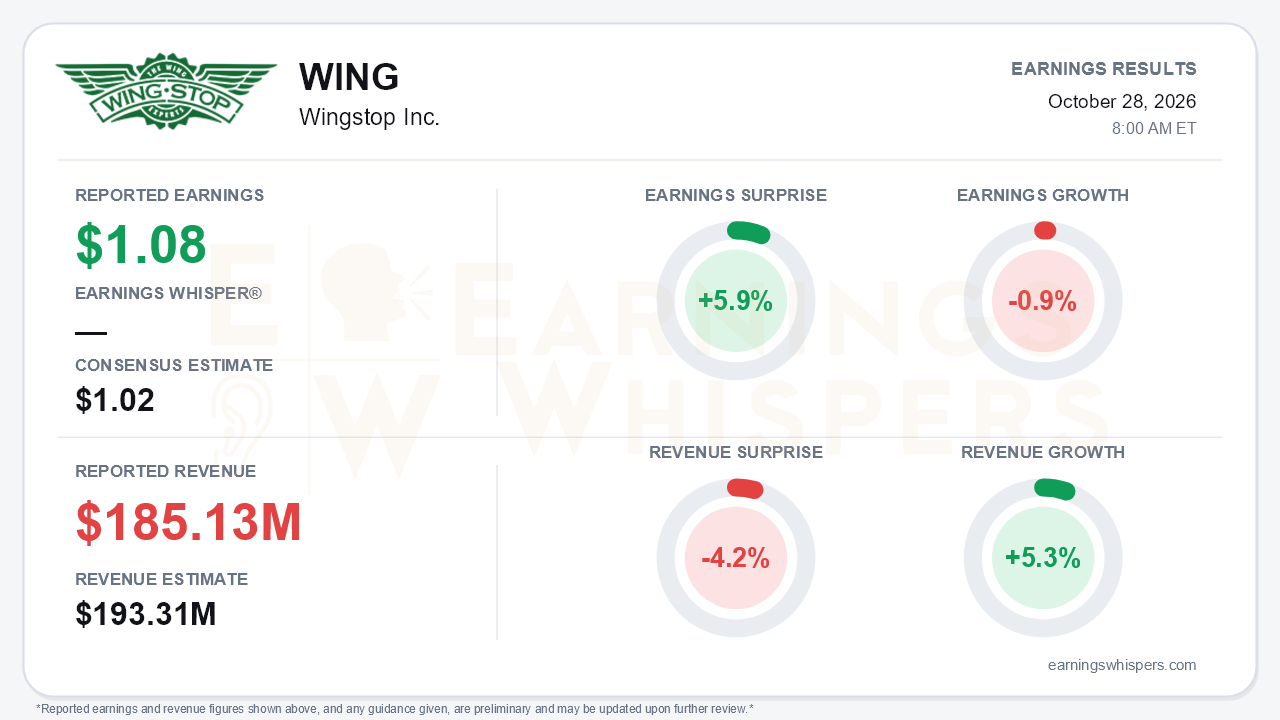
Wingstop (NASDAQ: WING) delivered a headline earnings beat that does little to settle the debate around the stock. Adjusted EPS of $1.08 topped the $1.02 consensus by 5.9%, but revenue of $185.13 million missed expectations by 4.2%, and adjusted earnings slipped 0.9% from a year ago. Revenue grew 5.3%, a clear slowdown from the double-digit system expansion that defined Wingstop in 2025. The central tension is that domestic same store sales are improving sequentially, yet management cut its full-year outlook again. It also trimmed unit growth for the first time and warned that fourth-quarter profitability will come in below prior expectations. The beat was on the bottom line. The deterioration was in nearly everything investors use to value the franchise model.
The quality of the beat deserves scrutiny. SG&A fell $0.2 million year over year only because $2.0 million of stock-compensation forfeitures offset higher headcount costs. The effective tax rate also eased to 27.3% from 28.1%. Buybacks did meaningful work, too: diluted shares fell to about 27.1 million from 28.0 million, so a flat profit pool still yielded near-flat per-share results. Adjusted EBITDA rose just 0.5% to $64.0 million. Company-owned restaurant cost of sales jumped to 78.2% of sales from 74.8%, driven by fry and packaging costs, sales deleverage on fixed labor, and integration of the 13 Tampa restaurants acquired during the quarter. Domestic AUV fell to $1.848 million from $2.061 million a year earlier. Depreciation climbed $2.8 million as technology investments came into service.
The call offered a credible but still unproven improvement story. Domestic comps declined 5.4%, narrowing from -7.5% in the second quarter and -8.7% in the first. Management described early traction from a marketing reset launched with the NFL season, including a watch-party bundle, Thursday Night Football promotions and front-loaded video spots. It cited higher first-party weekly sales, more reactivated guests and rising organic search. Club Wingstop enrollment is running ahead of plan. New members show a 13-point higher 30-day return rate and roughly 20% higher frequency after 90 days. Food-quality complaints are down about 30% after systemwide retraining. However, management did not quantify any sales lift. It also acknowledged that pressure on its core lower-income consumer has intensified and that the turnaround is taking longer than anticipated.
The guidance path is where bears have the strongest ammunition. The full-year domestic comp outlook has moved from flat-to-low-single-digit growth in February, to a low-single-digit decline, to -4% to -6%, and now to -6.5% to -7%. That implies fourth-quarter comps down roughly 4.5% to 6.5%, which offers no clean inflection. Unit growth guidance, held at 15-16% for three calls, was lowered to 440-450 net new units (14.4%-14.7%) on ground-up site delays. Management also hinted that U.S. development may moderate, and the India entry slipped to early 2027. Cash-on-cash returns are now cited around 60%, down from about 70% earlier in the year, which matters for franchisee appetite. Adjusted EBITDA expectations have collapsed from roughly 15% annual growth to a roughly flat fourth quarter as incremental marketing spend absorbs the upside. Offsets include more than 2,300 development commitments, 27% international unit growth, expected 2027 poultry costs at or below 2026 levels, and $102.9 million in year-to-date buybacks. Still, cash has fallen to $104.8 million against $1.21 billion of long-term debt, and Walmart's entry into delivery adds competitive uncertainty.
Investor sentiment deteriorated going into the report, slipping from essentially neutral to modestly negative at -0.145. The price action has been volatile. Shares opened at $137.57 after the July report and hit a quarterly high of $147.11 that day. They then collapsed to a 52-week low of $95.82 on September 25. The stock rallied nearly 29% off that low to $123.52 ahead of the release, still 10.2% below the post-July open and 25.6% beneath its 200-day moving average. That rebound suggests some investors were already pricing in the early marketing signals. Another guidance cut tests that positioning. Earnings Whispers trend readings are mixed, with sequential growth positive, consistent with narrowing comp declines, while momentum remains negative.
The bottom line is that Wingstop's EPS beat was built on buybacks, a stock-comp forfeiture and a lower tax rate rather than operating strength. The revenue miss, a third straight comp cut, the first unit-growth reduction and weaker fourth-quarter EBITDA tell the more important story. Sequential comp improvement and encouraging loyalty and marketing data keep the recovery thesis alive. Until management can show those early indicators translating into positive traffic and stabilizing AUVs, the burden of proof remains on the turnaround.
Read our earnings preview for Wingstop Inc.: https://www.earningswhispers.com/article/WING/20891
This earnings review was originally published on Earnings Whispers.
This article is for informational purposes only and is not investment advice. Earnings Whispers and its staff may hold positions in the securities mentioned. It is AI-assisted, based on proprietary Earnings Whispers data and company reports, and edited by Earnings Whispers staff.
Mentioned In This Article
Latest News
| 5 hours | |
| 7 hours | |
| 8 hours | |
| 8 hours | |
| 12 hours | |
| Oct-23 | |
| Oct-21 | |
| Oct-20 | |
| Oct-20 | |
| Oct-19 | |
| Oct-19 | |
| Oct-13 | |
| Sep-29 | |
| Sep-22 | |
| Sep-16 |
